Oct 28, 2026Buying Guides
Watch Case Opener Knife Guide: Blades, Pry Sets and Hand-Wheel Openers
Compare watch case opener knives, wooden pry sets, and hand-wheel bench openers for friction backs. Find your tool type and send case measurements to Kocandy.
Snap-on case backs, or friction backs, seal directly into the midcase rim with an internal compression gasket. Unlike threaded backs, they lack drive notches or perimeter flats, so a two-pin or three-pin wrench slips immediately and gouges the case flank. Threaded screw-down backs belong strictly to adjustable pin wrenches, including our Jaxa-style models such as the GF-OP-S-0001 steel kit, the thumb-wheel SP000050 wrench, and the large-capacity 2819-T-XL waterproof wrench. To select a wrench for threaded cases, consult our watch case opener buying guide, or review our stuck watch case back removal guide for stubborn threaded rings.
Opening a friction case back requires lateral wedging leverage applied at a dedicated lip. Kocandy catalogs compact pocket knives, a six-piece wooden-handled pry set, a heavy-duty parallel-carriage tool, a bench-mounted hand-wheel press, and a specialized rotor bearing tool.
Watch Case Opener Knives: When Friction Case Backs Resist Three-Pin Wrenches
Handheld case opener knives provide direct tactile control when separating friction-fit case backs. Because snap-on backs rely on perimeter interference rather than rotational threads, applying rotational torque with a wrench will strip drive pins and deform the case rim. A knife blade works through localized wedging: the thin bevel penetrates the seam between case back and midcase, converting linear inward force into perpendicular lift.
This wedging action requires precise blade positioning. If the blade is too thick, it cannot enter the hairline seam; if the blade is overly flexible, it bends under thumb pressure and slips across polished case flanks. Kocandy supplies dedicated case opening blades engineered with rigid tangs and ground tapers suited to factory tolerances.
Pocket-Style Opener Knives: Compact Brown and Black Fixed-Blade Tools
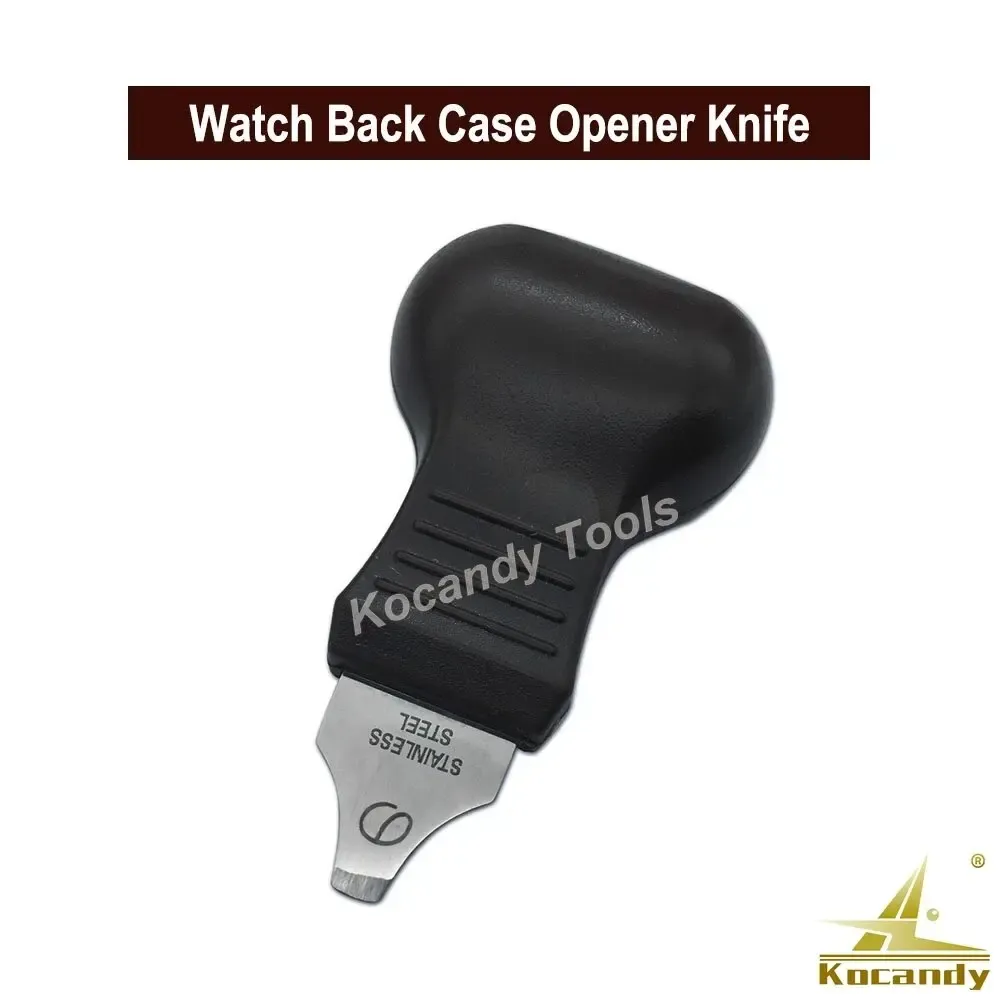
For routine watch battery replacement, handheld pocket knives serve as the primary bench tool. Kocandy catalogs two fixed-blade pocket opener designs engineered with rigid blade tangs that do not fold into the handle during use, protecting fingers from accidental closure.
The brown pocket case opener knife measures 76 mm by 45 mm, weighs 45 grams, and pairs a contoured brown plastic handle with a sturdy steel blade, guiding the bevelled tip directly into the case back pry lip.
For technicians seeking extended leverage, Kocandy provides two black PVC-handled models. Each measures 115 mm (11.5 cm) in overall length and weighs 35 grams, combining an ergonomic PVC grip with a fixed tempered steel blade. One model carries catalog number BGCK-GF-B-0001, providing an exact identifier for workshop replenishment.
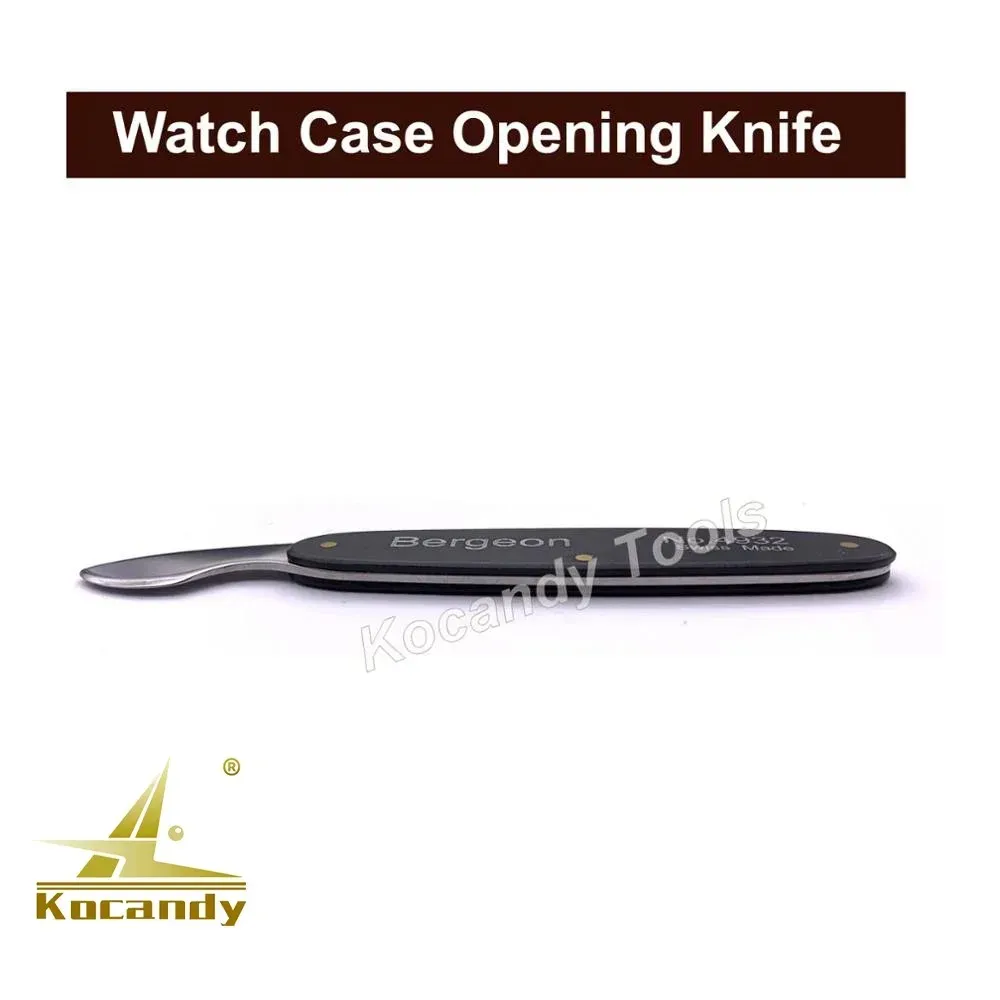
Pocket-style case opener knife with PVC handle and fixed tempered steel blade.
Six-Piece Wooden-Handle Pry Tool Set: Varied Blade Profiles for Tight Seams
Because case back tolerances and lip geometries vary across watch designs, a single blade profile cannot open every case. Kocandy catalogs a six-piece watch case back pry tool set fitted with hardwood handles and stainless steel blades, weighing 460 grams in total.
The six tools provide a graduated selection of blade widths, bevel angles, and tip curvatures: fine, thin edges access tight hairline seams on vintage dress cases, while broader wedges provide rigid leverage for water-resistant snap backs. The contoured wooden handles give a non-slip grip during delicate prying.
Catalog anomaly note: Although the catalog specifications mistakenly state that only one wrench is supplied, workshop dispatch provides the full six-piece wooden-handled pry tool set depicted in catalog media.
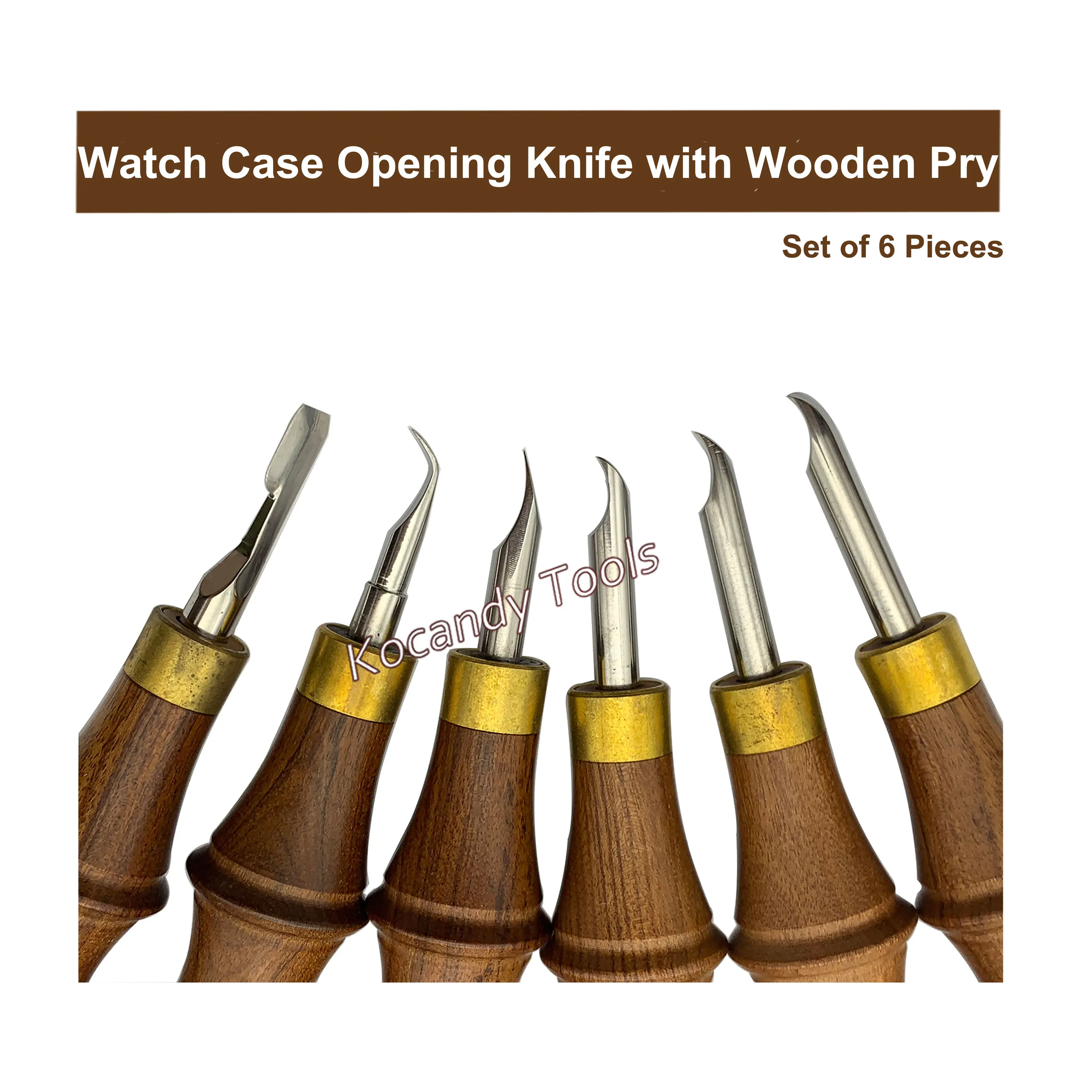
Six-piece stainless steel case back pry tool set with contoured wooden handles.
Parallel-Carriage Metal Pry Fixture: Dual-Rail Delrin Protection up to 48 mm
When a snap-on case back is tightly pressed or held by dried gasket residue, handheld prying risks slipping across polished lugs. For stubborn friction backs, Kocandy catalogs a 900-gram alloy steel pry fixture with guided linear blade advancement.
A dual-rail parallel carriage system driven by an ergonomic handle advances the hardened steel blade horizontally into the case seam — steady wedging force without twisting. Blades come in 2.2 mm, 4 mm, and 5.5 mm widths, plus a multi-grade tip assortment spanning 0.5 mm to 2.0 mm.
A spring-supported Delrin case holder clamps the watch without scratching metal, accommodating case diameters up to 48 mm and fitted bands up to 45 mm wide. The fixture also assists with bracelet pin extraction and bezel separation — see our watch bezel removal tool guide.
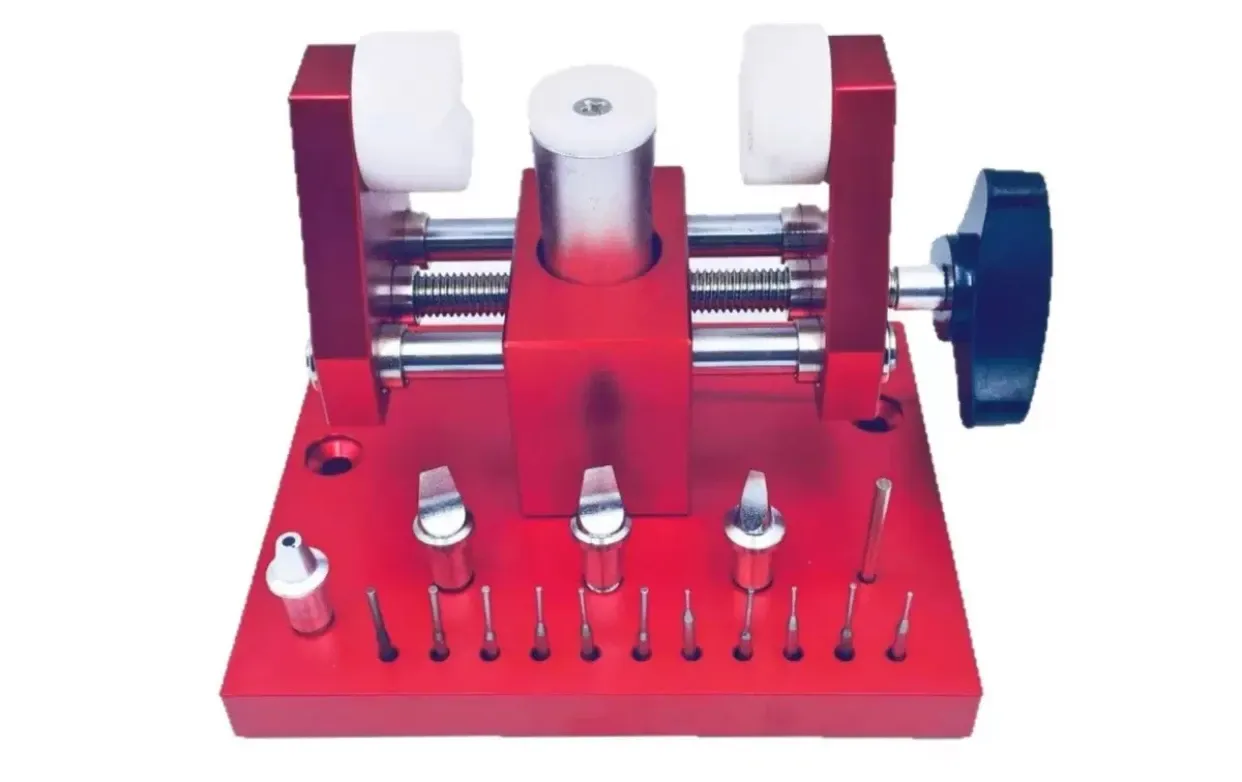
Alloy steel parallel-carriage pry tool with Delrin holder and hardened steel blades.
Rotating Hand-Wheel Bench Opener: Controlled Vertical Descent with Dual Blades
When case opening demands millimeter-scale feed control, a bench press fixture offers superior stability. Kocandy catalogs a rotating hand-wheel watch cover opener weighing 900 grams that secures directly to the workbench.
The overhead hand wheel drives a threaded leadscrew, lowering the blade assembly smoothly — no abrupt slips, and blade engagement stays visible under a loupe as pressure builds. Two polished stainless blades of different profiles accommodate curved cases and flat shoulders; the package adds a watch case holder accessories set for the base plate.
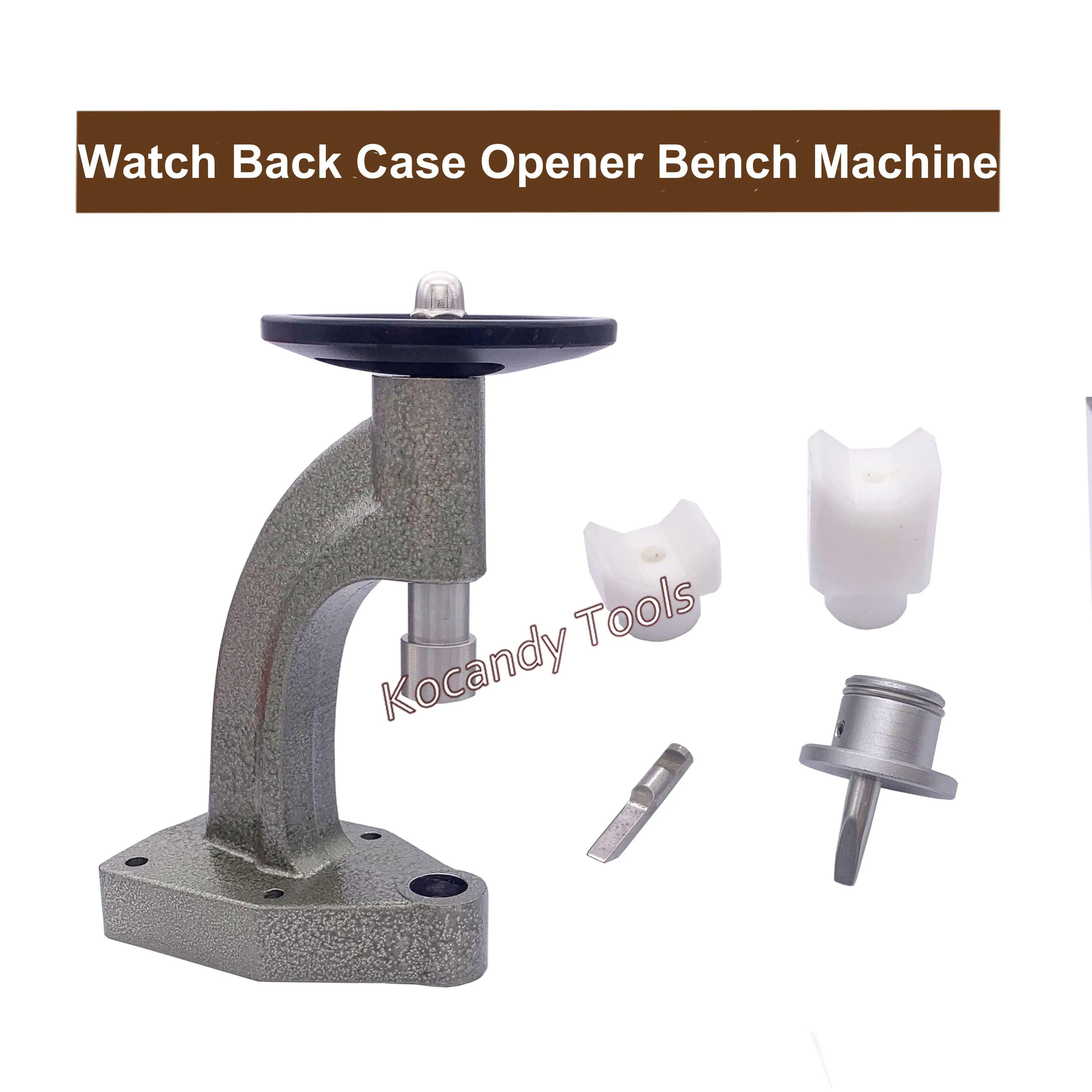
Rotating hand-wheel case back opener with dual stainless steel blades.
Movement-Level Rotor Bearing Tool: Omega 1120 Stated Designation
Once a case back is removed, bench work often moves from casing to movement servicing. Servicing the oscillating weight bearing in automatic calibers requires specialized tooling — prying a rotor bearing with a case knife will bend the rotor arm and destroy the miniature ball race.
Kocandy catalogs an alloy watch bearing opener tool stated for the Omega 1120 watch movement, weighing 120 grams. Constructed from rigid red alloy, the fixture features an ergonomic driver paired with a matching round red die on a wooden base plate.
The tool provides square axial engagement with the rotor bearing retaining ring, enabling disassembly without radial distortion. Verify your movement caliber designation before ordering.
Common Bench Prying Techniques: Locating the Lip, Sacrificial Film, and Controlled Twist
Friction case back removal requires disciplined bench methods to protect polished case shoulders and prevent snapping delicate blade tips:
- Notch identification under magnification: Inspect the case perimeter under a 10x bench loupe. Most snap-on cases feature a small opening recess or lip, typically near the 9 o'clock position or opposite the crown. Never force a blade into an unnotched seam.
- Sacrificial barrier film: Place polyethylene film or watchmaker tape over the case flank and lugs before positioning the blade — the compressed plastic layer acts as a barrier against slip marks.
- Gentle rotational wrist twist: Seat the blade tip fully into the recess. Rather than levering the handle outward like a crowbar, apply a gentle rotational twist of the wrist; this lifts the back vertically without gouging the midcase.
- Gasket inspection upon opening: Friction backs rely on thin rubber or nylon compression gaskets that often displace or tear during opening. Inspect immediately, measure with a caliper, and consult our watch case back gasket and O-ring size guide before resealing.
Watch Case Opener Knife and Pry Tool Comparison Tables
Table 1: Technical Specifications of Case Opener Knives, Pry Sets, and Bench Fixtures
Product Stated Model & Description | Tool Material | Dimensions & Stated Weight | Blade Mechanism & Adjustment Range | Packaging & Included Accessories | Catalog Product Link |
|---|---|---|---|---|---|
Brown Pocket Opener Knife | Stainless steel and plastic | 76 mm x 45 mm; stated weight 45 g | Flat steel blade with tapered pry tip | 1 x watch back case opener knife | |
Black PVC Case Opener Knife | PVC plastic and tempered steel | Overall length 115 mm (11.5 cm); weight 35 g | Fixed tempered steel blade, non-folding | 1 x watch back case opener knife | |
Black PVC Knife Model BGCK-GF-B-0001 | PVC plastic and tempered steel | Overall length 115 mm (11.5 cm); weight 35 g | Fixed tempered steel blade, non-folding | 1 x watch back case opener knife | |
Six-Piece Wooden Pry Tool Set | Stainless steel and hardwood | Confirm by message; set weight 460 g | Six varied blade profiles, bevel angles, and tips | Six-piece pry tool set with wooden handles | |
Parallel-Carriage Metal Pry Fixture | Alloy steel with Delrin support | Frame takes cases up to 48 mm; weight 900 g | Dual-rail parallel carriage; blades 2.2 mm, 4 mm, 5.5 mm; tips 0.5–2.0 mm | Alloy steel fixture with ergonomic handle and Delrin holder | |
Rotating Hand-Wheel Bench Opener | Stainless steel blades and metal body | Confirm by message; weight 900 g | Hand-wheel leadscrew drive; two interchangeable polished stainless blades | 1 x opening machine, 2 x opening blades, case holder accessories | |
Jaxa XL Wrench 2819-T-XL (Contrast) | High-quality steel | Span 30 mm to 66 mm; weight 345 g | Three adjustable jaws with 12 tips across 4 sets | Yellow portable storage box x 1 | |
Jaxa Kit GF-OP-S-0001 (Contrast) | Stainless steel | 152 x 54 x 30 mm (approx.); weight 185 g | Threaded jaw carriage with 18 tips in 6 sets | Portable plastic storage box x 1 | |
Jaxa Screwdriver SP000050 (Contrast) | Stainless steel | 145 x 54 x 30 mm; max opening 52 mm; weight 140 g | Thumb-wheel adjustment with 18 interchangeable tips | Supplied together in a single storage bag | |
Omega 1120 Bearing Opener Tool | Lightweight rigid alloy | Confirm by message; weight 120 g | Axial engagement driver stated for Omega 1120 caliber rotor bearing | Red alloy opener, round red die, wooden base |
Table 2: Tool Architecture Selection by Case Back Style and Bench Task
Case Back Profile & Task | Recommended Tool Architecture | Engagement Geometry & Leverage | Primary Bench Advantage | Fit Verification Check |
|---|---|---|---|---|
Shallow friction back with distinct lip | Brown pocket knife or black PVC knife | Single-blade hand wedging with wrist twist | Fast, portable operation for routine battery changes | Measure notch width against blade tip thickness |
Varied case curves and tight hairline seams | Six-piece wooden-handle pry tool set | Assorted blade bevels, curvatures, and widths | Matches diverse vintage and modern case contours | Test thinnest blade profile against hairline seam |
Stiff or seized snap back up to 48 mm | Parallel-carriage metal pry fixture | Dual-rail linear carriage with Delrin support | Controlled mechanical advance without slip risk | Confirm midcase diameter does not exceed 48 mm |
Delicate high-grade case needing micro feed | Rotating hand-wheel bench opener | Threaded leadscrew with vertical blade descent | Sub-millimeter feed control; prevents abrupt shock | Check case height against bench clearance |
Threaded screw-down back with notches | Jaxa-style wrench (2819-T-XL or GF-OP-S-0001) | Two-point or three-point perimeter pin drive | Eliminates slip on threaded case back rings | Measure opposite notch spacing with caliper |
Omega 1120 caliber oscillating weight | Dedicated red alloy bearing opener | Direct axial drive with matching circular die | Prevents rotor warping and bearing race damage | Confirm Omega 1120 caliber designation on bridge |
Table 3: Common Bench Opening Challenges, Causes, and Hedged Bench Procedures
Bench Challenge | Underlying Cause | Recommended Bench Practice (Hedged) | Preventive / Corrective Action |
|---|---|---|---|
Knife blade slips and scratches polished case | Insufficient blade seating or excessive outward prying | Apply protective polyethylene film; use gentle wrist twist | Stop immediately; switch to a thinner blade or carriage tool |
Case back lip resists initial wedging pressure | Hardened gasket residue or tight interference fit | Seat case in parallel fixture; advance blade incrementally | Apply steady linear pressure; avoid sudden hammer taps |
Handheld knife flexes under bench pressure | Blade tang too thin or unstable folding joint | Select fixed-blade tool or heavy alloy steel fixture | Never use folding utility blades; verify fixed tang construction |
Gasket stretches or tears during back removal | Age-related hardening or adhesion to midcase rim | Clean groove with pegwood; replace with fresh O-ring | Measure groove diameter and cord thickness before resealing |
Compiling Your Case and Tool Identifiers Before Inquiring
To confirm tool suitability before ordering, compile your case measurements into precise identifiers:
- Case Back Closure Style: Verify whether the case is snap-on (friction) or screw-down. If perimeter notches are present, record notch spacing for a Jaxa wrench rather than a knife.
- Pry Notch Geometry: Measure the opening notch or lip along the case perimeter with a vernier caliper to the nearest 0.1 mm.
- Case Diameter and Lug Width: Measure midcase diameter against the 48 mm limit of the parallel carriage fixture, and strap width against its 45 mm capacity.
- Specific Tool Reference: Quote catalog model numbers when inquiring, such as Model BGCK-GF-B-0001 for the PVC knife, Model GF-OP-S-0001 or SP000050 for Jaxa wrenches, 2819-T-XL for large threaded cases, or the Omega 1120 designation for the rotor bearing tool.
Workshop Inquiries and Brand Disclaimer
Kocandy is an independent supplier of watchmaker tools and workshop replacement components. Kocandy is not affiliated with, authorised by, or a dealer for any watch brand or tool manufacturer mentioned, including Seiko, Rolex, Omega, Citizen, Breitling, Panerai, Hublot, ETA, Bergeon, Horotec, or Vetus. References to specific brands or caliber numbers represent catalog stated-for designations and bench application examples only.
If your case dimensions, pry lip profile, or required tool configuration are not listed anywhere above, send your case back measurements and clear photographs through our contact page. We check customer inquiries directly against our workshop catalog and reply within one working day.