Oct 28, 2026Buying Guides
Watch Screwdriver Set Guide: Starter Kits, Dual-Head Sets and the H-Screw Exception
Compare watch screwdriver sets from 10-piece rotating stands to portable pouch kits, explore demagnetizer pairings, and master 1.0 mm and 1.5 mm H-screw drivers.
Watch Screwdriver Set Selection: Why Buying a Kit Beats Individual Blades
Watchmaker bench work demands exact blade width and thickness for every threaded component. A mechanical movement houses dozens of screws, from delicate balance bridge screws under one millimeter to substantial case clamps and bracelet link pins. Relying on mismatched, loose screwdrivers forces technicians to compromise on tip fit. A blade that is too narrow or too thick concentrates rotational torque on the fragile slot corners rather than across the screw head, causing burred slots, chewed heads, and slips across polished bridges.
A dedicated watch screwdriver set eliminates this risk through systematic size increments and uniform handle ergonomics. Before selecting a set, bench hands should review our watch screwdriver blade size guide to understand standard blade geometries and slot engagement principles.
The 10-Piece Rotating Carousel Set: Complete Workbench Coverage
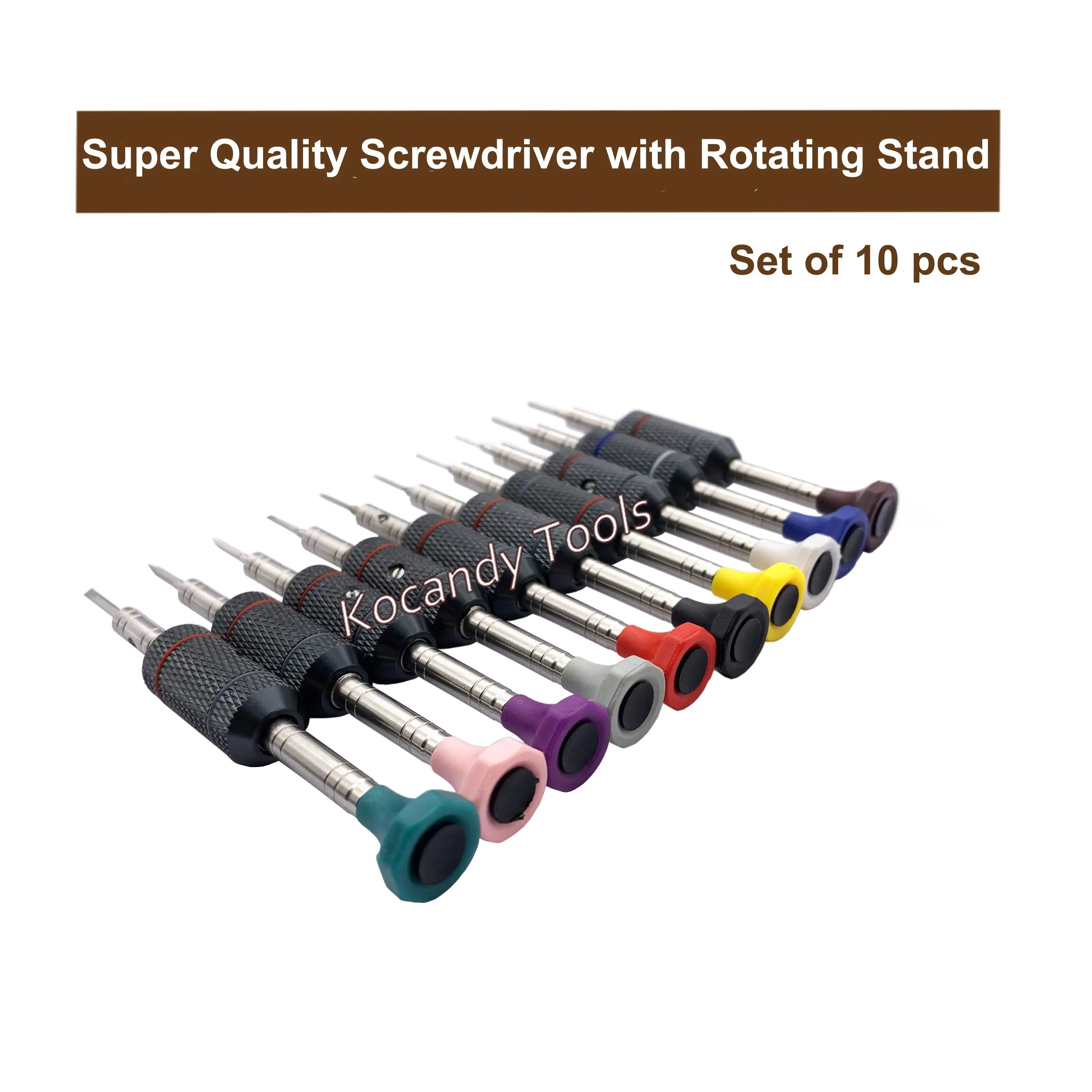
For movement overhauls, casing, and general bench tasks, the ten-piece rotating stand screwdriver set serves as a complete workstation hub. Mounted on a heavy rotating carousel base weighing 800 grams, this set keeps ten screwdrivers upright and instantly accessible. The weighted base prevents tipping on crowded benches, while scratch-resistant handle finishing helps protect surrounding watch components.
The set provides broad size coverage spanning eight slotted drivers and two cross-head drivers. The slotted blades cover 0.6 mm, 0.8 mm, 1.0 mm, 1.2 mm, 1.4 mm, 1.6 mm, 1.8 mm, and 2.0 mm, handling everything from minute train bridge screws to robust case clamps. For quartz casings and electronic modules, cross-head drivers in 1.4 mm and 1.6 mm are included. Positioned around the rotating base are ten color-matched accessory cups containing replacement bits and set screws, allowing quick tip replacement during disassembly.
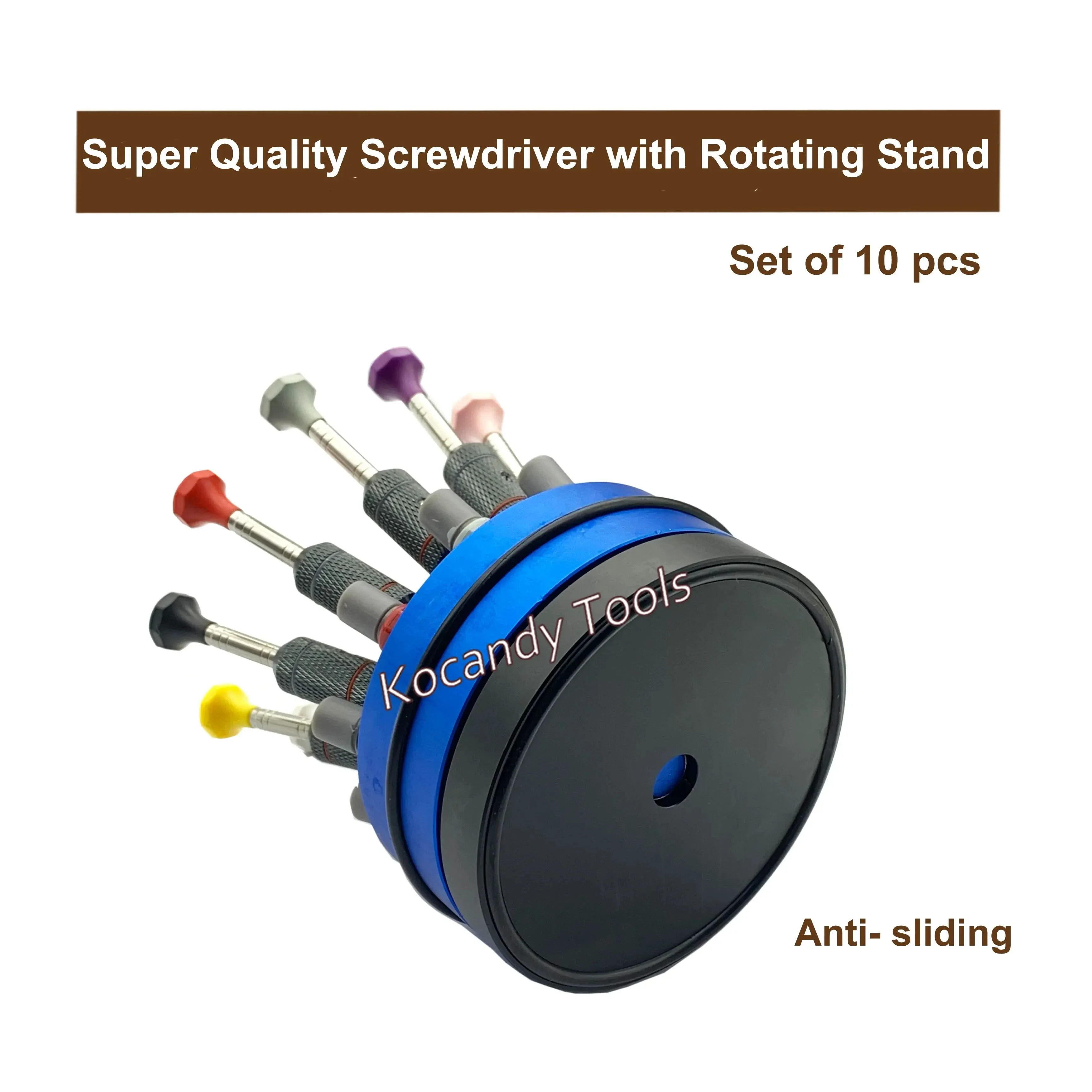
Ten-piece steel screwdriver set on a blue weighted carousel stand with spare blade barrels.
Portable Slotted and Dual-Head Pouch Kits for Quick Bench Adjustments
Bench hands handling counter sizing, mobile repairs, or travel kits need tools that store flat without sacrificing precision. For dedicated slotted fastener work, the five-piece precision slotted screwdriver set provides a compact kit in a blue carry bag. Weighing 80 grams, this stainless steel set covers the core horological spectrum: 0.8 mm, 1.0 mm, 1.2 mm, 1.4 mm, and 1.6 mm slotted blades. Each driver features multicolour collar coding for quick identification, and the set includes five matching spare blades.
When service routines involve both mechanical timepieces and quartz casings, the six-piece precision screwdriver kit, catalog model RH000008, expands tip options. Weighing 95 grams, this steel set supplies five slotted drivers (0.8 mm, 1.0 mm, 1.2 mm, 1.4 mm, 1.6 mm) alongside a 1.6 mm Phillips driver in a blue portable bag. Knurled barrels and free-spinning swivel caps ensure stable axial alignment during screw extraction.
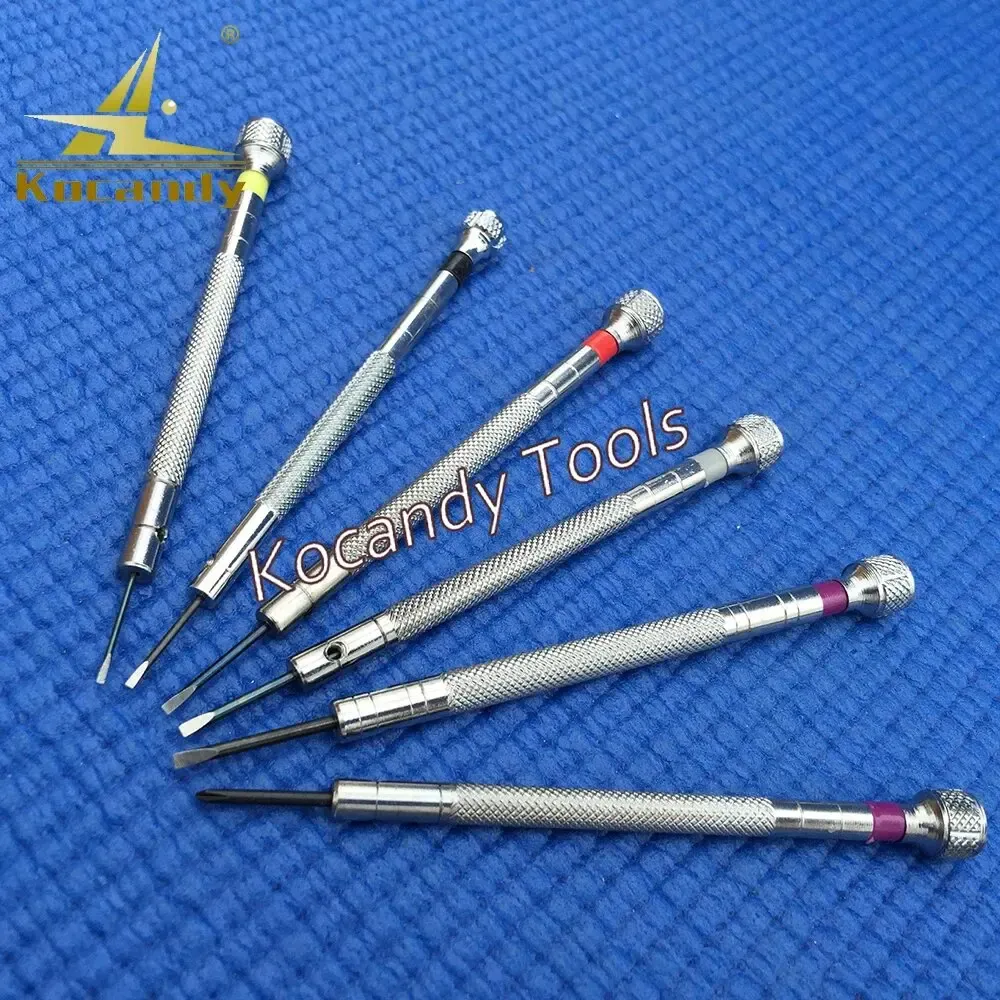
Six-piece precision screwdriver kit with color-coded knurled handles, model RH000008.
Screwdriver Set Specifications and Blade Size Comparison
Selecting a general-purpose screwdriver kit requires balancing blade variety, included spares, and bench footprint. Rotating stands suit stationary disassembly where frequent bit changes occur, whereas roll-up bags favor portability. The table below compares the three primary general-purpose kits in our catalog.
Set Configuration | Catalog Identifier | Total Pieces | Included Blade Sizes (mm) | Included Spare Bits | Storage Format | Stated Weight |
|---|---|---|---|---|---|---|
10-Piece Rotating Carousel Set | Confirm by message | 10 | Slotted: 0.6, 0.8, 1.0, 1.2, 1.4, 1.6, 1.8, 2.0; Cross: 1.4, 1.6 | 10 replacement bit cups with screws | Blue rotating carousel stand | 800 g |
5-Piece Slotted Precision Set | Confirm by message | 5 | Slotted: 0.8, 1.0, 1.2, 1.4, 1.6 | 5 spare blades (0.8, 1.0, 1.2, 1.4, 1.6 mm) | Blue portable carry bag | 80 g |
6-Piece Dual-Head Precision Kit | RH000008 | 6 | Slotted: 0.8, 1.0, 1.2, 1.4, 1.6; Phillips: 1.6 | Confirm by message | Blue portable carry bag | 95 g |
When deciding between the 5-piece and 6-piece pouch sets, consider whether your repair work includes quartz modules requiring a 1.6 mm Phillips driver. For full mechanical servicing involving sub-millimeter balance cock screws, the 10-piece set is required.
The Electrical Demagnetizer and Bench Tool Combination
Steel screwdrivers readily pick up stray magnetic fields from motors, bench lamps, and electronic devices. Once magnetized, driver blades attract small screws to their flanks rather than seating cleanly in the slot. More critically, magnetized tools transfer residual magnetism into watch movements, causing balance hairspring coils to cling together and dramatically accelerating timing.
Incorporating a bench demagnetizer clears this interference. The watch repair demagnetizer tool set provides an electrical clearing field in a blue plastic casing. Measuring approximately 12 cm by 6 cm by 3.2 cm and weighing 0.3 kg, the unit operates on 110V and 220V power standards with EU and US plug options.
To demagnetize a tool, place the blade in the operation field, depress the button for approximately five seconds, and withdraw the tool smoothly before releasing the switch. While snapshot gallery images show screwdrivers and tweezers alongside the unit, the package specification explicitly lists one demagnetizer. Technicians needing companion tweezers should consult our watch tweezer tip size guide to select non-magnetic brass or antimagnetic steel tweezers.
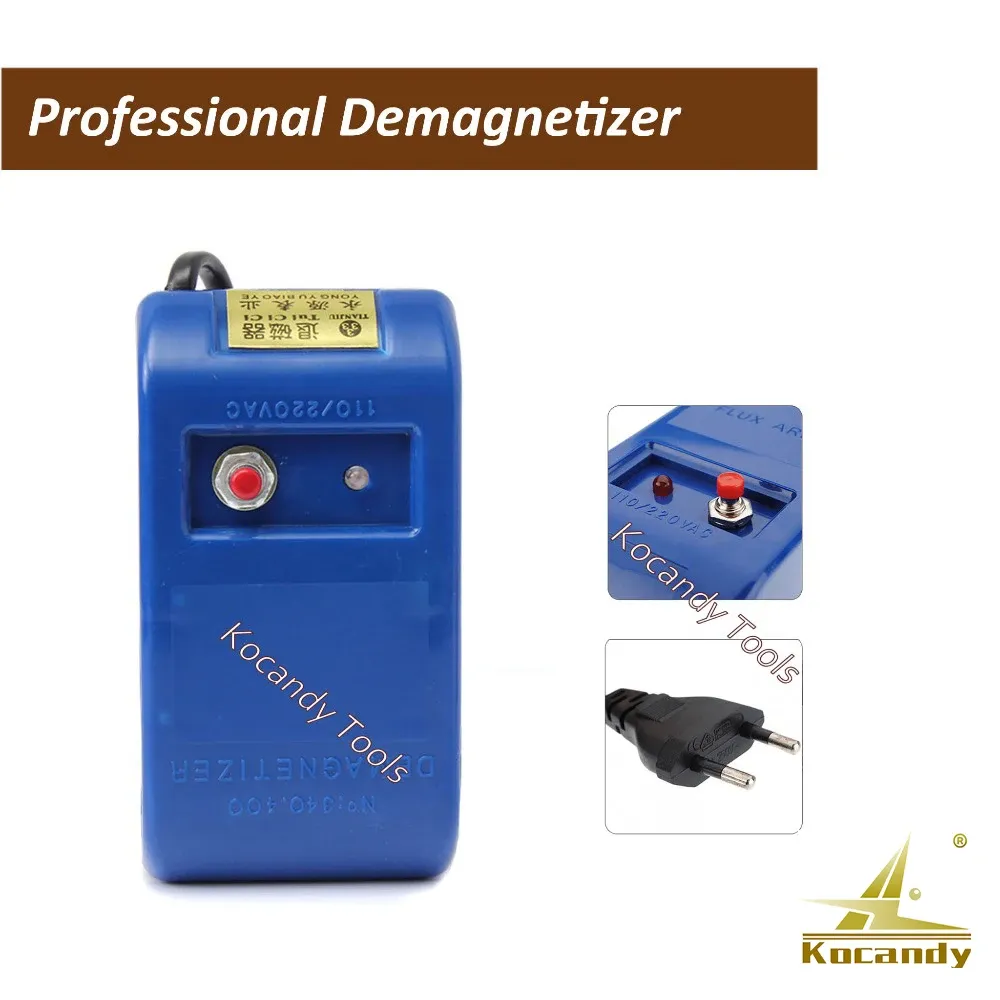
Electrical bench demagnetizer box shown alongside a cased watch screwdriver set.
The H-Screw Exception: Proprietary Two-Prong Fasteners on Luxury Bezels and Straps
Standard slotted screwdrivers cover traditional calibers, but luxury sports timepieces often incorporate proprietary case hardware. Distinctive H-shaped screws are commonly utilized across external bezels, strap attachment plates, and folding clasps. These fasteners feature a solid central bridge separating two perimeter slots, creating an H-shaped pattern across the screw head.
Using a flat screwdriver on an H-screw is a frequent bench error that leads to damaged hardware. A standard flat blade cannot cross the center bridge; it contacts only one slot corner at an unstable angle. Under turning torque, the blade slips out, gouging bezel surfaces, chipping ceramic inserts, or deforming the screw head.
Servicing these screws requires an H-type driver equipped with twin prongs that straddle the central bridge to engage both slots simultaneously. Before ordering, measure the fastener carefully using fine calipers across the head diameter and between slot openings. Our watch screw size guide outlines step-by-step techniques for measuring thread diameters and specialized screw head profiles.
Comparing 1.0 mm and 1.5 mm H-Type Drivers: Bezel vs Strap Plate Work
H-pattern fasteners appear in two primary prong-width standards: 1.0 mm and 1.5 mm. To service these assemblies, Kocandy supplies dedicated double-ended drivers engineered specifically for H-screw geometries.
For smaller fasteners on bezel rings and clasp plates, the double-ended 1.0 mm H-screw driver features a stated 1.0 mm blade prong span with a 2.5 mm shank width. Finished with blue and steel handle accents, the tool measures approximately 97 mm in length and weighs 20 grams. For larger strap attachment plates and lug screws, the double-ended 1.5 mm H-screw driver, catalog model WL000007, provides a 1.5 mm prong span and a 2.5 mm shank, distinguished by a green accent handle.
Both tools feature coated steel tips for wear resistance. Each driver incorporates an independent rotating head and shaft mechanism, allowing steady downward axial pressure on the swivel cap while rotating the knurled barrel.
Driver Specification | 1.0 mm H-Type Driver | 1.5 mm H-Type Driver (WL000007) |
|---|---|---|
Model Number | Confirm by message | WL000007 |
Primary Stated Blade Span | 1.0 mm wide | 1.5 mm wide |
Stated Shank / Barrel Width | 2.5 mm | 2.5 mm |
Overall Tool Length | 97 mm approx. | 97 mm approx. |
Handle Swivel Mechanism | Independent rotating head and shaft | Independent rotating head and shaft |
Distinctive Handle Accent | Blue and steel | Green accent |
Stated Application Scope | Listed for bezel, clasp, and lug H-screws | Listed for bezel, clasp, and lug H-screws |
Stated Tool Weight | 20 g | 20 g |
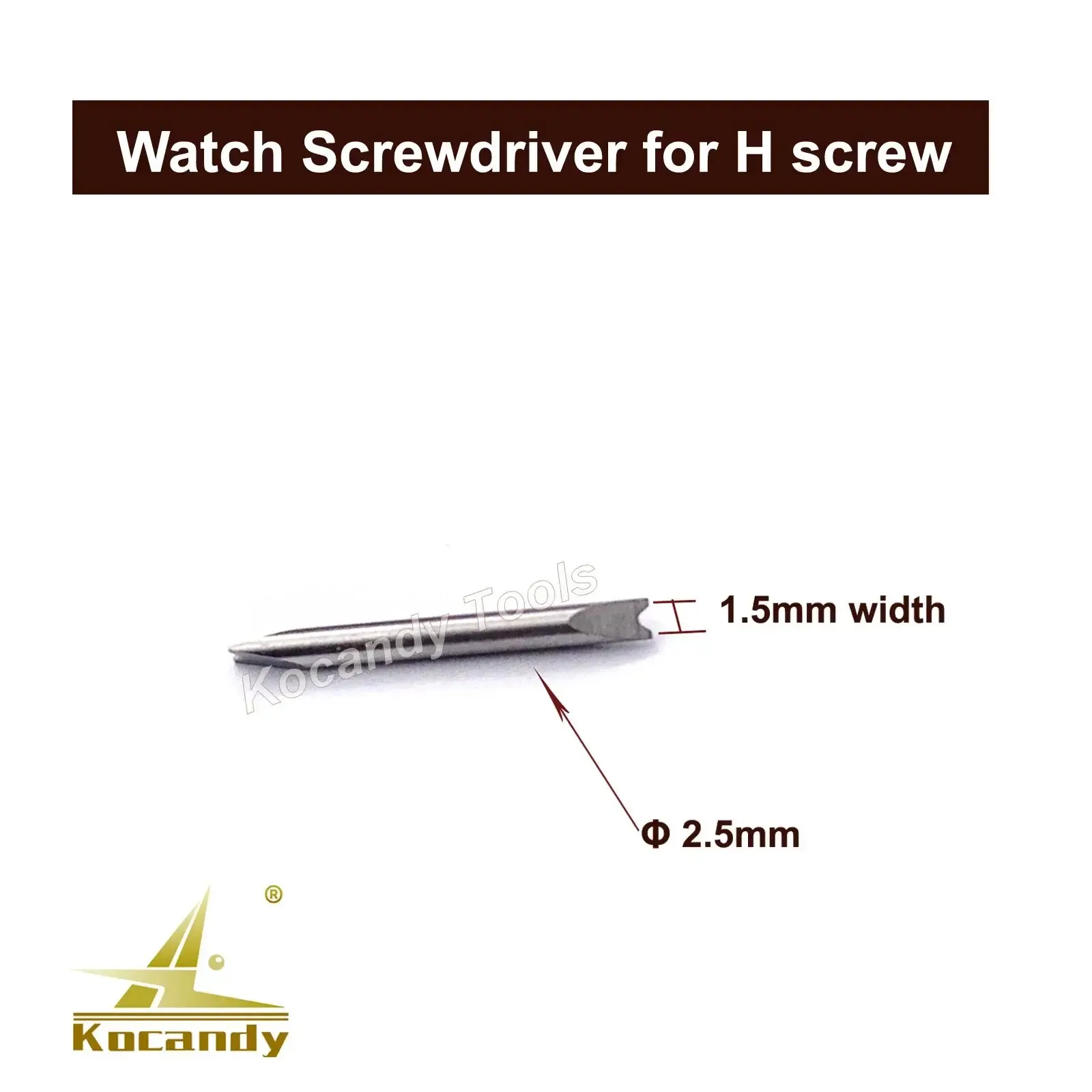
H-screw driver tip profile with 1.5 mm blade prong span and 2.5 mm barrel callout, model WL000007.
Bench Technique: Torque Control, Blade Dressing and Screw Preservation
Proper bench technique protects valuable watch components when driving slotted or H-type screws:
First, maintain perpendicular tool alignment. Tilting the driver concentrates rotational force on a single slot edge, risking slippage. Apply steady downward pressure through the swivel cap with your forefinger while turning the knurled barrel with your thumb and second finger.
Second, manage factory thread lockers. Case bezels and strap plates often use thread-locking compounds to resist vibration. Forcing a stubborn screw cold can twist driver tips or deform screw recesses; controlled localized warmth is a common way to soften the compound before turning.
Third, inspect and dress blades regularly. Loupe inspection reveals micro-chips and tip rounding before they mark screw heads. Dress worn flat blades on an Arkansas stone with a sharpening guide to re-establish crisp, parallel faces.
Fourth, swap damaged blades promptly. The 10-piece carousel set and 5-piece portable set include spare blades for routine maintenance: loosen the collar set screw, extract the worn bit, seat the replacement fully against the internal stop, and re-tighten the collar.
Identifying Your Screwdriver Requirements and Verification Service
Selecting the right screwdriver setup depends on your bench focus: full movement servicing calls for the 10-piece rotating carousel set, mobile repairs are well served by the 5-piece or 6-piece kits (model RH000008), and proprietary H-fasteners require dedicated 1.0 mm or 1.5 mm H-type drivers.
If your required screw head diameter, slot spacing, or fastener profile is not listed above, do not force an unverified tool into the assembly. Measure your fastener dimensions with calipers, take a clear macro photograph, and contact us through Kocandy Contact Us. Our team replies within one working day to check your measurements against our parts catalog.
Disclaimer: Kocandy is an independent supplier of watchmaker tools and replacement components. Kocandy is not affiliated with, authorised by, or associated with any watch brands, including Hublot, Rolex, Omega, Citizen, Seiko, Breitling, Panerai, ETA, Bergeon, Horotec, or Vetus. All brand names are trademarks of their respective owners and appear solely as descriptive compatibility identifiers for fastener types.