Oct 28, 2026Buying Guides
Watch Band Adjustment Tool Guide: Link Removers, Pin Pushers and Strap Cutters
Match watch band adjustment tools to metal bracelets and leather straps. Compare link pin pushers, spring bar tools, cutters, and pin vises, then submit measurements for catalog verification.
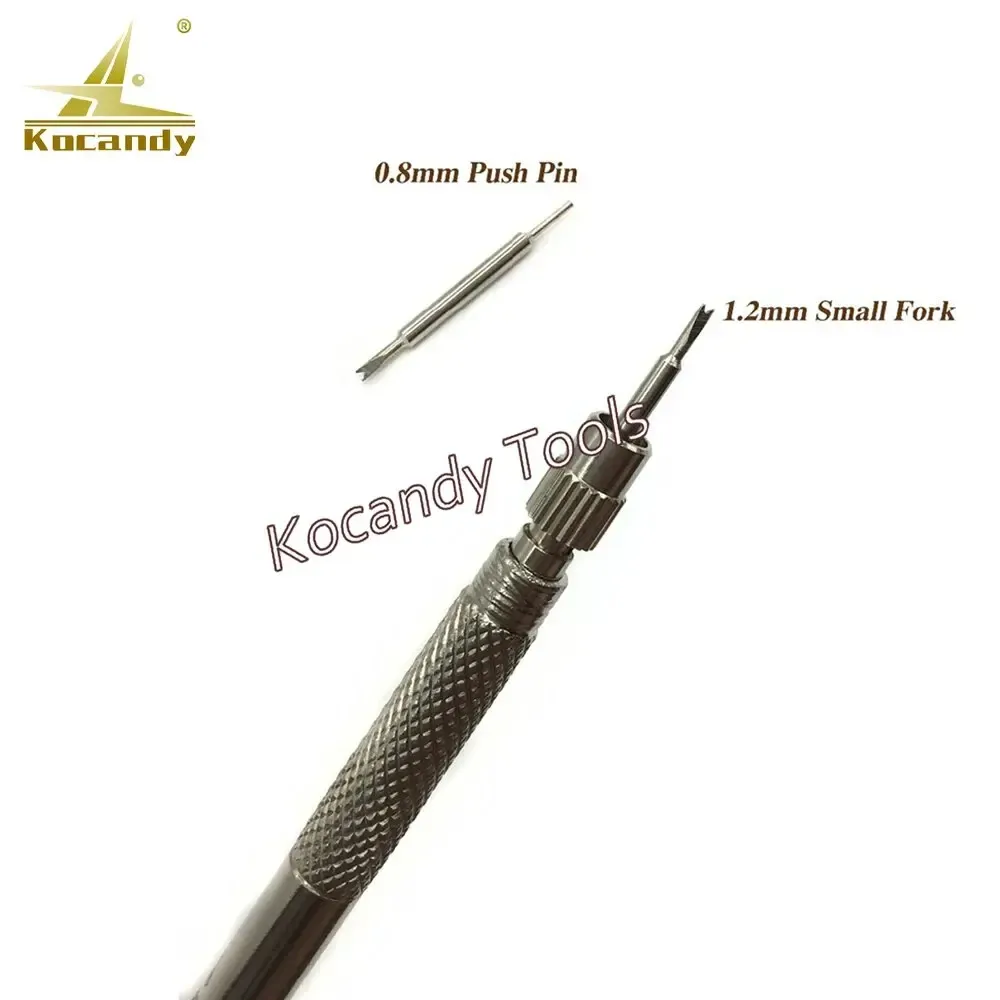
Watch band adjustment tools: matching link removers, pin pushers, and strap cutters
Resizing a metal bracelet or fitting a custom leather strap requires dedicated bench tools matched to the fastener mechanism inside the band. Driving friction pins with improvised punches or prying spring bars with knives scratches polished links, bends pivots, and distorts lug holes. A clean adjustment depends on selecting the proper bench tool for the strap material and joint design.
Strap adjustment hardware divides into three main categories: spring bar removers for lug and clasp connections, screw-drive pin pushers for bracelet links, and plier cutters for shaping leather tabs. Auxiliary tools—such as copper pin vises and needle oilers—handle hole clearing and clasp lubrication. To identify specific fasteners before starting work, our watch band pin types guide outlines differences between threaded screw pins, rivet bars, and knurled friction pins.
Two-piece spring bar and link remover sets: dual-ended tips and lug access
Spring bar tools provide the controlled leverage needed to compress internal springs without slipping. In the Kocandy catalog, this role is filled by the two-piece stainless steel spring bar and link remover set, model SP0000450. Weighing 70 grams, the set provides two identical handles with knurled non-slip centers to maintain a backup tip at the bench.
Each handle carries dual-profile tips: a v-edged flat fork for flanged spring bars, and an opposite end converting to a 1.5 mm push pin for drilled lugs and clasp micro-adjustment holes. Catalog specifications record an overall length of about 13 cm (noted as 13c and 13inch). While catalog copy lists these tools for brands such as Omega, Rolex, and Seiko, treat brand mentions strictly as catalog indexing. For tip clearance techniques on solid lugs, our Seiko Alpinist SPB121 spring bar guide illustrates safe pivot compression.
Alloy screw-drive pin pushers: controlled link pin extraction on the bench
Bracelets assembled with friction pins require progressive linear force. Hammer-driven punches risk glancing blows that mar link flanks. The alloy adjustable strap watch pin remover tool, model Rh00000095, converts rotational torque into steady axial thrust without impact shock.
Machined from blue aluminium alloy, model Rh00000095 weighs 95 grams and measures 8 cm long, 3 cm wide, and 3.5 cm high. An adjustable platform thumbwheel raises or lowers the bracelet to align the link bore directly with the threaded pusher pin. Turning the handle advances the hardened pin forward, extracting the link pin cleanly. The tool includes one pre-fitted pin and one extra replacement pin.
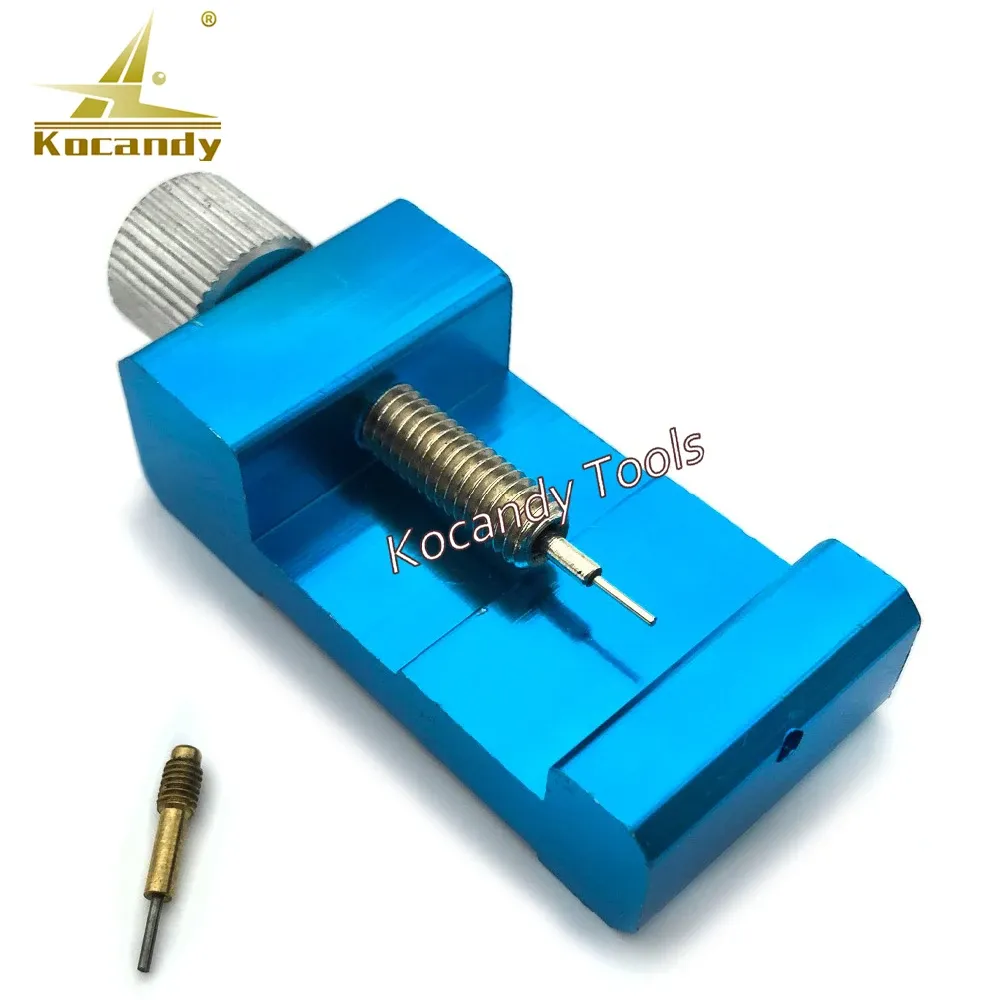
Alloy screw-drive watch band pin remover model Rh00000095 pushing a link pin along its extraction axis.
Compact aluminium link pin removers: base storage and spare pin support
Technicians needing a compact bench press can use the green aluminium alloy adjustable pin remover, model SP00000593. Weighing 52 to 53 grams, this unit measures 60 mm by 27 mm by 20 mm (recorded as 6 cm by 2 cm in specifications).
Model SP00000593 advances a slender pin along a machined channel to push out link pins. Because narrow pushers can bend when encountering seized pins, this tool houses two spare replacement pins inside its base. Storing spares inside the tool prevents bench delays during resizing.
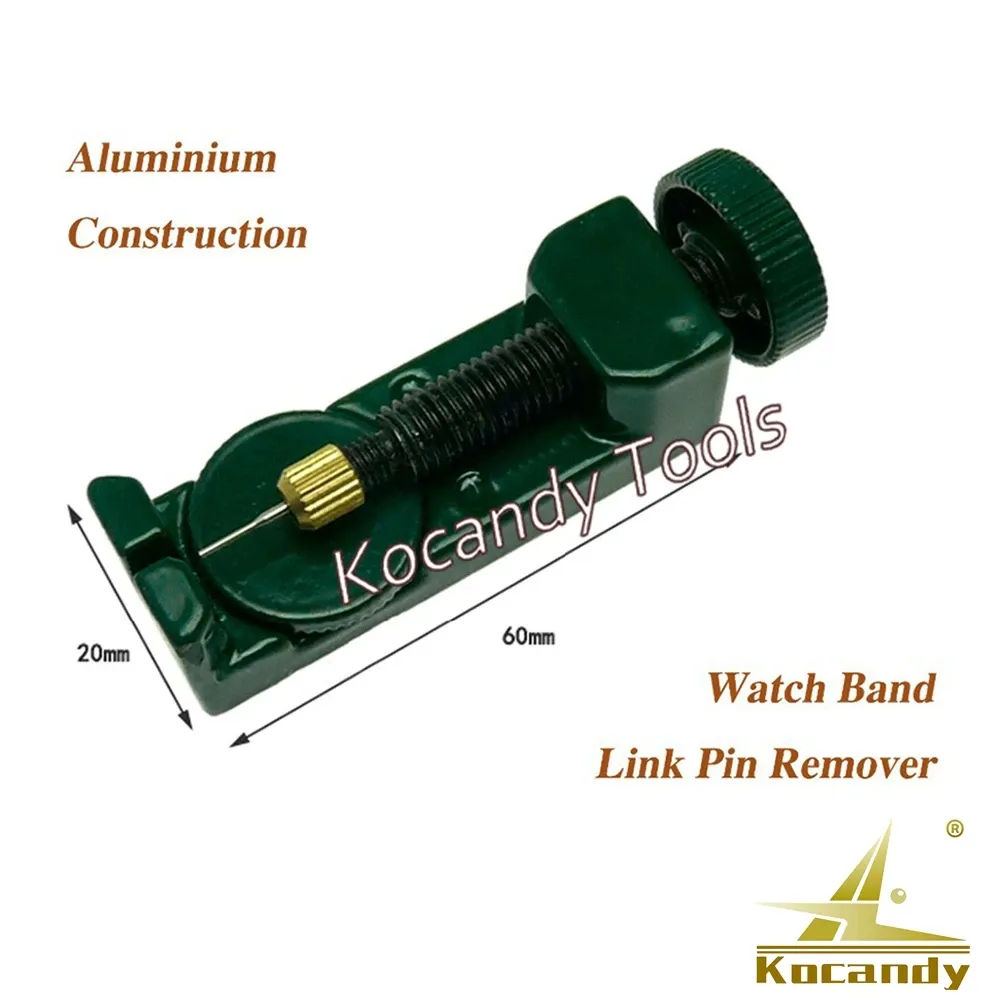
Green aluminium link pin remover model SP00000593 showing the threaded pusher screw and spare pins.
Comparing screw-drive pin pushers versus hand-held pin punches
Choosing between screw presses and manual pin punches depends on bracelet construction. Screw presses support the bracelet across a flat bed, maintaining axial alignment and protecting polished links. Hand punches require a slotted block and hammer taps, risking damage if the punch slips. For friction sleeve and collar dimensions, consult our watch band link pin size guide before applying force. The table below compares Kocandy link adjustment and spring bar hand tools.
Tool Description | Catalog Model | Primary Material | Recorded Dimensions | Tool Weight | Included Spares / Tips | Key Mechanical Advantage |
|---|---|---|---|---|---|---|
Spring Bar & Link Remover Set | SP0000450 | Stainless Steel | Length approx. 13 cm | 70 g | 2 tools per set, dual tips | V-edge fork and 1.5 mm push pin |
Adjustable Alloy Pin Remover | Rh00000095 | Aluminium Alloy | 8 cm x 3 cm x 3.5 cm | 95 g | 1 pre-fitted, 1 extra pin | Height-adjustable base thumbwheel |
Green Adjustable Pin Remover | SP00000593 | Aluminium Alloy | 60 x 27 x 20 mm | 52 to 53 g | 1 pre-fitted, 2 spare pins | Internal base storage for spare pins |
Leather strap cutting and notching pliers: interchangeable profile dies
Fitting leather or rubber straps to watches with central case horns, hooded lugs, or stepped recesses requires accurate tab notching. The Kocandy watch leather strap cutting pliers provide a dedicated workshop solution for custom strap profiling.
Weighing 190 grams and measuring 20 cm by 11 cm by 3.5 cm, these aluminium alloy pliers feature a sprung handle for smooth action. The kit includes a storage box and six interchangeable cutting dies in various profile shapes and sizes to punch clean notches without tearing leather grain. Note a catalog oddity: the body copy mentions removing spring bar pins, but catalog specifications and box contents confirm this instrument is an interchangeable-die leather strap cutting plier.
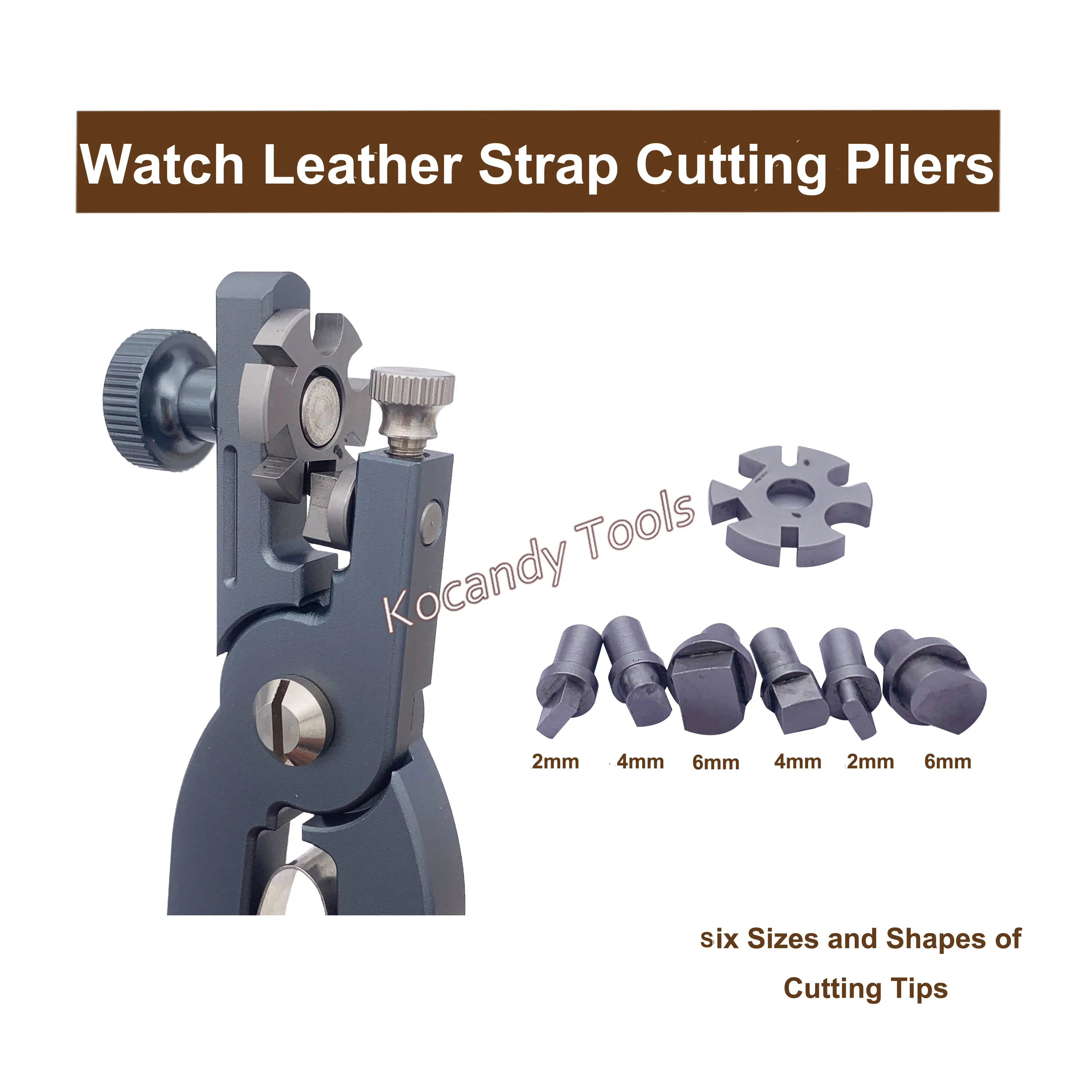
Aluminium alloy leather strap cutting pliers with six interchangeable profiling dies and fitted storage box.
Multi-size copper pin vises: securing micro drill bits and broaches
Strap maintenance frequently requires clearing dirt from link apertures, extracting broken pin ends, or resizing buckle holes. For these fine operations, the Kocandy three-piece copper pin vise hand drill set provides three handheld chuck holders.
Weighing 80 grams in a storage bag, the set features copper bodies with black collet chucks in lengths of 10 cm (3.9 in), 9 cm (3.5 in), and 8 cm (3.1 in) to hold micro drill bits, broaches, and pivot wire. Note a catalog oddity: titles cite 3.1, 3.5, and 3.9 twisted bits, but catalog dimensions confirm these figures denote tool lengths in inches. Furthermore, bench drill bits are steel, while the pin vises are machined copper.
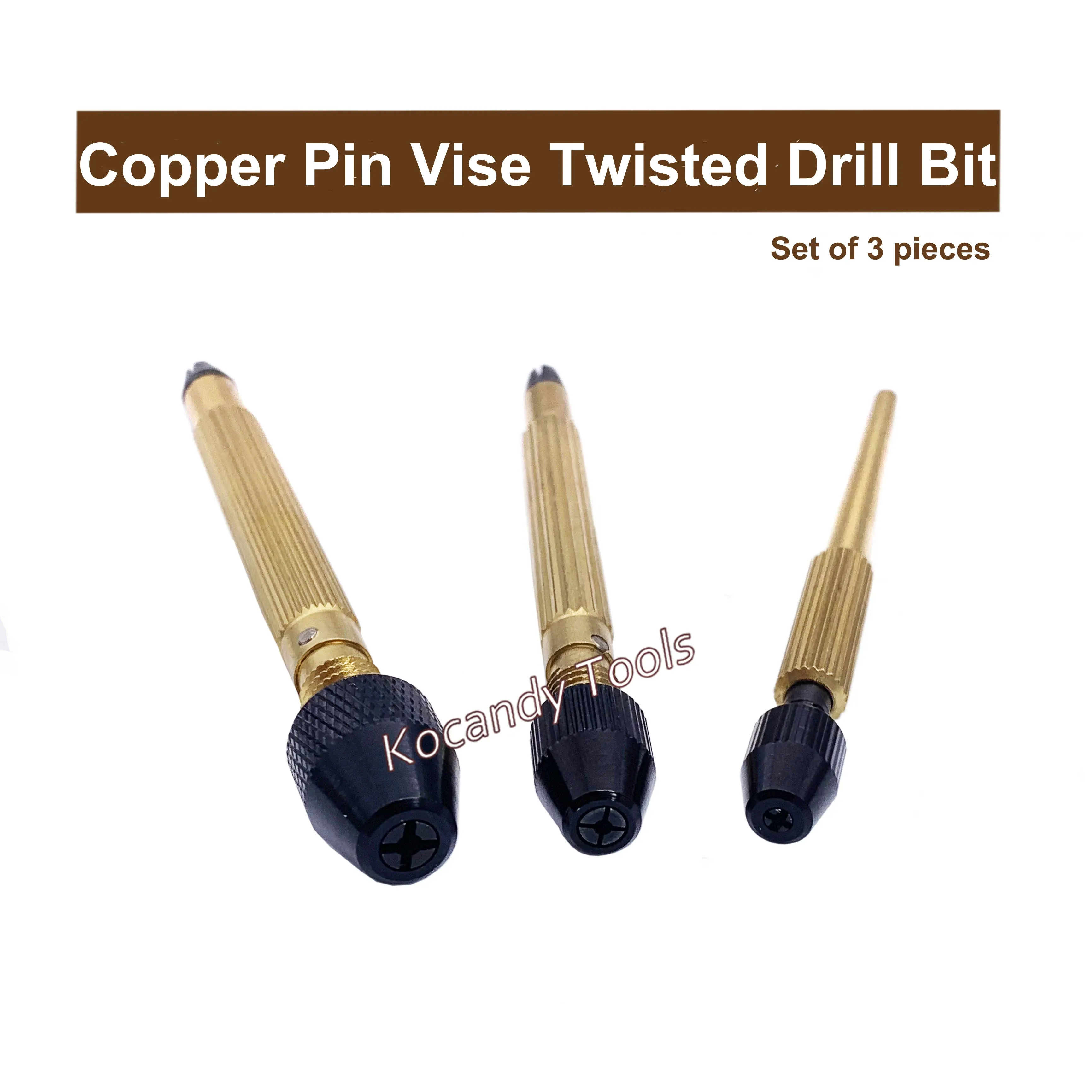
Three copper pin vises with black collet chucks in graduated lengths of 8 cm, 9 cm, and 10 cm.
Precision oiler pens for strap clasps: lubricating pivot points and hinges
Fine lubrication prevents metal-on-metal wear on folding clasp pivots, diver extension slides, and friction spring catches. Applying oil from bottles soils straps and attracts grit, whereas an oiler pen places micro-droplets directly onto concealed friction points.
The Kocandy watch oiler pen features an aluminium alloy rod and a weighted plastic base, weighing 60 grams. Total height with base is 10.3 cm, pen length is 9.7 cm, and the base measures 3.3 cm high by 3.3 cm wide. Catalog specifications list two needle tip options: Gray (0.4 x 0.2 mm) and Red (0.3 x 0.1 mm). The stand protects the fine tip between applications, dispensing minute droplets to restore smooth clasp operation.
Bench tool specifications and sizing matrix across adjustment hardware
The tables below summarize catalog specifications and match tools to specific strap adjustment tasks.
Tool Description | Model / Ref | Material Specification | Recorded Dimensions | Pack Weight | Primary Bench Application |
|---|---|---|---|---|---|
Spring Bar Remover Set (2pcs) | SP0000450 | Stainless Steel | Length approx. 13 cm | 70 g | Spring bar fitting, drilled lug pin pushing |
Adjustable Alloy Pin Remover | Rh00000095 | Aluminium Alloy | 8 cm x 3 cm x 3.5 cm | 95 g | Metal bracelet link pin pushing via twist drive |
Green Aluminium Pin Remover | SP00000593 | Aluminium Alloy | 60 mm x 27 mm x 20 mm | 52 to 53 g | Compact bracelet link resizing with base spare pins |
Leather Strap Cutting Pliers | Catalog Ref | Aluminium Alloy | 20 cm x 11 cm x 3.5 cm | 190 g | Notching and profiling leather strap lug ends |
Copper Pin Vise Set (3pcs) | Catalog Ref | Copper Body, Black Chuck | Lengths 8 cm, 9 cm, 10 cm | 80 g | Holding micro-drills, broaches, and link pins |
Watch Oiler Pen with Base | Catalog Ref | Aluminium Rod, Plastic Base | Length 9.7 cm (10.3 cm w/ base) | 60 g | Micro-lubrication of clasp hinges and sliding rails |
Matching tool capabilities to bracelet hardware prevents distorted link bores and damaged components, as detailed in the reference table below.
Strap Type & Fastener | Recommended Bench Tool | Catalog Identifier | Tool Operation Method | Workshop Precaution |
|---|---|---|---|---|
Metal Bracelet with Friction Pins | Alloy Screw Pin Remover | Rh00000095 or SP00000593 | Screw-drive axial thrust | Align base height to prevent pusher pin bend |
Drilled Lug Case & Spring Bars | Stainless Spring Bar Tool | SP0000450 | 1.5 mm push pin depressing | Support case flank to prevent tip slippage |
Flanged Spring Bars on Solid Lugs | Stainless Spring Bar Tool | SP0000450 | V-edged forked blade | Engage bar shoulder squarely without case contact |
Custom Notched Leather Strap | Strap Cutting Pliers | Catalog Ref | Interchangeable profile dies | Verify notch width before depressing handle |
Clasp Pivot & Friction Catch | Precision Oiler Pen | Catalog Ref (0.3 or 0.4 mm) | Fine needle micro-droplet | Apply minimal lubricant to prevent residue |
Bench procedure: step-by-step bracelet resizing and strap refitting
Executing clean bracelet resizing requires disciplined bench technique. Follow these sequential steps:
First, inspect the bracelet underside under magnification for stamped directional arrows indicating pin removal direction.
Second, place the bracelet in the screw press (Rh00000095 or SP00000593) and turn the thumbwheel until the pusher aligns with the link hole center.
Third, turn the drive handle to advance the pin smoothly. If heavy resistance occurs, stop immediately to check for threaded screws or collar sleeves; never force a binding pin.
Fourth, extract the pin with pliers, remove redundant links, and rejoin the band. Press the pin back in the reverse direction of the arrow, seating the knurled end flush.
Fifth, for leather straps, align the cutting die before depressing the plier handles. Lubricate clasp pivot points with a micro-droplet from the oiler pen.
Identifying your tool requirements and requesting catalog verification
Accurate tool selection ensures reliable results across bracelets and straps. When ordering, quote model SP0000450 for the stainless steel spring bar tool set, Rh00000095 for the blue alloy pin remover, or SP00000593 for the green aluminium compact pin remover. For items without model numbers—including the leather cutting pliers, copper pin vise set, and oiler pen—quote the product titles and required sizes.
Kocandy is not affiliated with, authorised by, or a dealer for any watch brand (Seiko, Rolex, Omega, Citizen, Breitling, Panerai, Hublot, ETA, Bergeon, Horotec, Vetus…). Brand names appearing in catalog descriptions represent stated-for indexing designations only and do not imply OEM sourcing or manufacturer endorsement.
To confirm tool availability, request quantity orders, or identify the matching pin pusher for your bracelet dimensions, contact our technical team at Kocandy Contact Us. We reply within one working day. If your required pin diameter, pusher thread, cutting die shape, or tool size is not listed anywhere above, send us your measurements anyway—we will check against the catalog.