Oct 12, 2026Reference & Sizing
Watch Tweezer Tip Size Guide: Matching Geometry to Movement Tasks
Straight, curved, broad or super-fine: Vetus tweezer tip shapes with stated lengths, materials and model numbers. Match the geometry to your bench task and send us the code.
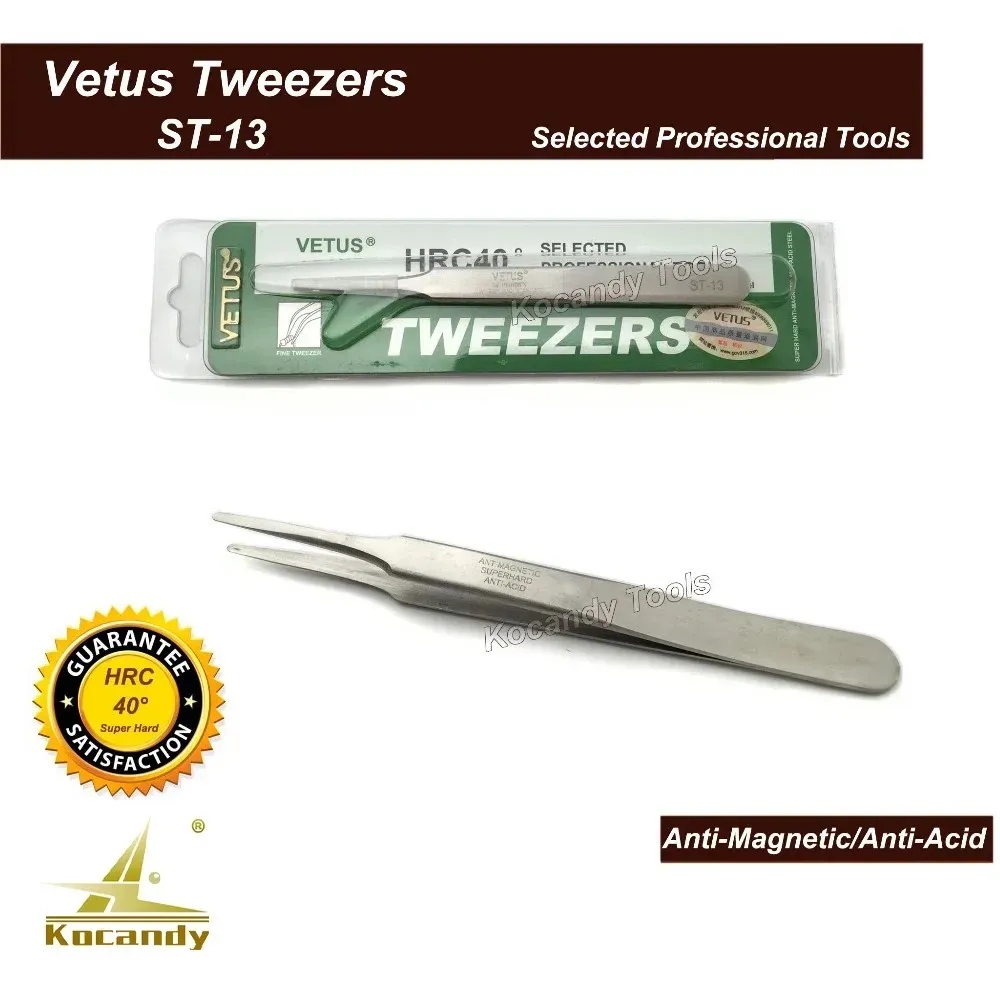
A watchmaker's tweezer is chosen by tip geometry, overall length, and material properties, never by brand guesswork. Working over an uncased caliber with the wrong tweezer leads directly to scratched bridge plates, dropped screws, or crushed hairspring coils. An overly wide tip cannot enter recessed jewel settings, while a blunt tip slips off miniature screw heads. Matching the right tweezer requires reading the physical tip profile and confirming dimensions. Once you identify what you are gripping, choose by stated catalog specifications rather than assumptions.
Watch Tweezer Tip Sizes and Shapes: Choosing by Bench Task
Selecting tweezers begins by categorizing the tip shape against component geometry. The Kocandy catalog lists four distinct tip silhouettes across the Vetus precision tweezer range: fine straight, super fine straight, fine broad, and fine curved. Each profile serves a dedicated mechanical purpose at the bench.
Straight fine tips provide an unobstructed axial line of sight for general disassembly, case screws, and train bridges. Super fine tips taper to needle points for micro-clearances, including hairspring coils and balance pivots. Broad tips form flat paddles that distribute pressure across plates, calendar discs, and quartz battery cells without puncturing surfaces. Curved tips bend downward, providing horizontal clearance beneath overhanging bridges where straight tweezers collide with plates.
Before selecting a tool, determine whether your task demands maximum clearance, surface protection, or gripping stability.
Movement Components and Grip Requirements: Screws, Pivots, and Hairsprings
Different movement assemblies place distinct demands on tweezer tips. Understanding these physical requirements prevents component damage and lost parts across the workbench:
- Movement Screws: Screws require rigid shanks that resist splaying under pressure. Fine straight tweezers seat squarely against screw head diameters, ensuring positive control while transferring fasteners into threaded holes.
- Hairsprings and Regulating Assemblies: Hairspring manipulation demands microscopic clearance. Super fine tips allow a watchmaker to nudge coils or adjust regulator pins without grazing adjacent turns. Tools must remain strictly non-magnetic.
- Balance Pivots and Escapement: Handling balance wheels requires steady, light contact. A curved or super fine tip clears the balance cock, preventing bent pivots.
- Battery Cells and Circuit Shields: In quartz calibers, sharp tips risk shorting contacts or puncturing foils. Flat broad tips provide wide, safe contact pads.
When handling uncased movements, secure the caliber in a holder and confirm layout, especially when identifying an unmarked movement before disassembly.
The Three-Piece Tweezer Set: ST-10, ST-13, and ST-15 Overlap
For outfitting a workbench, our catalog lists a 3-piece tweezer set under model SP0000082/83/84. Rather than presenting a new geometry, this set bundles three established individual models: the ST-10 fine straight tip, ST-13 fine broad tip, and ST-15 fine curved tip.
The set features an overall length stated as 11.5 cm with an item weight of 35 grams. Built from stainless steel, each tool is catalogued as super hard, acid resistant, and non-magnetizing. The bundle covers the primary requirements of casing and general repair.
If your bench already utilizes one of these individual models, note that ordering the set duplicates those specific profiles.

The three-piece Vetus tweezer selection showing straight, broad, and curved geometries.
Straight Fine Tips: ST-10, ST-12, and ST-14 for General Assembly
The straight fine tip profile is the foundational tool for watch assembly. The Kocandy catalog lists three individual models: ST-10, ST-12, and ST-14.
Model ST-10 (catalog model SP0000083) measures 110 mm (11 cm) overall with a 1 cm width and a 35-gram weight. Built from stainless steel, it resists acids and magnetic fields, featuring a very hard, sharp straight tip suited for inspection and assembly.
Models ST-12 and ST-14 share the stated 110 mm (11 cm) total length, 35-gram weight, and non-magnetic, acid-resistant stainless steel construction. Model numbers for ST-12 and ST-14 are unlisted in snapshot specifications; confirm by message when ordering.
Note that catalog text for ST-10, ST-12, and ST-14 includes boilerplate references to a 50 mm curved tip, despite all three featuring straight tips. Furthermore, packaging text on ST-12 and ST-14 mistakenly cites ST-10 packaging. Rely on the model title and straight tip designation.
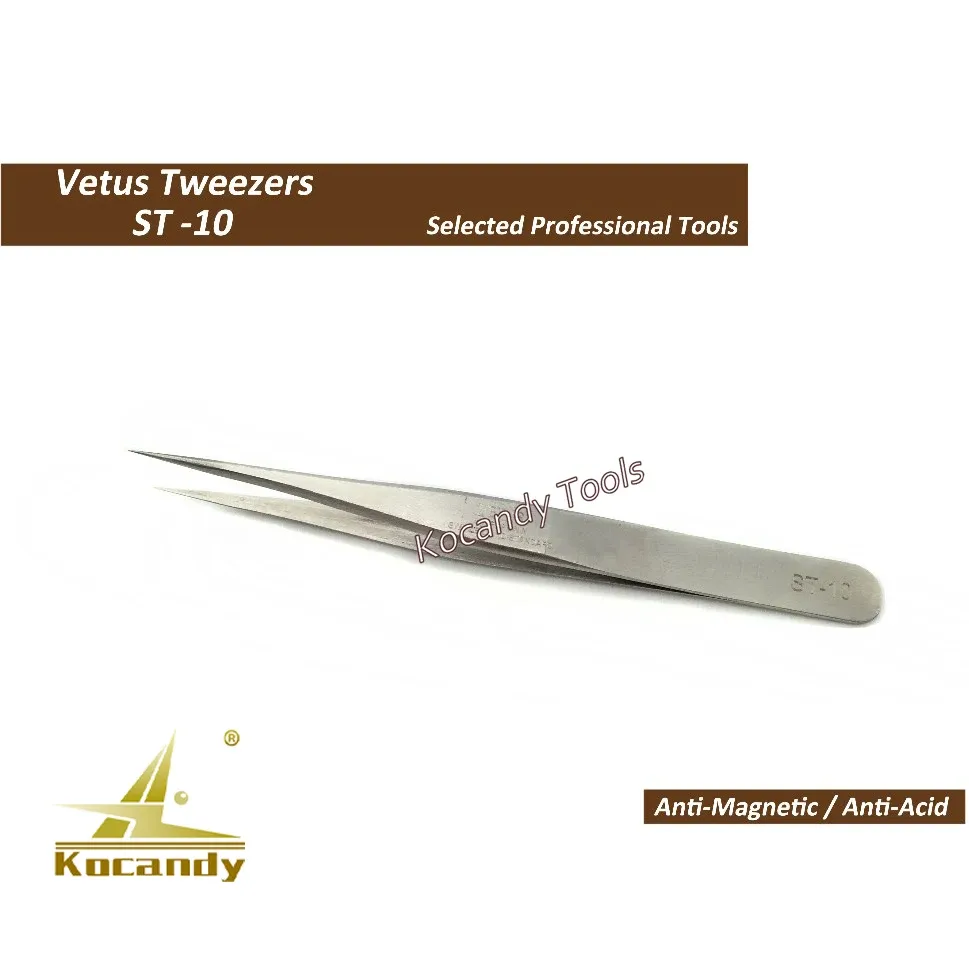
Close-up of the ST-10 fine straight tip geometry for general component handling.
Broad Tip Geometry: ST-13 for Flat Components and Plates
Model ST-13 (catalog model SP0000084) provides a fine broad tip geometry. Rather than tapering to a sharp needle point, the tip widens into a flattened paddle.
Catalog specifications state a total length of 120 mm, a 35-gram weight, and HRC 40 hardness. The stainless steel body resists acid and magnetism. Catalog tables record an item length of 1.2 inches, which is a typographical error for 12 cm (120 mm). The body text also mistakenly mentions a 35 mm curved tip, whereas the tool features a straight broad profile.
At the bench, the broad tip stabilizes thin brass shims, train wheels, and calendar springs. The wide contact surface prevents marring soft plates and distributes pressure safely when seating coin cells in quartz movements.
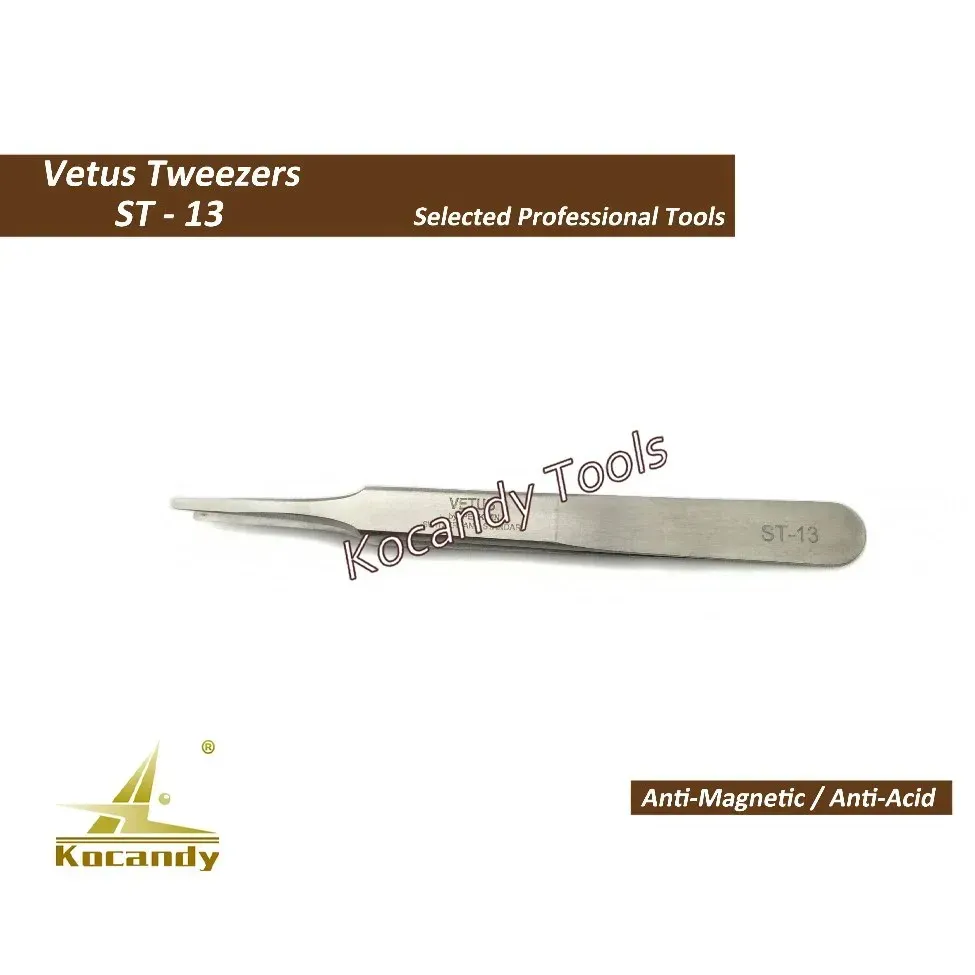
The ST-13 broad tip profile designed for flat component and battery handling.
Curved Tip Geometry: ST-15 for Recessed Bridge and Hairspring Access
Model ST-15 (catalog model SP0000082) features a dedicated fine curved tip for angular movement access. The tool measures 115 mm overall with a 33 mm curved tip section and weighs 35 grams.
Forged from high-grade stainless steel, model ST-15 resists acids and magnetism. The tips arch downward, allowing the hand to stay elevated while the tips enter horizontally beneath overhanging bridges.
This geometry proves valuable when guiding center wheel arbors into jewels or seating pallet forks. The curved shank also maintains visual clearance when inspecting hand collets, complementing specialized hand removal and setting tools during dial assembly.
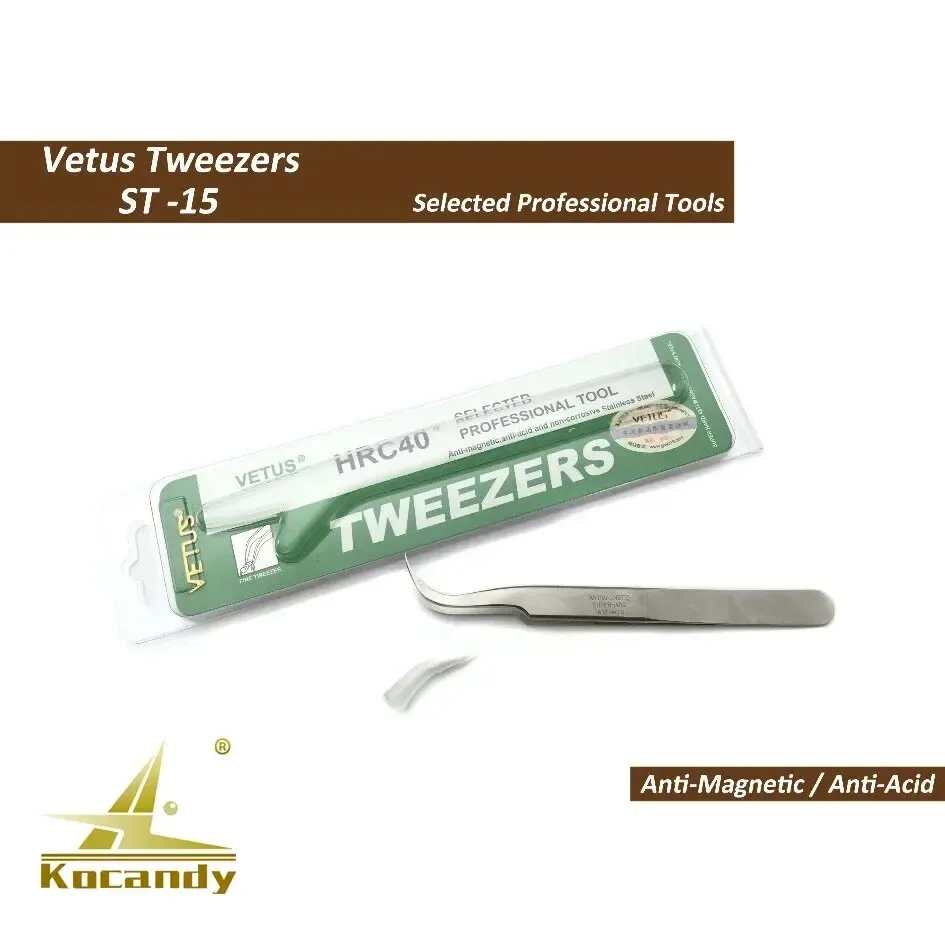
Close-up of the ST-15 curved tip profile for angled bridge access.
Super Fine Long Tips: ST-11, ST-16, and ST-17 for Micro-Clearances
For micro-clearance work, the catalog provides three super fine tip models: ST-11, ST-16, and ST-17.
Model ST-16 (catalog model SP00000890) is the longest tweezer in the series, measuring 180 mm (18 cm) overall with a 65 mm super fine tip section and weighing 35 grams. Made from stainless steel rated at HRC 40, it is non-magnetic and acid resistant. The extended 180 mm reach provides leverage and visibility inside deep cases.
Model ST-11 features an ultra-slender straight tip in stainless steel weighing 35 grams. Total length and model number are omitted in snapshot records; confirm by message.
Model ST-17 is catalogued as high-grade stainless steel with a super fine, sharp straight tip weighing 35 grams. While traditional ST-17 designs feature curved tips, catalog text explicitly states a sharp straight tip; confirm tip angle by message if your task requires an offset.
Tweezer Model and Spec Reference Tables
Use the reference tables below to compare tweezer geometries, dimensions, materials, and catalog model numbers across all nine products in scope.
Table A: Tweezer Model Reference
Model | Tip shape | Total length | Tip detail | Product link |
|---|---|---|---|---|
Vetus ST-10 | Fine straight tip | 110 mm (11 cm) | Sharp, straight tip (body notes 50 mm curved tip) | |
Vetus ST-11 | Super fine tip | Confirm by message | Sharp, straight super fine tip | |
Vetus ST-12 | Fine straight tip | 110 mm (11 cm) | Sharp, straight tip (body notes 50 mm curved tip) | |
Vetus ST-13 | Fine broad tip | 120 mm | Sharp and broad tip (body notes 35 mm curved tip) | |
Vetus ST-14 | Fine straight tip | 110 mm (11 cm) | Sharp and straight tip (body notes 50 mm curved tip) | |
Vetus ST-15 | Fine curved tip | 115 mm | Sharp, curved tip (33 mm curved tip) | |
Vetus ST-16 | Super fine tip | 180 mm (18 cm) | Sharp, fine straight tip (65 mm super fine tip) | |
Vetus ST-17 | Super fine tip | Confirm by message | Sharp and straight tip | |
Vetus 3-Piece Set | Straight, broad, curved | 11.5 cm | Bundle containing ST-10, ST-13, and ST-15 |
Table B: Spec Comparison
Model | Material | Weight | Anti-magnetic | Product link / Model |
|---|---|---|---|---|
Vetus ST-10 | Stainless Steel | 35 g | Resists acids and magnetic fields | Model SP0000083 |
Vetus ST-11 | Stainless Steel | 35 g | Resistant to acid and to magnetism | Confirm by message |
Vetus ST-12 | Stainless Steel | 35 g | Non-magnetic and unaffected by acid | Confirm by message |
Vetus ST-13 | Stainless Steel (HRC 40) | 35 g | Resistant to acid and magnetism | Model SP0000084 |
Vetus ST-14 | Stainless Steel | 35 g | Does not magnetize, holds up to acid | Confirm by message |
Vetus ST-15 | High-grade Stainless Steel | 35 g | Withstands acid and resists magnetism | Model SP0000082 |
Vetus ST-16 | Stainless Steel (HRC 40) | 35 g | Non-magnetic and unaffected by acid | Model SP00000890 |
Vetus ST-17 | High-grade Stainless Steel | 35 g | Resists acid and magnetism | Confirm by message |
Vetus 3-Piece Set | Stainless Steel | 35 g | Resists acid and does not magnetize | Model SP0000082/83/84 |
Task to Tip Matching Guide: Selecting by Bench Operation
Matching tweezer geometry to bench operations prevents parts slippage and surface marking. Table C pairs common watchmaker tasks with suited tip shapes based on craft practice.
Table C: Task to Tip Matching
Bench task | Tip shape suited | Reasoning (craft) |
|---|---|---|
Handling bridge screws & case screws | Fine straight tip (ST-10, ST-12, ST-14) | Straight alignment provides direct axial line of sight when picking up screws from organizer trays and lowering them into tapped holes. |
Placing batteries & flat calendar springs | Fine broad tip (ST-13) | Flat, wide paddle profile distributes pressure over broad surface areas without puncturing thin copper contact foils or denting coin cells. |
Reaching under balance cocks & train bridges | Fine curved tip (ST-15) | The 33 mm curved profile clears overhanging bridge rims, allowing horizontal entry to position levers or steady wheels without tilting the hand. |
Manipulating hairspring coils & pallet pivots | Super fine tip (ST-11, ST-16, ST-17) | Narrow taper enters compact clearances between hairspring turns or jewel chatons without grazing adjacent delicate steel springs. |
General movement disassembly & casing | Three-piece set (ST-10, ST-13, ST-15) | Provides the three core bench geometries—straight for fasteners, broad for plates/cells, and curved for recessed components—in a single kit. |
Assembling Your Tweezer Identifier Before Requesting a Match
To verify tweezer availability or request confirmation on an unlisted specification, compile your requirements into a standard bench identifier string before messaging our workshop desk:
- Target Component: Specify the part being handled (for example, ETA 2824 train screws, quartz coin cells, hairspring coils, or chronograph bridges).
- Required Tip Shape: State whether your operation requires a fine straight tip, a super fine point, a wide broad paddle, or a curved profile.
- Desired Tool Length: Indicate preferred overall length, such as standard 110 mm handling, 115 mm curved access, 120 mm broad grip, or extended 180 mm reach.
- Catalog Model Number: If matching an existing catalog record, quote model SP0000082 (ST-15), SP0000083 (ST-10), SP0000084 (ST-13), SP00000890 (ST-16), or SP0000082/83/84 (3-piece set).
Providing this identifier ensures our staff can verify tip tolerances against catalog stock before dispatch.
Workshop Inquiries and Brand Disclaimer
Kocandy is an independent supplier of watchmaker tools and replacement parts. Kocandy is not affiliated with, authorised by, or a dealer for any watch brand or tool manufacturer mentioned, including Seiko, Rolex, Omega, Citizen, Breitling, Panerai, Hublot, ETA, Bergeon, Horotec, or Vetus. All references to Vetus model numbers (such as ST-10, ST-11, ST-13, ST-15, and ST-16) represent stated catalog designations.
If your required tweezer length, tip radius, or model number is not listed anywhere above, send your specifications through our contact page. Provide details of your handling task and component dimensions. We check customer inquiries directly against our workshop catalog and reply within one working day.