Oct 27, 2026Reference & Sizing
Watch Movement Caliber Identification Guide: How to Read an Unmarked Caliber
No readable caliber name? Photograph four angles, measure the diameter, and map the movement to holders and bearing tools by stated caliber. Unlisted platforms like NH36 route to verification.
An unlabelled watch movement on the workbench is an immediate repair puzzle: no brand mark, no caliber reference, nothing engraved across the winding weight. Yet holders, stem extenders, and bearing tools are all ordered against a caliber or a measured diameter. This guide turns an unlabelled caliber into an identified movement — or, when identification stays uncertain, into the exact string of photos and dimensions you send us.
Movement caliber identification: how to read an unlabelled watch movement
Movement caliber identification begins by recognizing that watch movements rely on standardized mechanical architectures known as ebauches. Movement factories produce base movements that brands then finish or customize with proprietary rotors — so dial names and rotor branding are secondary clues. The foundation is defined by mainplate architecture, bridge cutouts, escapement geometry, and keyless works layout.
Examining these hallmarks establishes the movement family and tells you whether caliber-specific holders or universal clamps can safely support it — identifying the platform before loosening screws prevents damage.
Where caliber stamps hide: under the balance, across bridge recesses, and below the dial
A movement often appears unlabelled simply because its caliber stamps sit beneath assembled components. Stamps are placed in recessed areas to protect them from wear or keep bridge surfaces clean.
The primary inspection zone is directly beneath the balance wheel: rotate the balance rim gently or view the mainplate through a 10x loupe under directional lighting, and ebauche symbols — a manufacturer cartouche plus a three- or four-digit caliber number — frequently appear on the mainplate.
The second common location is the dial side of the mainplate, near the setting mechanism or along the dial seat rim; reaching it requires removing the dial and hands. If both zones are blank, identification relies on visual geometry, bridge layouts, and physical measurements.
Bench photography checklist: four angles to capture before component removal
Before loosening a casing clamp or removing the balance cock, document the movement with clear macro photography — reference points disappear once components come apart. Four angles capture what you need to narrow an unknown caliber or submit it for verification.
Inspection Angle | Target Movement Features | Diagnostic Clues Revealed | Bench Recording Note |
|---|---|---|---|
Under the balance wheel | Mainplate stampings, shock protection spring shape | Ebauche cartouche, caliber digits, Incabloc or Novodiac style | Record stamp text or note unengraved surface |
Mainplate & bridge layout | Bridge contours, barrel ratchet, click spring design | Base gear train family, automatic winding module integration | Note whether chronograph module is integrated or modular |
Dial side keyless works | Setting lever, yoke, clutch wheel, minute work bridge | Unique footprint of setting parts specific to movement family | Capture clear macro photo with dial and hands removed |
Rotor & balance bridge | Oscillating weight profile, jewel count, regulator arm | Winding direction clues, stated jewel count, balance style | Note jewel markings and regulator pointer configuration |
Recording these four views preserves the structural footprint of a movement that carries no readable caliber name for catalog cross-referencing.
Diagnostic clues and their limits: beat rate, jewel counts, and rotor engraving
When examining a movement that carries no readable caliber name, bench workers often gather secondary clues such as timegrapher readings, jewel counts, and rotor styling. However, these metrics indicate possibilities rather than definitive proof.
For example, 28,800 beats per hour (bph) on an acoustic timer indicates a modern high-beat escapement — characteristic of platforms like the ETA 2824 or 7750 family, but it does not confirm the caliber, since many independent calibers share the frequency. A 21,600 bph reading suggests a standard-beat architecture and narrows nothing further.
Jewel counts stamped across bridges — 17, 21, 25, or 28 jewels — vary across revisions of the same caliber, and rotor inscriptions can be swapped or custom-engraved. Dynamic readings and decorative text narrow the field; physical geometry and casing dimensions remain mandatory for tool selection.
Why movement holders require either a stated caliber or physical dimensions
Movement holders secure the mechanism rigidly on the bench, preventing damage to delicate balance pivots, center wheel posts, and chronograph levers during hand-setting or assembly. For an extensive examination of holder styles, read which holder to buy — our movement holder guide.
A dedicated movement holder features machined recesses tailored to the exact profile of one caliber — a holder stated for an ETA 7750 chronograph, for instance, clears the protruding chronograph levers and heart pieces. Clamping an unconfirmed movement into a dedicated holder risks bending unseen levers or balance staffs.
When a movement lacks a verified caliber, measure the casing diameter with a vernier caliper. In workshop parlance, movement diameters are frequently stated in Paris lignes (one ligne commonly cited as approximately 2.26 mm). Diameter in millimeters and lignes decides whether a universal adjustable clamp or a dedicated ring can support the mainplate.
Dedicated movement holders: catalog options organized by stated caliber
Kocandy catalog listings organize dedicated fixing holders strictly by stated caliber. Once visual inspection or a stamp confirms a recognized caliber, a purpose-machined holder gives the stablest bench support.
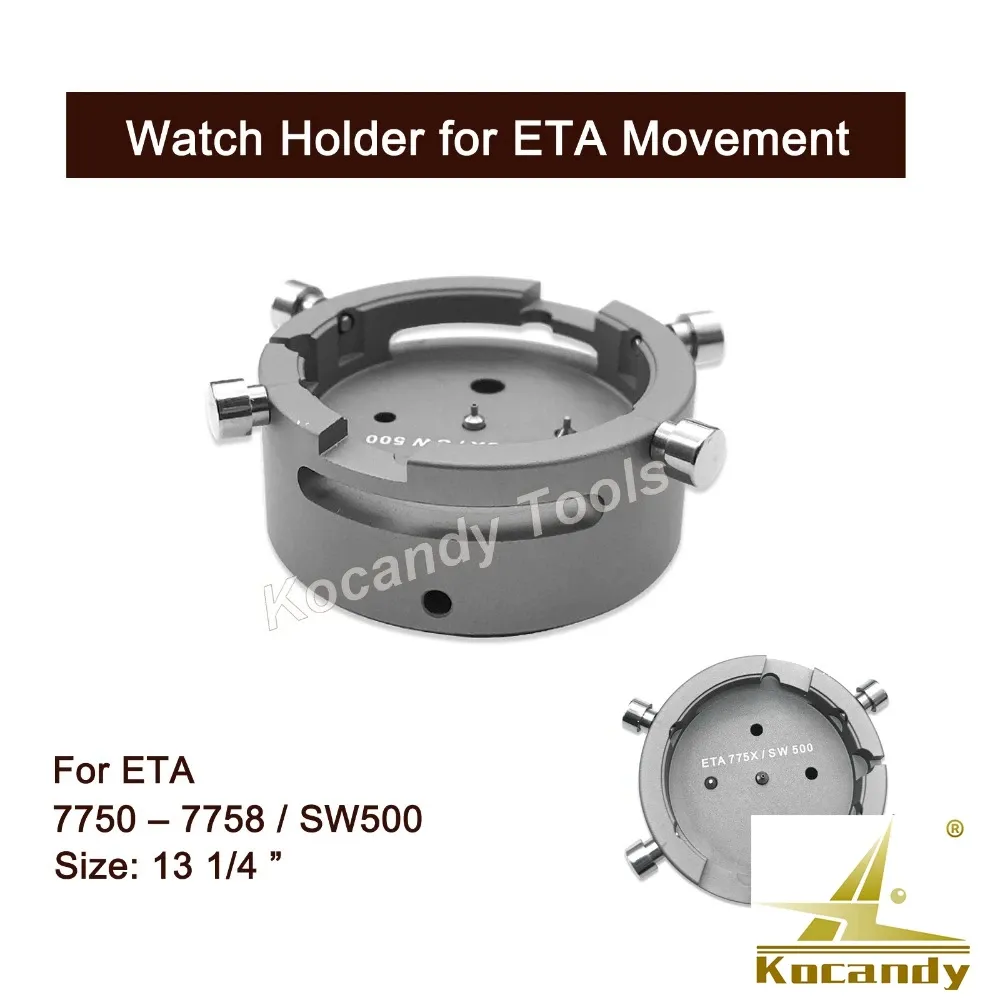
For chronograph architectures, the catalog supplies an anodized aluminum holder stated for ETA 7750, ETA 7758, and SW500 calibers, with hardened steel support screws and a base stated as 31 mm in diameter. For modular chronograph movements, a copper holder stated for ETA 2894-2 comes with locating hardware and a storage box.
Anodized aluminum movement holder stated for ETA 7750, 7758, and SW500 in size 13 1/4.
For slim automatic architectures, specialized copper fixing holders are stated for caliber ETA 2892-A2, while stainless steel variants are listed for caliber designation ETA 2892-5100.
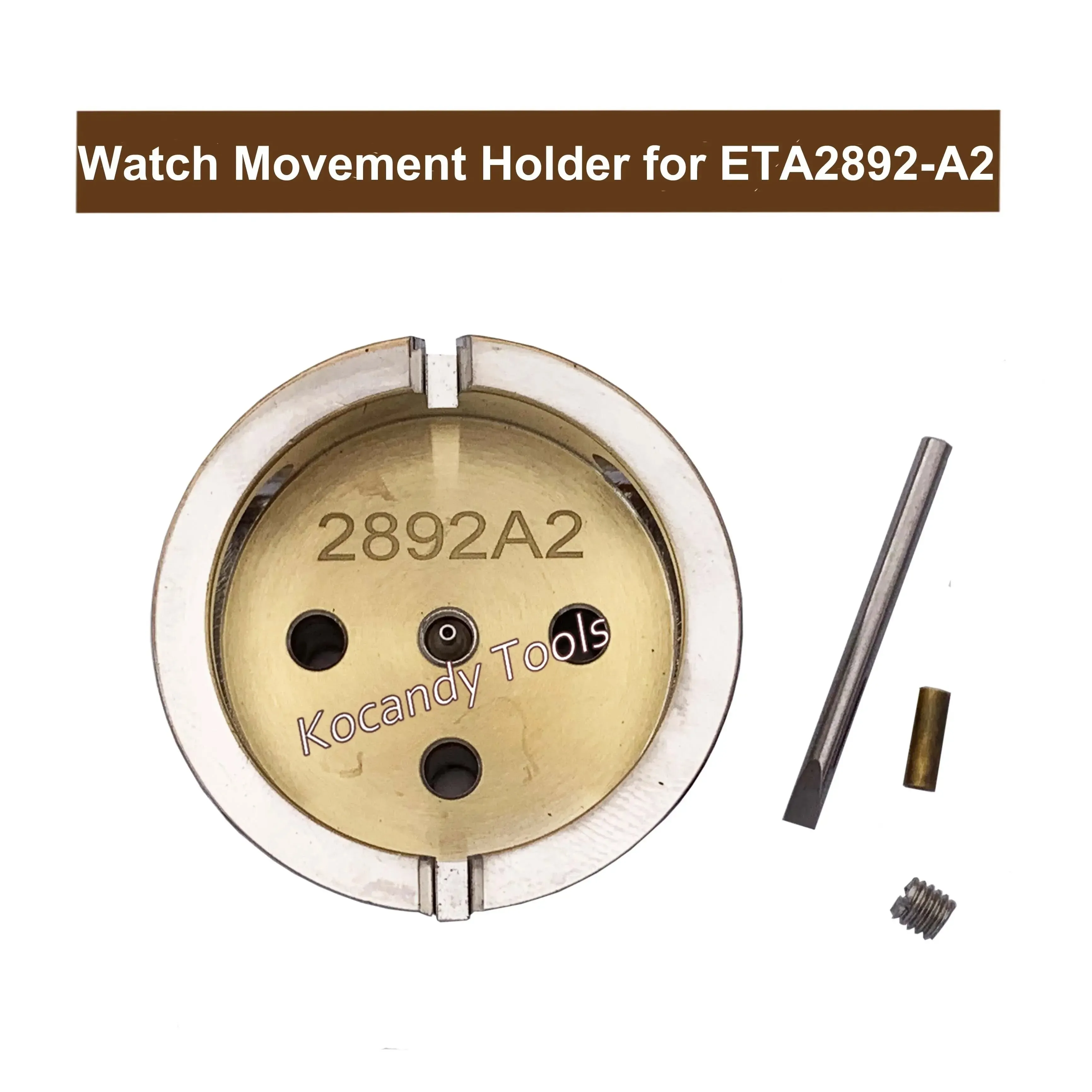
Copper movement fixing holder engraved for caliber ETA 2892-A2 with support pin.
Widely encountered modern movements such as the NH36, Miyota 8215, or Seagull ST19 have zero dedicated holder listings in our catalog. Never force them into holders designed for other calibers — they route to universal clamps or to catalog inquiry verification.
Catalog Tool | Stated Caliber | Stated Caliber Diameter | Material | Stated Accessories |
|---|---|---|---|---|
ETA 2894-2 | Confirm by message | High quality copper | Screws, screwdriver tip, storage box | |
ETA2892-A2 | Confirm by message | High quality copper | Screws, screwdriver tip, storage box | |
ETA 2892-5100 | Confirm by message | High quality stainless steel | Screws, screwdriver tip, storage box | |
ETA 7750 – 7758 / SW500 | 13 1/4 (base 31 mm) | Anodized aluminum | Hardened steel support screws with polished tips | |
Unlisted platform: NH36 | NH36 | Confirm by message | Confirm by message | Confirm by message |
Unlisted platform: Miyota 8215 | Miyota 8215 | Confirm by message | Confirm by message | Confirm by message |
Unlisted platform: Seagull ST19 | Seagull ST19 | Confirm by message | Confirm by message | Confirm by message |
Multi-caliber and universal holding tools: rotatable bases and four-sided clamps
When an unlabelled movement cannot be matched to a single stated caliber reference, or when servicing calibers that lack dedicated catalog tooling (such as NH36 or Miyota 8215), universal and multi-caliber solutions prevent workshop delays.
The catalog provides a 7-in-1 rotatable holder set manufactured from stainless steel. This system incorporates a rotating bench base that turns during assembly, paired with seven interchangeable holder rings stated for calibers ETA 2000, 7750, 2824, 2671, 3100, and 8500.
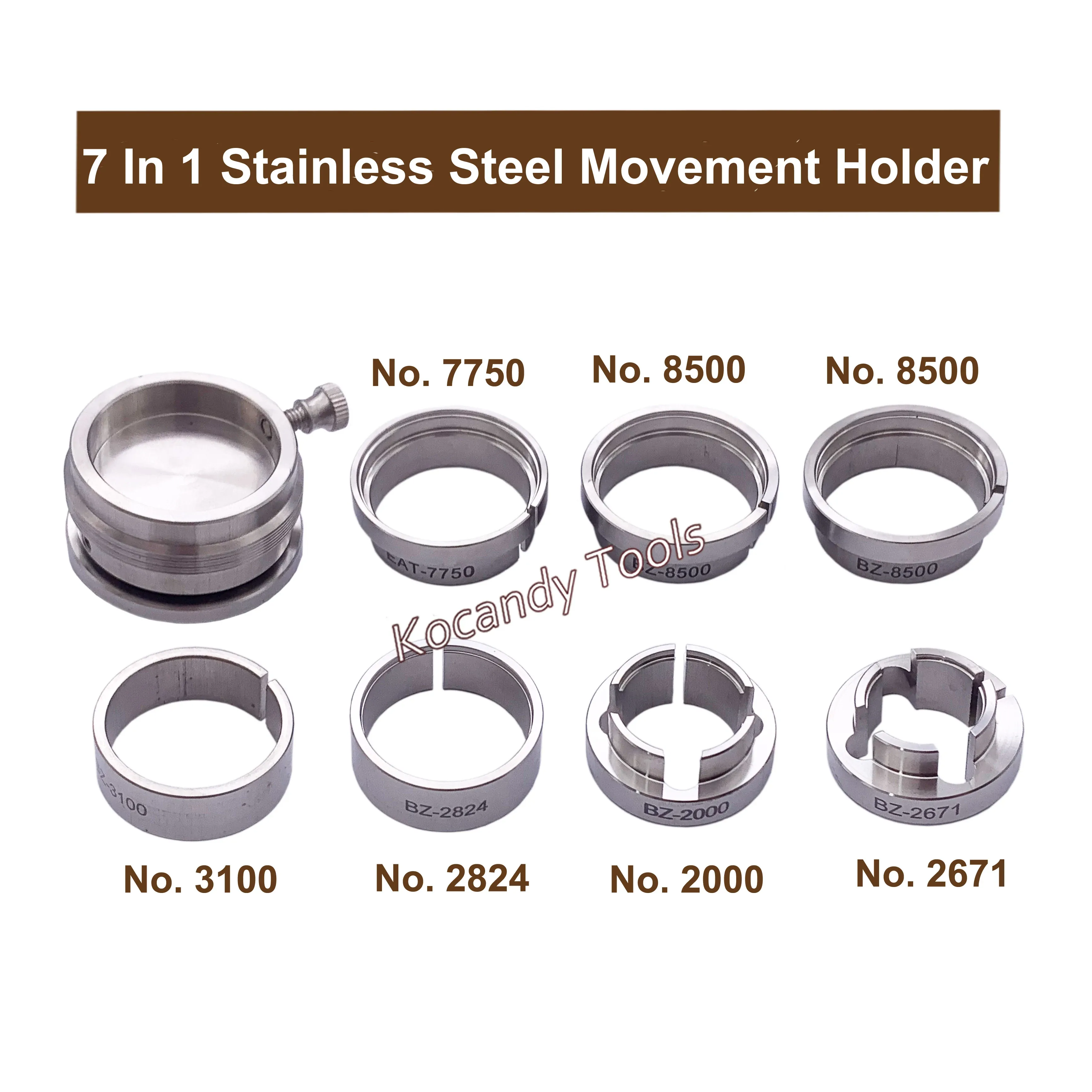
Multi-caliber stainless steel set supplying seven holder rings and a rotatable base.
For movements of unverified origin or custom casing dimensions, an adjustable four-sided fixed base clamp offers universal utility. Built from brass and steel, it operates from both sides with reversible jaws labelled A, B, C, and D, supplied as a pair (large 4x3.9 cm, small 3x2.8 cm), gripping mainplates by the rim without touching train wheels.
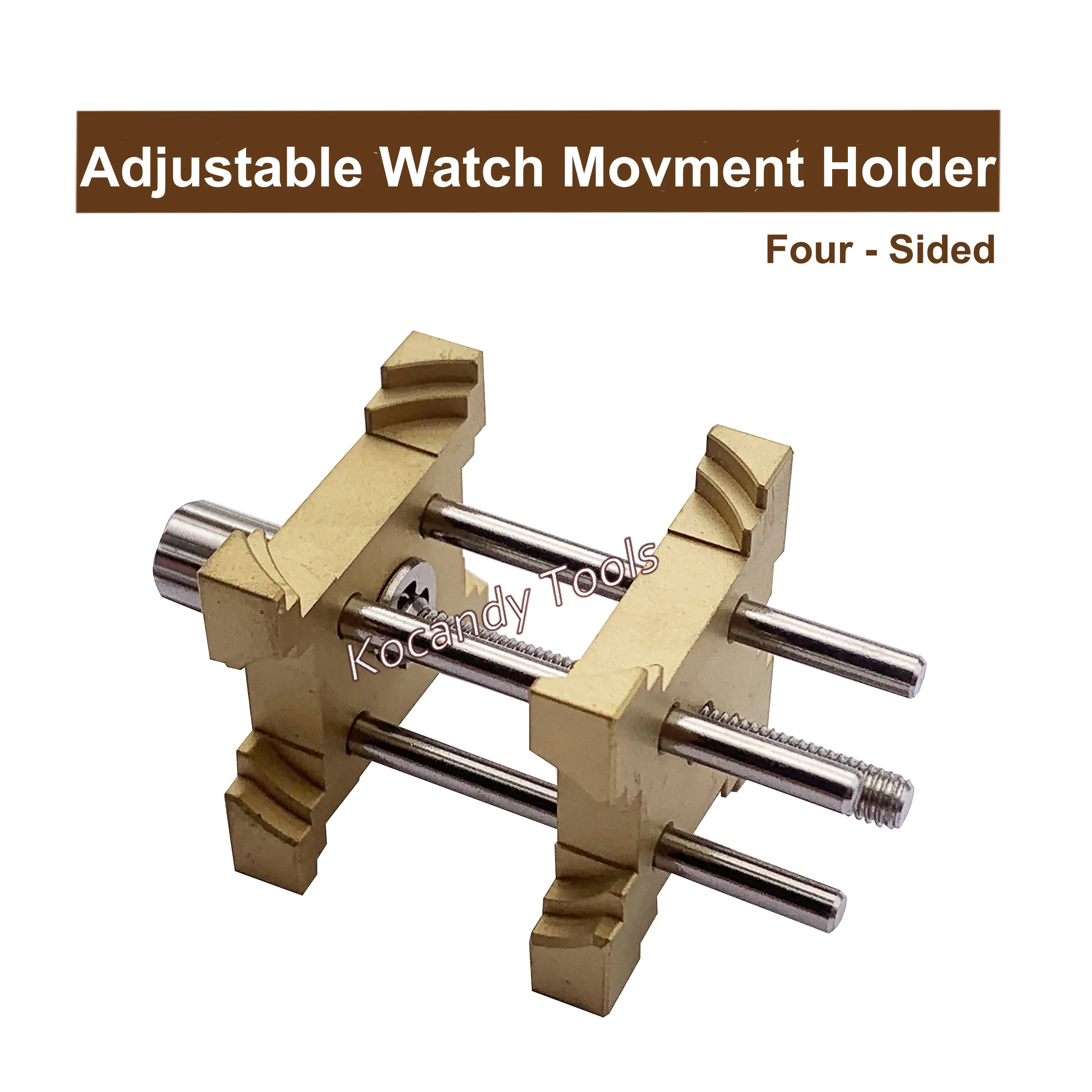
Adjustable four-sided brass movement holder with stepped parallel clamping jaws.
Catalog Product | Stated Movement Coverage | Stated Dimensions | Material | Bench Configuration |
|---|---|---|---|---|
ETA 2000, 7750, 2824, 2671, 3100, 8500 | Confirm by message | Stainless steel | 1 rotatable base plus 7 interchangeable rings | |
Confirm by message | Size L 4x3.9cm, Size S 3x2.8cm | Brass and steel | Dual-sided reversible jaws marked A, B, C, D |
Rotor bearing openers and stem extender cross-references
Beyond holders, an identified caliber often needs specialized disassembly tooling: automatic winding rotors run on miniature ball bearings that wear or contaminate. The catalog provides dedicated alloy bearing openers organized strictly by caliber designation.
For the ETA 2892 caliber family, the catalog offers an alloy bearing opener for ETA 2892 with a matching round die plate. For the 7750 chronograph platform, a black alloy bearing opener for ETA 7750 includes stepped tips and round dies. Both tools press rotor bearings in and out cleanly without distorting oscillating weight bridges.
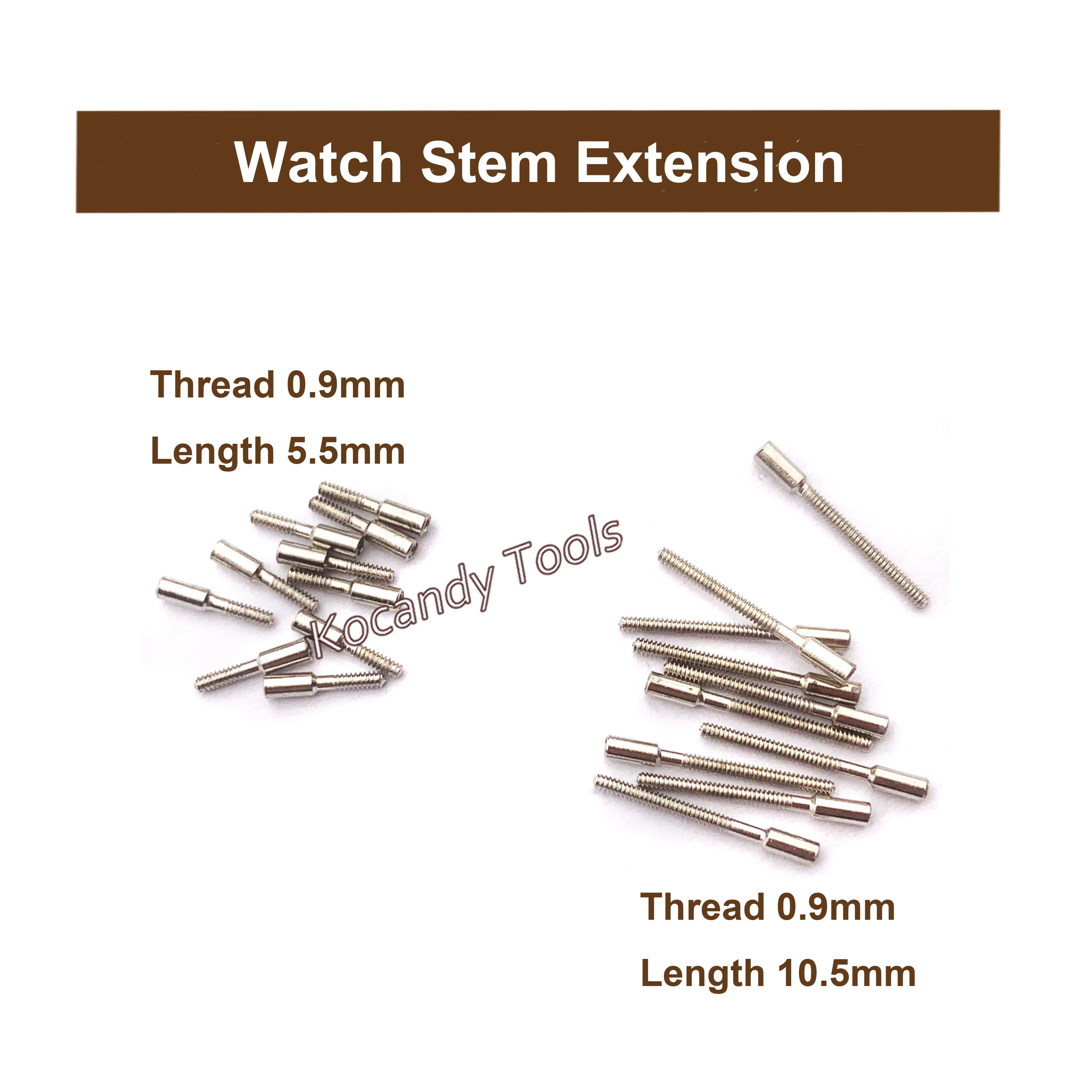
Once the caliber family is known, related parts like winding stems can be addressed. For stem sizing, see our stem thread measurement guide. When replacement stems are unavailable, the 10-type winding stem extender set provides steel extenders listed for calibers including 2824, 2836, 2892, 7750, 9015, 8200, 2671, 6601, and 2035, with 0.9 mm connector adapters.
Compiling your inquiry identifier: what to record and send for verification
When bench examination leaves a caliber unconfirmed, exact physical readings produce a concise identifier our technical team can cross-reference against catalog inventory.
Record the following details before reaching out:
- Visible markings: any text or numerals on the bridge, rotor, or under the balance, or note "no name".
- Casing dimensions: movement diameter measured in millimeters across the mainplate rim, converted to approximate lignes.
- Movement height: overall thickness from mainplate seat to cannon pinion tip or rotor bridge top.
- Photographs: clear macro images showing the rotor bridge layout, the balance wheel area, and dial-side setting components.
Kocandy is not affiliated with, authorised by, or a dealer for any watch brand (such as ETA, Miyota, or Seiko). All brand names, trade names, and caliber designations cited across this guide and our catalog serve exclusively for technical identification and comparative reference.
To verify tooling compatibility or check an unlisted caliber, submit your details through our contact desk:
We reply within one working day. If your size, model, or reading is not listed anywhere above, send it anyway — we check against the catalog to locate suitable workshop solutions.
Please format your inquiry with our bench identifier: stated caliber __ or no name, diameter __ mm / __ lignes, photos of rotor + bridge.