Oct 27, 2026Reference & Sizing
Watch Case-Back Gasket and O-Ring Size Guide: Measuring Seats and Selecting Assortments
Case-back O-rings and crown-post seals come in 0.1 mm steps. Measure the seat, pick the cross-section, and send us the numbers — tables built from our catalog listings.
A watch that fails a pressure test or develops moisture after case opening usually has a compromised elastomeric seal. Over years in service, rubber O-rings flatten, harden, or take a permanent set. Replacing them restores the moisture barrier, but selecting the proper replacement requires systematic bench measurement when factory technical sheets are unavailable.
Watch gasket sizes: case-back O-rings versus crown-post seals
Watch gasket sizes fall into distinct categories across the watch case. When diagnosing water resistance failures or replenishing bench stock, watchmakers primarily work with two elastomeric sealing families: case-back O-rings and crown-post micro O-rings.
Case-back O-rings are large-diameter circular rubber rings with thin wire cross-sections. They seal the perimeter between case back and case body across threaded, snap-on, and screw-secured assemblies. Crown-post O-rings are miniature rings with sub-millimeter wire gauges seating over a crown post or cap bore to seal against the case tube. Conflating them causes ordering errors: case-back gaskets are chosen by inside diameter and wire gauge, whereas crown gaskets are chosen by micro outside diameter and post clearance.
Anatomy of an O-ring seal: cross-section, inside diameter, and groove geometry
An O-ring functions as a toroidal elastomer that seals through controlled mechanical compression. Three metric dimensions govern whether a ring seals effectively:
- Inside Diameter (ID): The center opening seating against the inner groove wall.
- Cross-Section (CS): The circular wire thickness, typically 0.5 mm to 0.8 mm.
- Outside Diameter (OD): The outer boundary, calculated as ID + 2 × CS.
Closing the case back compresses rubber cross-section by twenty to thirty percent, filling metal marks to block moisture. If the cross-section is too thin, the back contacts the rim without compressing rubber, leaving a leak path. If too thick, rubber jams threads, prevents flush seating, or extrudes outward.
The case-back O-ring cross-section ladder: Kocandy workshop assortments
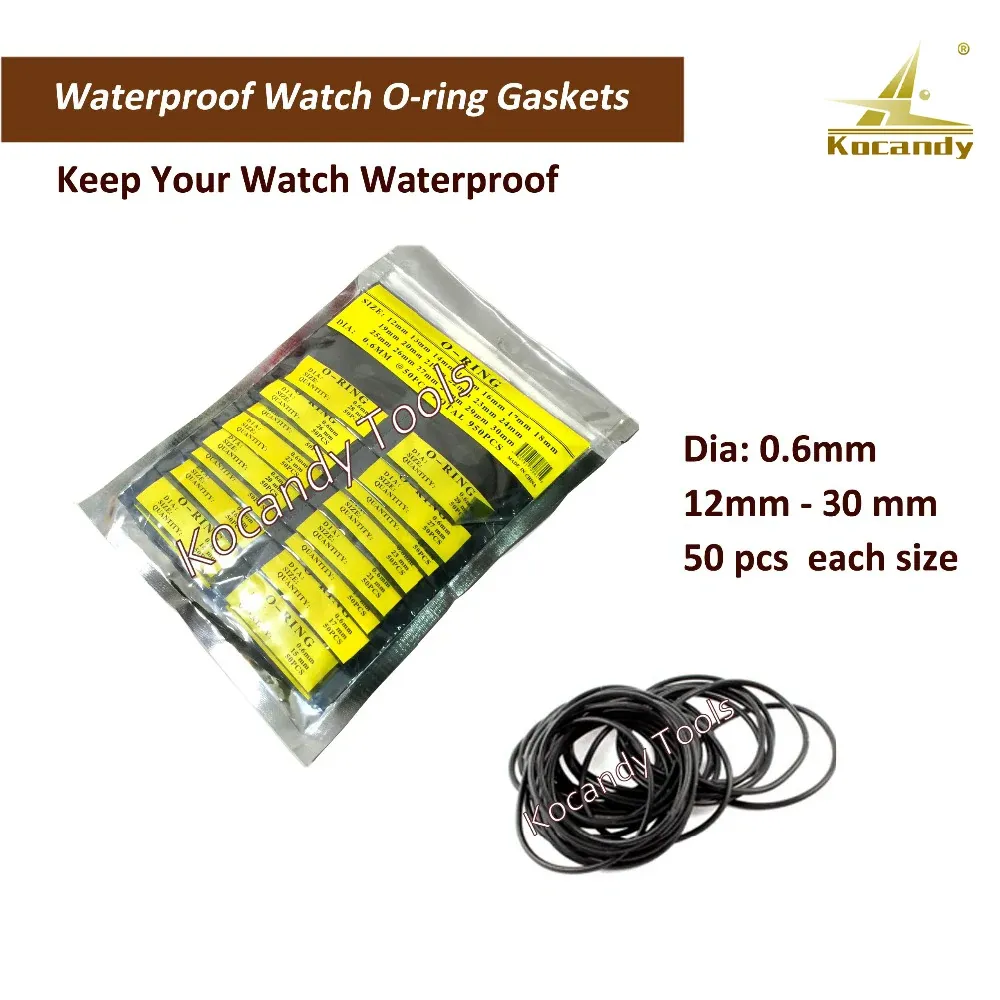
The Kocandy catalog arranges circular case-back gaskets along a four-tier cross-section ladder. Because case designs dictate groove depth, selecting wire thickness represents the initial sorting step. Assortments come packaged in 50-piece increments per size, providing repair benches with consistent stock.
The table below outlines the four case-back O-ring assortments documented across catalog snapshots:
Assortment Item | Stated Cross-Section | Stated Diameter Range | Quantity Stated | Model Number |
|---|---|---|---|---|
0.5 mm | 12 mm to 30 mm (19 sizes) | 50 pcs per size (950 pcs total) | RH0000070 | |
0.6 mm | 12 mm to 30 mm (19 sizes) | 50 pcs per size (950 pcs total) | RH0000071 | |
0.7 mm | 16 mm to 30 mm (15 sizes) | 50 pcs per size (750 pcs total) | Confirm by message | |
0.8 mm | 31 mm to 40 mm (10 sizes) | 50 pcs per size (500 pcs total) | Confirm by message |
Slim dress watches with shallow recesses typically require 0.5 mm or 0.6 mm cross-sections to avoid distorting snap backs. Modern utility cases with deeper channels call for 0.7 mm or 0.8 mm cross-sections to maintain pressure resistance.
0.6 mm cross-section case-back O-rings covering inside diameters from 12 mm to 30 mm (Model RH0000071).
Inside-diameter coverage: kit ranges and unstated ring increments
Each cross-section tier covers a designated span of inside diameters. The 0.5 mm and 0.6 mm assortments provide 19 sizes from 12 mm to 30 mm in 1 mm steps, accommodating mid-size and vintage dress watches.
The 0.7 mm watch washer O-ring assortment spans 16 mm through 30 mm across 15 sizes for men's watches. For oversized sports cases, the 0.8 mm assortment spans 31 mm to 40 mm across 10 sizes.
Catalog listings state whole millimeter sizes. Half-millimeter increments (such as 29.5 mm or 33.5 mm) are not listed in published kit charts. When a seat measures to a half-millimeter increment, avoid forcing an approximation; record the exact measurement for inquiry so we can check unlisted stock.
Crown-post O-ring kits: 10-size vs 12-size workshop assortments
Sealing a winding crown requires miniature elastomeric rings that seat over an internal crown post or within the crown cap bore to seal against the case tube.
The catalog provides two boxed assortments of miniature rubber crown O-rings:
Product Designation | Stated Assortment Breakdown | Stated Dimensions (OD x ID x CS) | Material & Packaging | Model Number |
|---|---|---|---|---|
10 sizes listed | 1.4mm (0.6x0.4) to 3.6mm (1.7x0.8) | Rubber; plastic compartment box (30 g) | SP0000015 | |
12 sizes titled (10 sizes listed in body) | 1.4mm (0.6x0.4) to 3.6mm (1.7x0.8) | Rubber; plastic compartment box (40 g) | Confirm by message |
The 10-size kit details ten metric entries from 1.4 mm (0.6 × 0.4) up to 3.6 mm (1.7 × 0.8). Outer diameter precedes bracketed inner diameter and wire cross-section.
Watchmakers reviewing the 12-size crown O-ring gasket set should note a catalog contradiction: although titled as a 12-size set with a 40 g boxed weight, its body text lists only the 10 sizes of the 10-size kit. Gallery photos show labels for additional sizes (including 3.1 × 1.6 × 0.5 mm), indicating broader contents in physical stock.
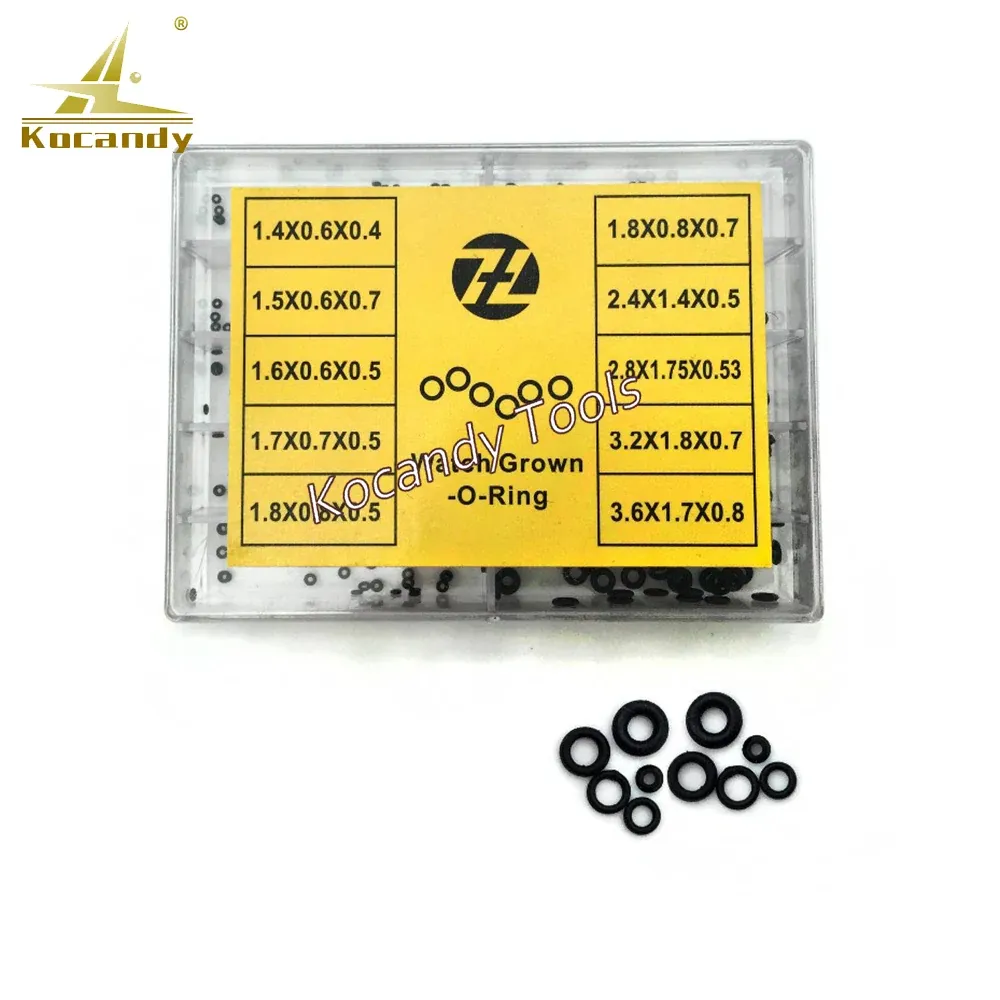
Ten-compartment workshop box of miniature rubber crown O-rings ranging from 1.4 mm to 3.6 mm outer diameters (Model SP0000015).
Measuring the case-back gasket seat with a caliper
Measuring a worn gasket produces misleading figures because aged rubber suffers from compression set and distortion. Reliable sizing requires measuring the machined metal case seat directly using calipers.
Follow these four bench steps to capture case dimensions:
- Clean the Channel: Scrape away dried lubricant and degraded rubber with pegwood; wipe with isopropyl alcohol.
- Measure Inner Diameter: Place caliper inside jaws against the rebate wall. Rotate forty-five degrees to confirm roundness.
- Measure Groove Width: Measure the radial distance between the inner shoulder and outer thread wall.
- Measure Groove Depth: Use the depth probe from rim face to channel base; cross-section should exceed this depth by twenty to thirty percent.
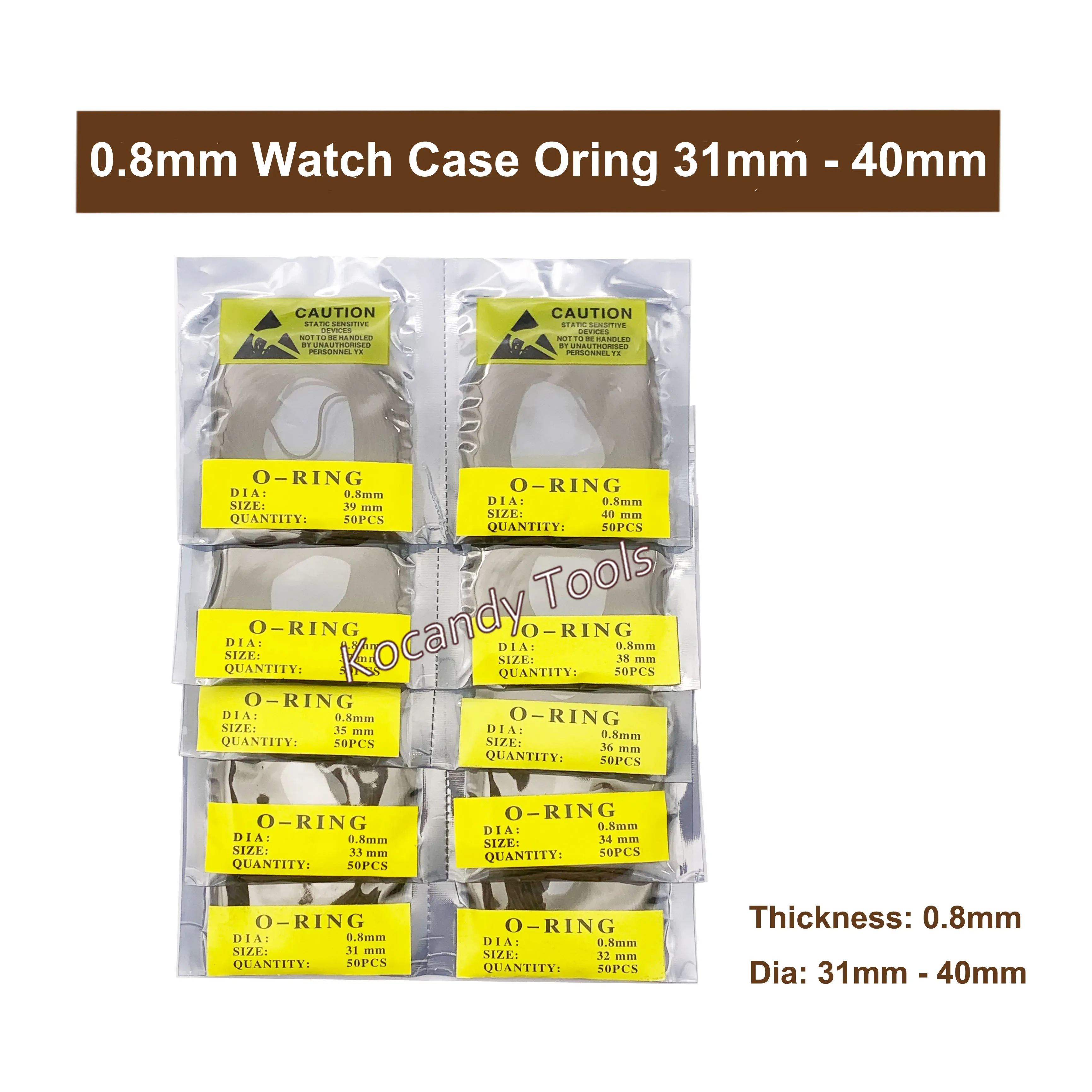
0.8 mm cross-section rubber gaskets spanning 31 mm to 40 mm diameters for larger watch case backs.
Undersized rings and stretch behavior: community bench practices
In watchmaker workshops, technicians frequently select a case-back O-ring whose inside diameter is slightly smaller than the measured seat. For instance, a technician measuring a 30.0 mm seat might choose a 29.0 mm inside diameter ring.
This aids assembly: an O-ring under slight tension grips the pilot shoulder while inverted over the case. An oversized ring puckers or slips into threads, where torque pinches it.
However, stretching represents hedged community craft practice rather than a certified rule. Stretching an elastomer over a larger diameter thins its cross-section through tensile elongation. Stretching a 0.7 mm ring across several millimeters reduces working thickness, compromising sealing compression. Slight stretch of one to two percent is common bench practice, but significant stretching should never substitute for the correct diameter.
Applying silicone sealing grease: preservation and seating
Rubber gaskets must never be installed dry. Dry installation creates rotational friction as the case back turns, causing rubber to twist or tear.
Applying silicone sealing grease solves this problem. Supplied as a Japanese pasty fluid in a Φ2.9 cm by 3.2 cm container (Model WL0005242), it allows the case back to glide over the gasket during tightening without distorting rubber.
Silicone grease also protects rubber from atmospheric drying. Apply a minimal coating between gloved fingers until a light sheen coats the ring, avoiding excess that could migrate toward the movement or dial.
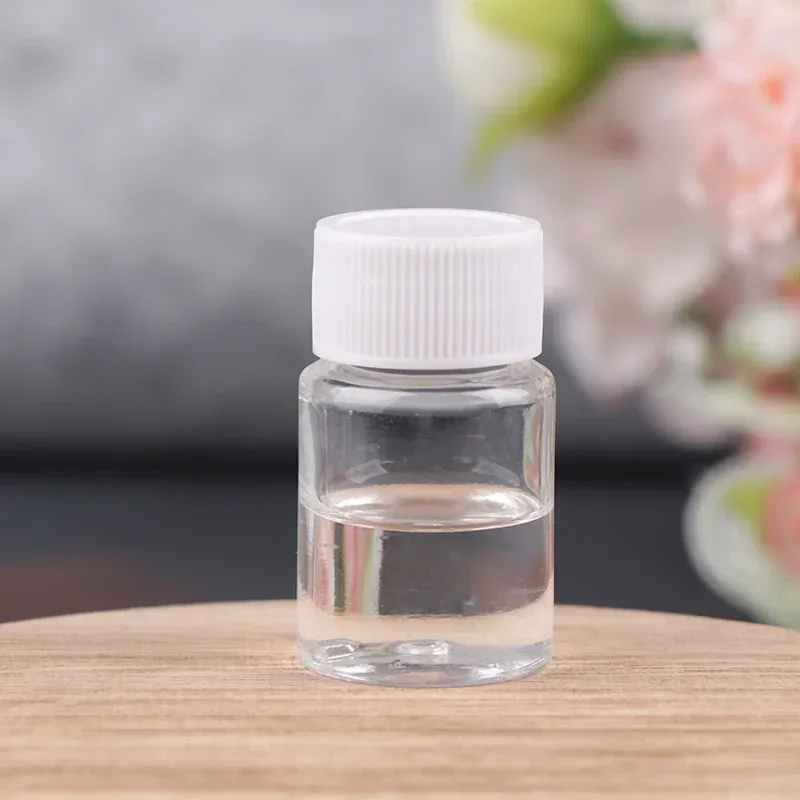
Silicone sealing grease in a Φ2.9 cm by 3.2 cm container for lubricating case-back and crown gaskets (Model WL0005242).
Gasket boundaries: crystal L-gaskets and case-tube seals
Circular rubber O-rings handle case backs and crown posts, but they do not serve every case junction. Understanding these boundaries prevents misapplication.
Watch crystals rely on rigid nylon or plastic L-gaskets pressed into bezels under die force rather than flexible rubber rings. Damaged case tubes require dedicated extractors and replacement pipes rather than loose O-rings.
For servicing crown and stem assemblies, refer to our watch crown stem tube replacement guide. For extracting and installing threaded case pipes, see our watch case tube removal tool guide. When checking stem threading and replacement crowns, consult our watch winding stem thread size guide.
Case-back and crown gasket measurement worksheet
Before submitting an inquiry, record case measurements systematically. Compiling readings into a standardized identifier allows our team to check physical stock directly.
Use the worksheet table below to log your bench dimensions:
Sealing Parameter | What to Measure on the Watch | Your Bench Reading | Catalog Assortment Reference |
|---|---|---|---|
Case-Back Seat Diameter | Inner shoulder or rebate diameter of the case seat | __ . __ mm | 12–30 mm or 31–40 mm assortment |
Case-Back Groove Depth | Depth from case rim face to floor of groove | __ . __ mm | 0.5 mm, 0.6 mm, 0.7 mm, or 0.8 mm cross-section |
Crown-Post Neck Diameter | Outer diameter of the crown post or stem neck | __ . __ mm | 10-size or 12-size crown kit |
Crown Recess Diameter | Internal diameter of crown cap cavity | __ . __ mm | Confirm by message |
Gasket Profile Type | Cross-sectional geometry of the channel | Round toroidal / Flat washer | Confirm by message |
Once measured, your inquiry identifier should read: "case-back seat Ø __ mm, groove depth __ mm" or "crown post Ø __ mm".
Submitting your gasket dimensions for verification
Kocandy is not affiliated with, authorised by, or a dealer for any watch brand (such as Seiko, Rolex, Omega, Citizen, Miyota, ETA, Bergeon, or Horotec). All brand names, calibers, and dimensions across our catalog are cited strictly for identification and comparative reference purposes.
If you are uncertain which cross-section or diameter assortment matches your repair project, submit your measurements directly through our inquiry desk:
We reply within one working day. If your size, cross-section, or case reference is not listed anywhere above, send it anyway — we check against the catalog to locate matching stock or workshop alternatives.