Oct 12, 2026Buying Guides
Watch Hand Removal and Setting Tools Guide: Levers, Pullers, Pushers, and Dial Protection
Levers, plunger pullers, pushers and dial shims: what each hand tool does, the stated sizes our catalog lists, and the measurements to check before you order.

Setting up a workbench for watch hand servicing begins before touching any pinion. After you open the case first and secure the uncased caliber to support the movement while you work, the dial face becomes exposed. Hand removal and setting carry high cosmetic risk: a slipped blade or uneven pusher stroke can mar dial lacquer, shear a seconds pivot, or ruin delicate hands.
Matching tip geometry and mechanical leverage to the hand collet and dial clearance ensures damage-free operations across levers, pullers, pushers, and dial shims.
Watch Hand Removal Tools vs Pushers: How Lever and Plunger Types Differ
Hand servicing involves two opposing mechanical operations: removal and installation. Removal tools lift the friction-fitted hand pipe away from its center pinion or arbor. Hand pushers apply controlled downward axial pressure to seat hand collets squarely onto their pivots without canting or marring the polished boss.
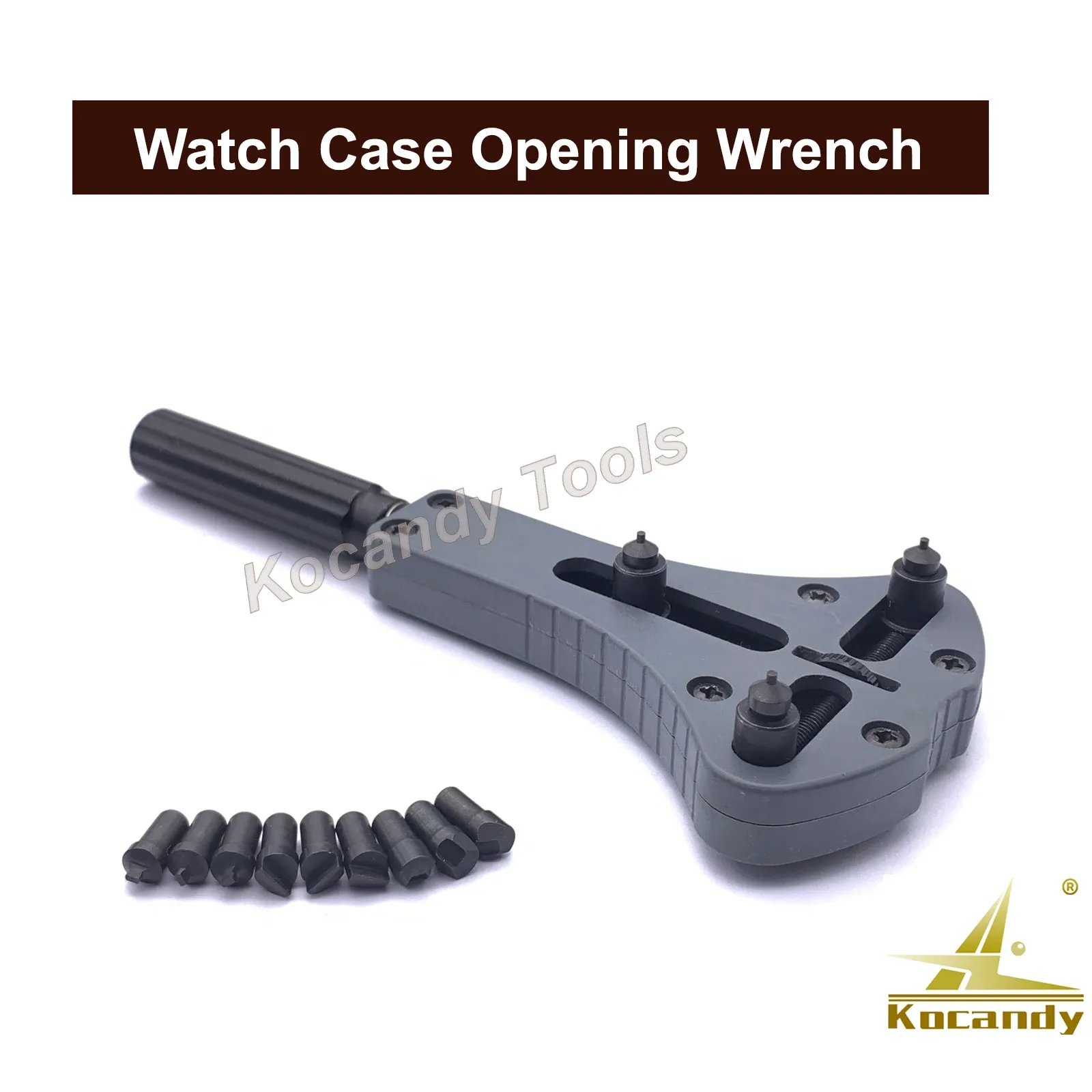
For removal, watchmakers use two tool types: levers and plunger pullers. Hand levers work in opposing pairs, sliding wedge-shaped blades beneath the collet from opposite sides to deliver balanced upward prying leverage. Plunger pullers, commonly modeled on the Presto design, use spring-loaded jaws that close under the collet while a central pin braces against the center arbor, lifting hands straight upward.
Pushers feature hollow cylindrical tips in synthetic material or steel that clear the central arbor while pressing the hand collet flat. Using inappropriate tools—such as tweezers for seating or a single screwdriver for lifting—risks scratched dials and bent pinions.
Why Dial Protection Shims and Support Pads Come Before Tool Force
Metal tool tips must never contact an unprotected dial. Even polished lever heels exert concentrated fulcrum pressure that indents paint, burnishes sunburst textures, or chips enamel. A non-marring barrier between dial and tool heel is essential.
Slotted dial protector shims in thin synthetic plastic slide over the cannon pinion, spreading fulcrum pressure while leaving hand collets accessible. When an hour hand sits flush against the dial, forcing a shim risks scraping the surface. In tight assemblies, watchmakers micro-lift the dial: loosening the movement dial-foot screws slightly allows the dial to shift forward a fraction of a millimeter, creating clearance for a protective shim and thin lever tips.
After separating the dial from the movement, resting it flat on a bench risks bending fragile dial feet. A dedicated dial support pad with perforated holes supports the dial body while letting dial feet hang freely without deflection.
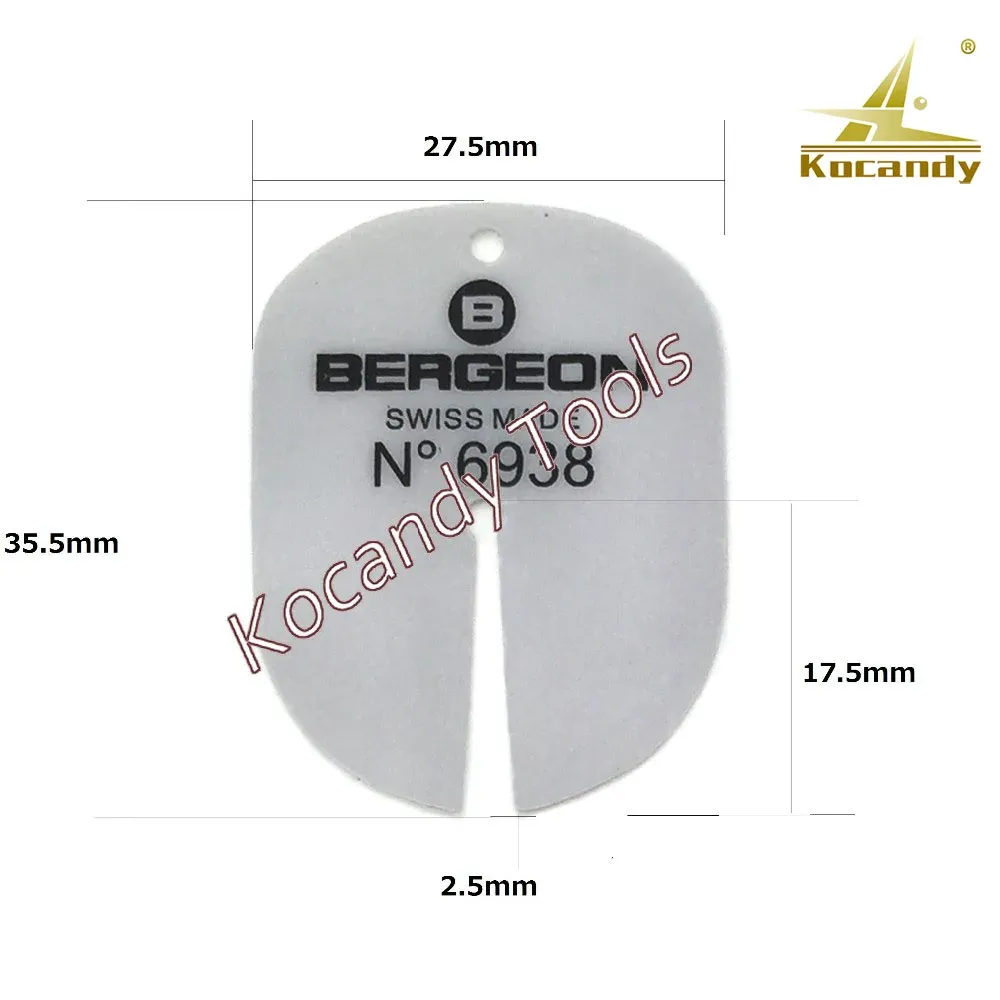
Dial-protector shim with 35.5 mm outer span and 2.3 mm slot width, model RH00000093.
Hand Removal and Setting Tool Types Compared
Selecting the right tool style depends on hand clearance, collet diameter, and caliber architecture. Table A outlines the primary tool categories and their bench roles.
Tool type | What it does | Typical use | Catalog example |
|---|---|---|---|
Dual hand levers | Lifts hand collets upward from opposite sides using balanced fulcrum prying | Subdial hands, tight clearance hour hands, and vintage calibers | 5-pair collet lever sets |
Plunger-style puller | Squeezes opposed jaws under collet while central plunger steadies arbor | Center hour, minute, and second hands removed in one vertical pull | Presto plunger puller |
Hand setting pushers | Applies vertical downward pressure to drive hand pipes onto pinions | Installing replacement hands flat without cocking or marring collet | Hand pusher set in wooden box |
2-in-1 pry and press tool | Combines prying blade on one end with hollow press fitting tip on opposite end | Portable service kits, universal casing work, and quick hand adjustments | Dual-ended pry and press tool |
Dial protector shims & pads | Shields dial finish from lever fulcrum pressure and protects dial feet | Surface protection during hand lifting and safe uncased dial handling | 6938 shims and 7153 work pad |
Lever-Type Removers: Collet Levers, Stated Tip Widths, and Stand Sets
Lever-type removers are precision prying blades used strictly in opposing pairs. Prying with one lever applies asymmetric force, tilting the collet, ovalizing the pipe, or snapping the arbor. Inserting matching levers 180 degrees apart lifts the hand straight along its axis.
If a hand bends during removal, bench practice dictates replacement over straightening. Straightened hands suffer from weakened collets and microscopic tilt, causing them to drag across dial markers.
Our catalog provides several lever configurations. The gold-handled collet lever set includes 5 pairs (10 pieces) with stated tip widths of 3.75 mm, 3.0 mm, 2.5 mm, 2.0 mm, and 1.85 mm. The red-handled 5-pair variant lists stated tip widths of 9.0 mm, 3.3 mm, 2.7 mm, 2.1 mm, and 1.4 mm in catalog text (with photo markings showing narrower sizing; confirm before ordering).
For bench storage, the 10-piece lever set with metal standing base provides five pairs of 12 cm stainless steel levers with knurled grips and rotating heads, stored on an included metal rack.
Plunger-Type Pullers: Presto Action, Vertical Lift, and Alloy Sets
Plunger-type removers provide vertical lifting favored for center-hand assemblies. Presto-style pullers operate through spring-loaded side arms connected to opposing jaws that close beneath the lowest hand collet.
A central plunger with a fiber tip presses against the center pinion arbor. As compression continues, the jaws lift upward against the post, drawing hour and minute hands off together in a vertical motion without dial contact.
Our catalog includes a stainless steel Presto plunger puller measuring 8 cm high by 2 cm wide, equipped with fiber tips to protect pinions and dials. The premium aluminium alloy puller set features forged, quenched alloy construction with shovel-style handles and an acrylic storage box.

Presto-style plunger hand remover with spring-loaded side jaws and fiber pusher tip.
Dual-Ended Tools and Combination Lever-and-Pusher Sets
Hand setting demands vertical alignment. If a replacement hand is pressed home at an angle, the collet reams loose or binds against the arbor, causing hand tips to scrape the dial or crystal. Hand pushers feature hollow tips that clear center arbors while pressing squarely on collet shoulders.
The 5-pairs hand removal and pusher tool set in a wooden storage box pairs five pairs of 316 stainless steel levers (with finely polished 0.15 mm thin blades) with ten pusher tips covering stated diameters from 0.6 mm to 2.0 mm (with upper range noted up to 2.6 mm). The levers are catalogued for specific calibers, from subdial hands to men's dress movements.
For mobile work, the 2-in-1 dual-ended tool measures 10.5 cm in aluminium alloy and stainless steel, combining a curved prying lifter at one end and a hollow press fitter at the other, with stated press hole diameters of 1.0 mm and 1.3 mm.
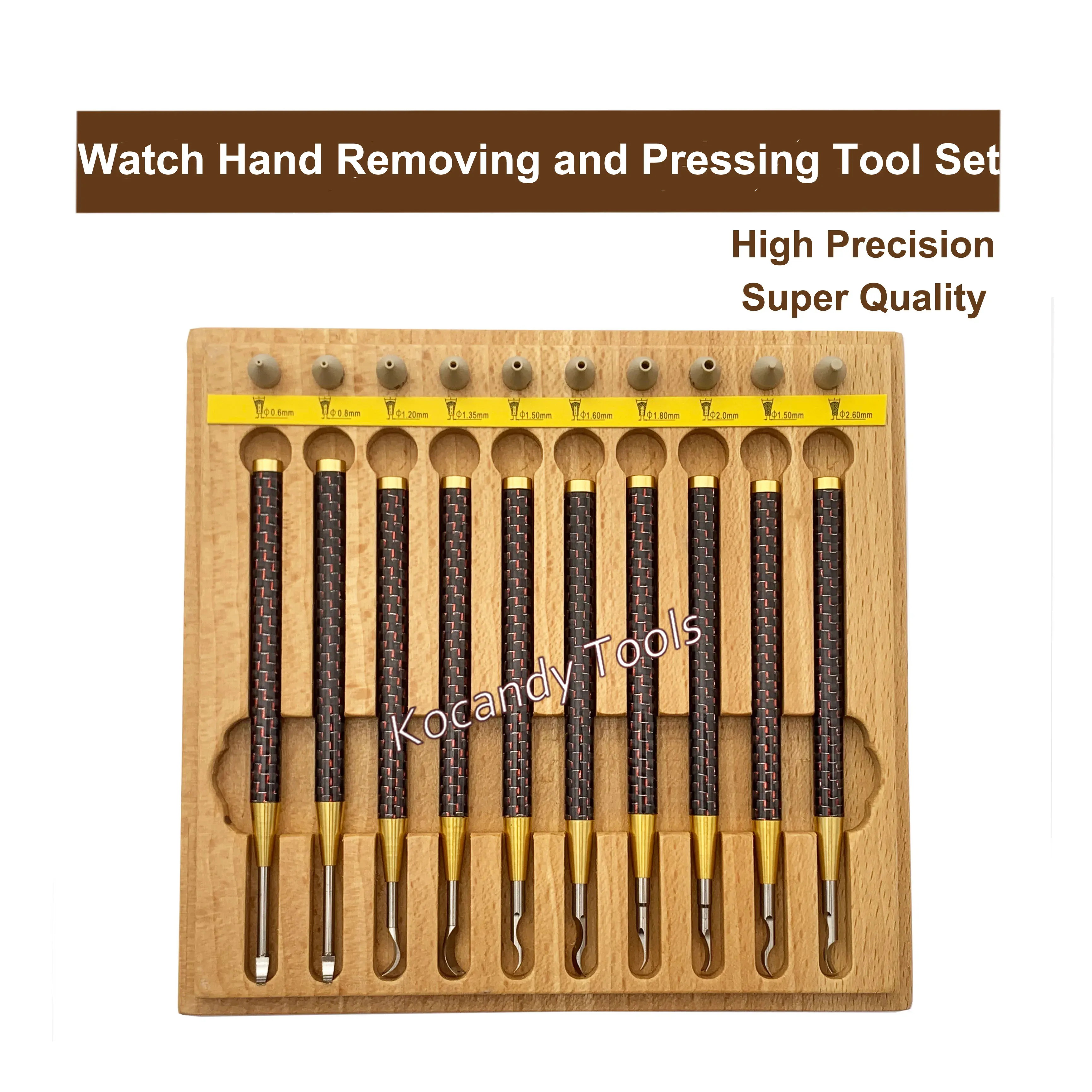
Five-pair lever remover and ten-pusher set in a fitted wooden storage box.
Dial Protection Shims and Base Support Pads in the Kocandy Catalog
The 6938 dial-protector shims our catalog lists (model RH00000093) arrive as a 5-piece synthetic plastic set. Each shim measures 35.5 mm across with a 2.3 mm central slot that slides around cannon pinions, providing a smooth bearing surface that shields dial lacquer from lever heels.
For uncased dials, the model 7153 dial base support pad measures 60 mm in diameter and 8 mm thick. Its perforated synthetic surface receives dial feet in varied patterns, holding the dial flat and stable during inspection while preventing bent feet.

Model 7153 dial base support pad with 60 mm diameter and 8 mm thickness.
Catalog Hand Tools and Dial Protection Specification Reference
Table B summarizes technical specifications, materials, packaging, and catalog links for hand tools and dial protection items in our scope.
Product | Stated type / size | Stated material | Pack | Product link |
|---|---|---|---|---|
6938 Dial Protector Shims (RH00000093) | 35.5 mm span, 2.3 mm slot | Plastic / synthetic | 5 pcs per pack | |
7153 Dial Base Support Work Pad | ∅ 60 mm, E 8 mm | Synthetic material | 1 pc | |
Gold-Handled Collet Levers (5 Pairs) | Tip widths 3.75, 3.0, 2.5, 2.0, 1.85 mm | Steel blade | 10 pcs (5 pairs) | |
Red-Handled Collet Levers (5 Pairs) | Tip widths 9.0, 3.3, 2.7, 2.1, 1.4 mm | Steel blade | 10 pcs (5 pairs) | |
Aluminium Alloy Hand Puller Set | Tip sizes Confirm by message | Aluminium alloy | 5 pairs in acrylic box | |
Hand Removal & Pusher Set with Wooden Box | Blade 0.15 mm; pushers 0.6–2.0 mm | 316 Stainless steel | 10 levers + 10 pushers | |
10-Piece Hand Lever Set with Metal Base | Length 12 cm; tips Confirm by message | Stainless steel | 10 levers, 1 base, 1 box | |
Presto Plunger Puller | 8 cm height, 2 cm width; fiber tips | Stainless steel | 1 pc | |
2-in-1 Dual-Ended Pry & Press Tool | Length 10.5 cm; press holes 1.0 & 1.3 mm | Stainless steel & aluminium | 2 pcs |
Matching Tool Tip Geometry to Hand Collets and Movement Calibers
Selecting hand tools requires matching tip geometry to hand collet dimensions. Hour and minute hands on automatic calibers seat over thick cannon pinions, requiring wide lever blades or standard puller jaws. Chronograph subdial hands and small seconds pointers possess miniature pipes in recessed registers, demanding narrow tips.
The 5-pairs wooden box set outlines stated caliber associations for its lever sizes:
- 1.9 mm x 0.41 mm: Stated for timer hour and second hands on calibers 7750, 3313, and 4130.
- 3.8 mm x 2.0 mm: Stated for hour, minute, and date hands on calibers 7750 and 7751.
- 3.2 mm x 1.5 mm: Stated for men's watch hands on calibers 2894, 3135, and 8500.
- 2.5 mm x 1.2 mm: Stated for women's watch hands on calibers 2000, 2235, and 2671.
- 2.7 mm flat width: Stated for universal watch hands.
Because hands vary between factory and aftermarket assemblies, physical measurement is the safest approach. Friction-fit hands must be matched to pushers whose internal hole clears the arbor while bearing squarely on the collet.
Measurements to Collect Before Ordering Hand Tools
Before ordering hand tools, checking movement dimensions ensures proper blade and pusher sizing. Table C outlines parameters to verify with calipers or datasheets.
Parameter | How to get it | Your value |
|---|---|---|
Movement caliber reference | Read caliber stamp on movement bridge or under balance | __ (stamp) |
Hand configuration | Count main hands and chronograph or subdial registers | __ main / __ subdial |
Hand collet outside diameter | Measure hand boss with fine caliper jaws | __ mm |
Pinion / arbor outer diameter | Measure cannon pinion and second arbor from datasheet | __ mm |
Dial clearance under lowest hand | Measure gap between hour hand and dial with feeler gauge | __ mm |
Preferred tool architecture | Select lever pair, Presto puller, pusher set, or 2-in-1 | Lever pair / Presto puller / Pusher set / 2-in-1 |
Brand Disclaimers and Direct Catalog Sizing Support
Kocandy is an independent supplier of watchmaker tools and parts, not affiliated with, authorised by, or a dealer for any brand mentioned, including ETA, Valjoux, Rolex, Omega, Bergeon, Horotec, Seiko, Citizen, Breitling, Panerai, Hublot, or Vetus. All caliber codes and model designations cited represent stated-for compatibility references only.
If your movement caliber, subdial layout, or hand collet dimensions are not listed above, contact us through the Kocandy contact page. We reply within one working day. Send your caliber number, hand pipe measurements, or dial clearance anyway—we check customer measurements directly against our catalog stock to confirm matching tools, pushers, and dial shims before you order.