Oct 11, 2026Repair Tutorials
Stuck Watch Case Back Removal Guide: How to Loosen and Open Stubborn Case Backs
A stuck case back is a diagnosis, not a verdict. Identify screw-down, snap-back or fluted first, then work through grip options - built from our catalog openers and stated ranges.
Stuck Watch Case Back: Identify the Case Construction First
A watch case back that refuses to move is a common bench problem. Applying force without verifying retention leads to slipped prongs and gouged metal. Watch cases generally fall into three categories: screw-down threaded backs, snap-on press-fit backs, and specialized backs secured by proprietary fluted rings or casing screws.
A screw-down case back displays perimeter indentations—often six notches spaced around the rim—to seat an adjustable wrench. In contrast, a snap-on back sits flush with no perimeter notches, relying on a small pry lip along the rim. Specialized backs use fine exterior knurling requiring dedicated dies. Prying against a threaded back bends lugs and distorts mating surfaces, while twisting a snap-back scores the finish. Inspect the perimeter seam under a loupe before selecting an opener.
Screw-Down Case Backs: Downward Force, Alignment, and Notch Engagement
Threaded case backs tighten over time through dried rubber gaskets, grime accumulation, or past over-torquing. When using an adjustable wrench, the primary cause of slipped prongs is insufficient downward pressure. Twisting before the tool is fully seated causes steel tips to climb out of shallow notches and skate across the case back.
Mount the watch in a padded case holder resting flat on a non-slip bench mat. Adjust wrench pins so each tip sits dead center in its notch with zero lateral play. Direct roughly eighty percent of effort downward into the case back and twenty percent into counter-clockwise rotation. This downward bias keeps pins trapped in notch walls until thread friction breaks. If the tool begins to lean, stop immediately; tilting lifts opposing pins and causes slips.
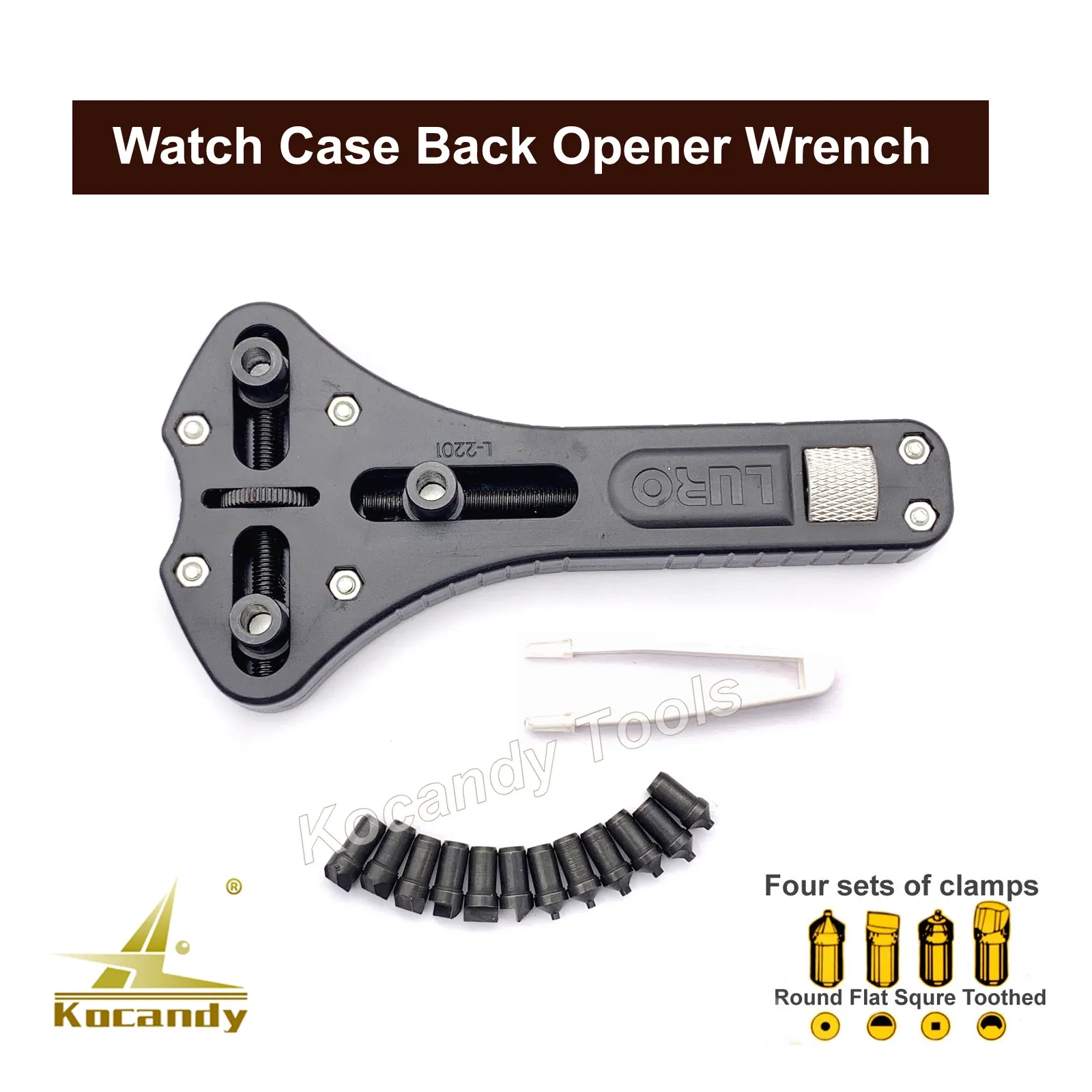
Three-point wrench listed for 18mm to 62mm case backs, model WWBK-RH-B-0001.
Stubborn Screw-Down Cases: Forum-Documented Escalation Methods
When steady downward pressure fails to break the thread seal, forcing the wrench risks shearing notches or bending pins. Independent watch repair communities document several non-destructive escalation techniques to release frozen threads.
One community method is applying a minimal droplet of penetrating oil along the perimeter seam. Allowing fluid to wick into the threads over several hours helps dissolve dried lubricant and light corrosion. Practical cautions apply: penetrating solvents can degrade rubber O-rings, craze acrylic crystals, and contaminate movements. Apply a single microscopic droplet with a fine needle, keep the watch face-down on a pad, and wipe away all external residue before reattempting removal.
A second approach uses gentle warmth. Because the outer case expands faster than the threaded back, mild heat can relieve thread tension. Repairers warm the case perimeter with a low-temperature hair dryer or warm cloth. Avoid open flames or heat guns, which bake lubricants, melt plastic movement spacers, or damage dial lacquers.
Grip aids offer an intermediate step. Placing latex sheeting or high-tack tape between the case back and opener increases friction and prevents slip. Alternatively, a silicone suction tool or sticky rubber friction ball exerts rotational grip across the back plate without scratching metal.
When standard tools fail on corroded threads, bench discussions frequently describe the cyanoacrylate adhesive-aid method. A steel hex nut is bonded to the stubborn case back with cyanoacrylate (super glue). Once cured, a socket wrench placed over the nut provides perpendicular leverage without notch slip. After unthreading, the case back is soaked in acetone to dissolve the adhesive. Practical cautions apply: work over a bench tray, keep acetone away from movements, and protect plastic spacers, dials, and acrylic crystals.
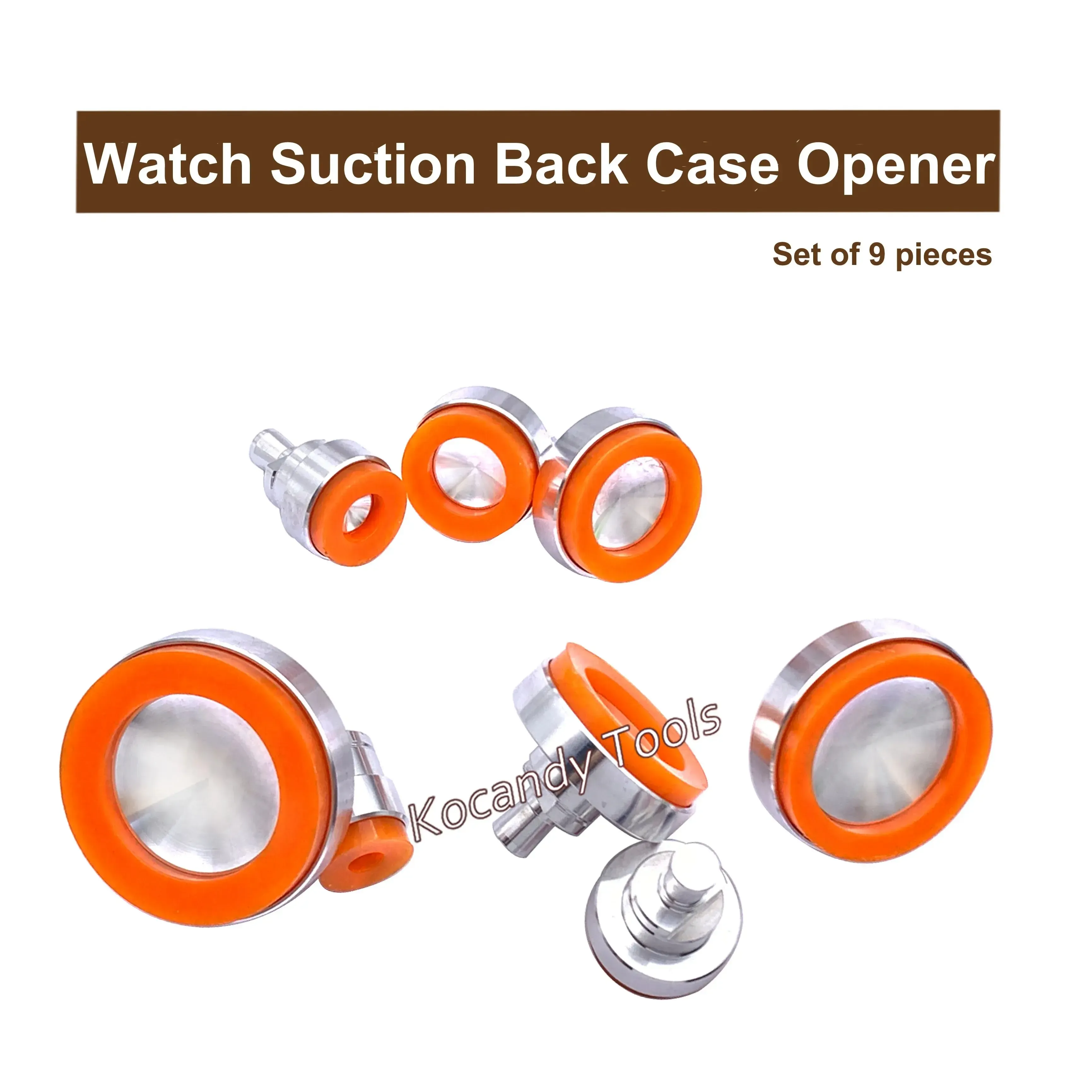
Suction case opener set with eight silicone dies covering 16mm to 45mm diameters.
Snap-Back Cases: Knife Blade Seating, Leverage, and Rim Protection
Snap-on case backs rely on friction and an interference fit between the case back flange and the mid-case. Resistance usually stems from a compressed, hardened gasket or tight manufacturing tolerances leaving minimal clearance.
Locate the designated pry tab using a loupe. Never drive a case knife into random points along the rim, which crushes the case lip. Protect lugs and polished bevels with plastic film or tape before positioning the blade. Seat the beveled edge of a rigid knife firmly into the notch, applying firm inward pressure while levering downward rather than twisting.
For snap-backs lacking a discernible notch, forum discussions describe starting the seam with a single-edge razor blade. The ultra-thin bevel slips into hairline gaps where standard knives cannot seat. Tapping the blade gently with a wooden peg creates slight clearance, allowing a sturdier case knife to complete the lift. This requires extreme care: razor blades are brittle, shatter easily under lateral force, and pose a cut hazard. Work over a bench tray with finger protection.
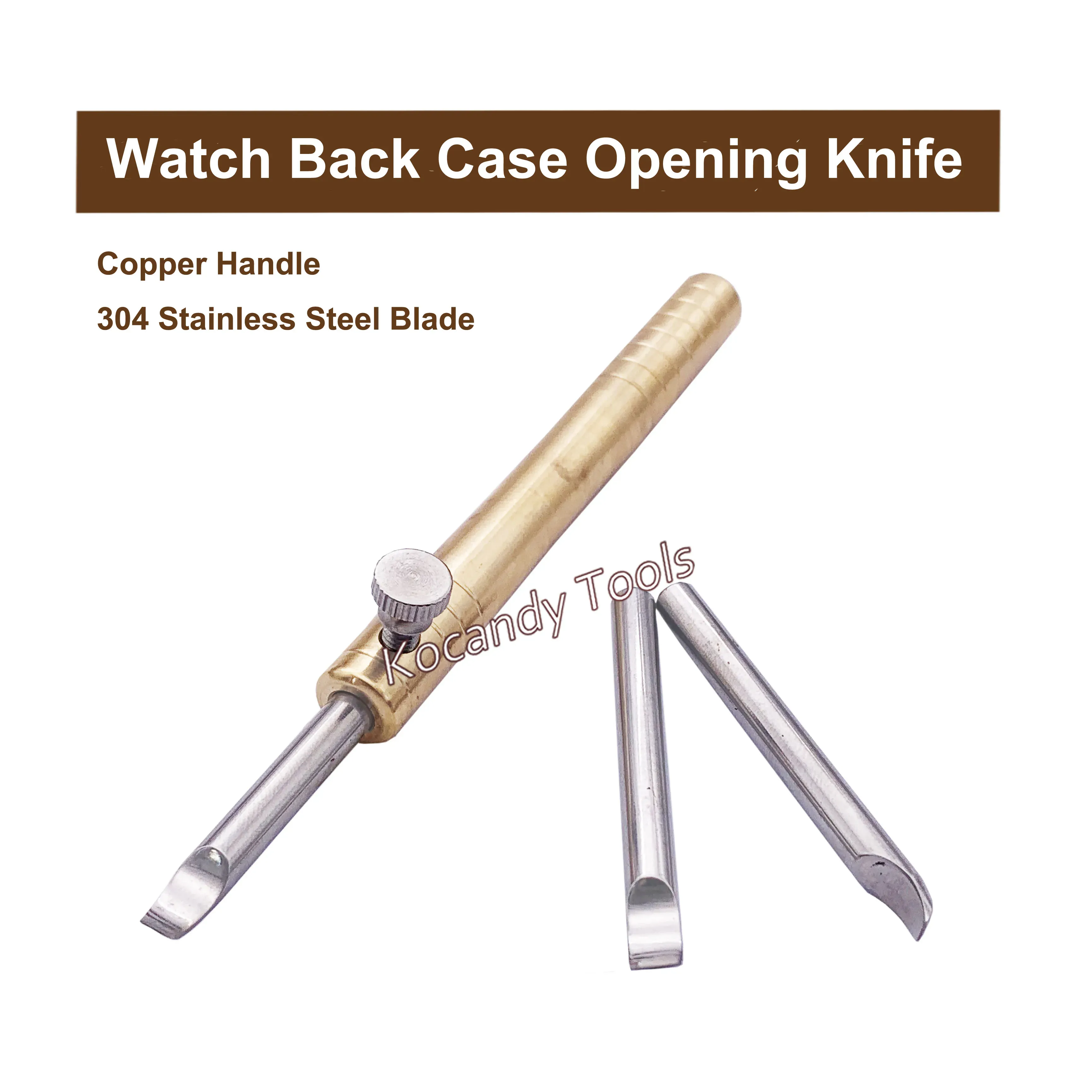
Case knife with interchangeable 3mm, 4mm, and 5mm stainless steel blades.
Specialized Fluted Backs and Proprietary Case Dies
Not all screw-down case backs feature perimeter notches. Many luxury and tool watches use finely fluted or polygonal backs that offer no purchase for Jaxa pins. Forcing an adjustable wrench across delicate milled fluting strips ridges and scars the case.
These specialized designs require dedicated dies machined to mesh with the specific tooth count and profile of the case back rim. Alternatively, heavy bench-mounted openers deliver non-marring torque. If deciding which platform to add to your bench, consult our guide on choosing between Jaxa, friction ball and knife openers to evaluate tool families before purchasing.
Matching Opener Types to Case-Back Styles
Selecting the correct opener requires matching the tool's mechanical interface to the physical geometry of the watch case. The summary below illustrates which opener mechanisms pair with common case-back designs found on the workbench.
Case-back type | How it opens | Opener type | Catalog examples |
|---|---|---|---|
Threaded with perimeter notches | Counter-clockwise rotation | Three-point adjustable wrench or two-pin parallel opener | |
Threaded without notches or delicate vintage | Surface friction rotation | Rubber friction ball or silicone suction dies | |
Snap-on / press-fit with pry lip | Levered wedge lift | Handheld case knife or bench press opener |
Opener Tools in Our Catalog and Stated Working Ranges
The Kocandy catalog supplies multiple case-opening tools spanning adjustable wrenches, rolling-ball levers, suction die sets, and opening knives. When choosing a tool, pay close attention to stated physical spans rather than assuming universal fit.
Our catalog includes distinct Jaxa-style variants with differing specifications. The standard Jaxa wrench (model WWBK-RH-B-0001) is stated for 18mm to 62mm cases with twelve dies, while our large Jaxa XL wrench lists a 16.5cm length for broader cases. Dual-ball openers also vary: the compact double rolling balls opener (model SP000023923) lists 27mm and 37mm maximum dimensions, whereas the long-style version lists 35mm. For snap-backs, the 3-in-1 knife provides interchangeable 3mm, 4mm, and 5mm blades.
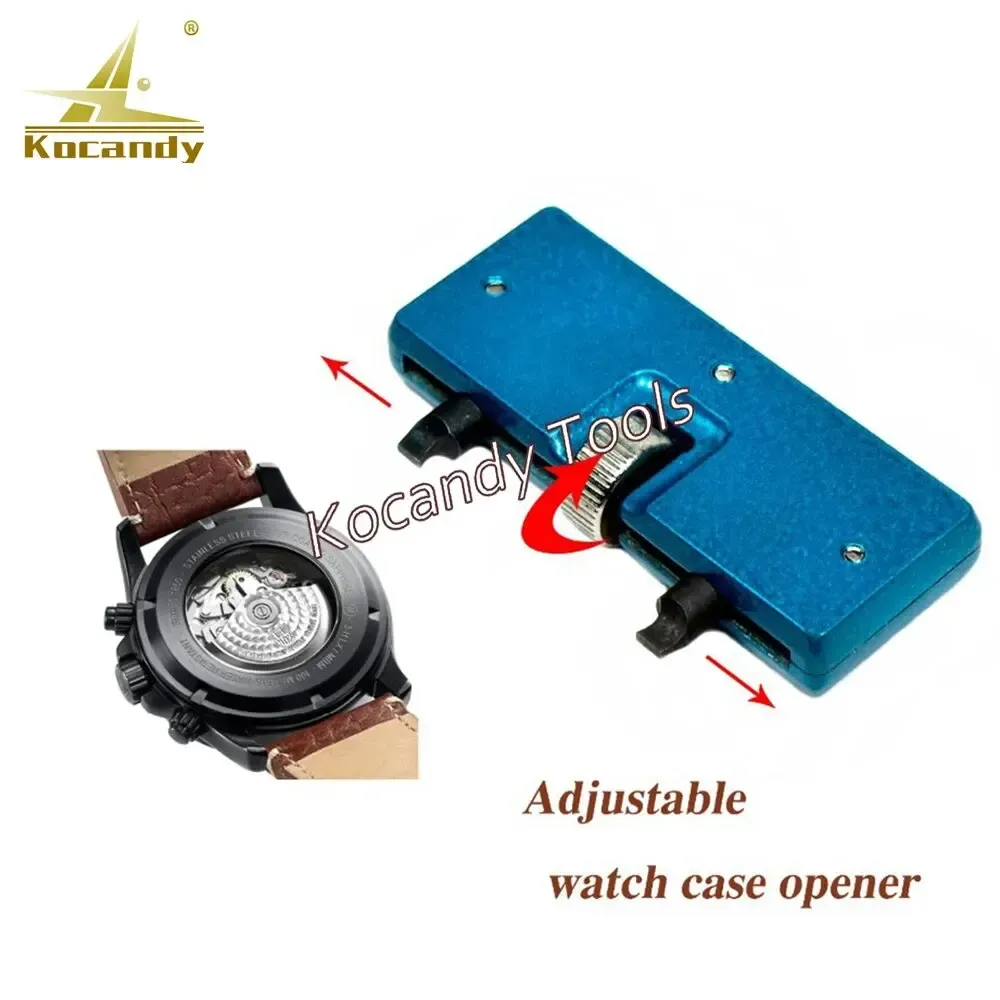
Two-pin rectangular opener with adjustable jaw spacing stated up to 55mm.
Product | Stated size range | Grip principle | Product link |
|---|---|---|---|
Jaxa Wrench (Model WWBK-RH-B-0001) | Stated 18mm to 62mm | Three-point notch engagement with 12 dies | |
Jaxa XL Wrench (16.5cm) | Stated 16.5cm length; jaw span Confirm by message | Three-point notch engagement with 12 dies for wide cases | |
Rectangular Screw Opener (SP0000423) | Stated 8mm to 55mm (title states 10mm–55mm) | Two-point parallel screw jaw engagement | |
Rubber Friction Ball | Listed diameter 7.1 (dimension unconfirmed; Confirm by message) | Non-marking rubber friction grip | |
Suction Opener Kit with 8 Dies | Stated 16mm, 20mm, 23mm, 26mm, 30mm, 34mm, 40mm, 45mm | Non-marking silicone suction grip with rotary handle | |
Double Rolling Balls Opener (SP000023923) | Stated max 27mm & 37mm | Rolling dual-ball screw thread contact | |
Long Double Rolling Balls Opener | Stated max 35mm (image marks max 32mm) | Extended dual-ball contact for screw cases | |
3-in-1 Case Knife Set | Stated 3mm, 4mm, 5mm blade widths | Pry blade leverage at rim lip |
After the Case Opens: Gasket Inspection and Thread Cleaning
Once a frozen case back breaks loose, unscrew it slowly and inspect the gasket immediately. A stuck back is frequently caused by an aged rubber gasket that has degraded into sticky residue bonding the threads together.
Clean the threads and case recess using pegwood and isopropyl alcohol to remove dried lubricant, corrosion, and degraded rubber before reassembly. Never reinstall a flattened or hardened ring. Always replace the case-back gasket while you are in there to maintain dust and moisture resistance, applying silicone grease to prevent thread binding in future servicing.
Closing and Re-Sealing: When a Case Press Is Required
Threaded case backs thread smoothly by hand once cleaned and lubricated, requiring only final snugging with an adjustable wrench. Snap-on backs present the opposite challenge: snapping them back into place demands significant, evenly distributed compressive force.
Never force a snap-back closed using thumb pressure or unpadded pliers, which can crack crystals or warp case backs. Snap-on backs require even compression, so press it closed again with the right die rather than using thumb pressure. Support the watch crystal with a concave die and press squarely until the back clicks fully home.
What to Measure Before Sending Us Your Case Identifier
When a case back will not move and you need sizing assistance, gathering key measurements allows our team to check catalog inventory for compatible tool profiles. Record your measurements before messaging us.
What to note | How to get it | Your value |
|---|---|---|
Case-back style | Visual check: perimeter notches, pry lip, polygonal flats, or smooth rim | Screw-down / Snap-on / Fluted |
Outer case diameter | Caliper across case excluding crown | __ mm |
Notch count and spacing | Count notches (commonly 6) and measure distance between opposite notch centers | __ notches / __ mm span |
Pry lip position (snap backs) | Examine rim with loupe under lugs or at 9 o'clock | Identified position / None visible |
Previous opening attempts | List tools and methods already applied | Friction ball / Jaxa wrench / Solvent / Heat |
Brand Disclaimer and Kocandy Sizing Support
Kocandy is not affiliated with, authorised by, or a dealer for any watch brand (Seiko, Rolex, Omega, Citizen, Miyota, ETA, Bergeon, Horotec, Vetus, Richard Mille, Hublot, or others). Product compatibility descriptions indicate only that an item is listed for or stated as suited to specific case types and dimensions.
If your case dimensions, notch pattern, or required die size are not listed in the tables above, contact us through our contact page. We reply within one working day. Send your measurements, case-back style, and photos of the case rim, and our team will verify compatible openers and replacement parts directly against our warehouse catalog.