Oct 27, 2026Repair Tutorials
Watch Quartz Movement Tester Guide: What Bench Readings Mean and What to Order Next
A stopped quartz watch is not a verdict: a tester separates battery faults from circuit faults in seconds. What pulse and battery testing show, QD-10 vs QD-20, and what to order next.
When a quartz watch halts on the workbench, guessing between an exhausted battery, a damaged circuit, and a blocked gear train wastes workshop time. Bench testers separate electrical faults from mechanical resistance in seconds and tell you whether an inexpensive button cell, a rechargeable capacitor, or a replacement movement solves the problem.
Watch battery testers: what quartz bench instruments measure and what they do not
Watch battery testers and quartz movement analyzers occupy a specialized place on the repair bench. Unlike acoustic instruments designed for mechanical escapements, quartz testers evaluate electrical power and electromagnetic rotor impulses. Readings showing 21,600 beat, lift angle 52.0°, rate +0.08 s/d, amplitude 284°, and beat error 0.1 ms represent an example of a mechanical-instrument reading, which is outside what QD testers measure because mechanical timegraphers form a distinct acoustic instrument class that our catalog does not cover.
Quartz testers focus strictly on the operational boundaries of battery-driven calibers. An entry-level bench unit like the QD-10 quartz movement analyzer checks whether a power cell maintains adequate electrical potential under load and senses whether the quartz circuit board pulses the stepper motor coil. These instruments do not listen for pallets striking escape teeth; they monitor electromagnetic fields, circuit continuity, and power supply stability.
Battery voltage testing versus pulse testing: two distinct diagnostic jobs
Diagnosing a non-running quartz watch involves two distinct measurements: checking available chemical energy and verifying circuit impulse generation. Confusing these two functions leads to incorrect repair assumptions.
A battery voltage test verifies the electrical potential across coin cell terminals. A fresh 1.55-volt silver oxide cell should maintain steady voltage above minimum operating thresholds. When measured out of circuit or against dedicated test pads, an exhausted cell drops below operational limits, depriving the movement of energy.
Conversely, a pulse test inspects the movement's electronic module and stepper motor coil. A quartz crystal vibrates at 32,768 Hz when energized. The integrated circuit divides this frequency into a single electrical pulse per second (or fractional steps on quartz chronographs) sent to the stator coil. The tester's inductive sensor detects this electromagnetic pulse. A detected pulse confirms that the battery, crystal oscillator, and integrated circuit function correctly, even if the watch hands remain motionless.
Triage flow for a stopped quartz watch: checking the power cell first
Systematic bench triage prevents unnecessary movement disassembly. When an analog or digital quartz watch stops, follow a logical elimination sequence:
First, inspect the case and movement under magnification. Check for battery leakage, salt corrosion, displaced insulator films, or misaligned battery clamp springs. Ensure that terminal contacts are free of tarnish and dried oil.
Second, extract the button cell with non-magnetic, plastic-tipped tweezers. Placing metal tweezers across positive and negative surfaces short-circuits the cell, draining capacity instantly. Place the cell onto the battery testing plate of your bench analyzer.
If the battery registers below normal operating limits, install a fresh replacement cell of the designated size. If the replacement cell restores normal second hand progression, the repair is complete. If the fresh cell fails to start the movement, proceed immediately to electronic pulse detection.
When the battery passes: detecting the electronic coil pulse
When a confirmed fresh power cell fails to move the gear train, watchmakers position the uncased watch or movement directly over the inductive sensor pad of their tester.
If the instrument emits an audible beep or flashes its pulse indicator LED at regular one-second intervals, the quartz electronic module is operational. The integrated circuit delivers driving pulses to the drive coil, proving that the electronic sub-assembly is intact. In this scenario, the stoppage is mechanical. Microscopic debris, degraded lubrication, dried grease in the center wheel post, or a magnetic chip lodged in the rotor pinion prevents the stator from turning the train.
If the tester registers no electromagnetic pulse whatsoever, the electrical path is broken. This symptom suggests a severed coil wire, fractured circuit trace, degraded quartz crystal, or oxidized battery contact tabs inside the movement plate.
Comparing bench testers: QD-10 analyzer versus QD-20 instrument
Kocandy catalog inventory includes two dedicated quartz movement testing instruments: the portable QD-10 unit and the expanded QD-20 bench machine. Both units serve workshop inspection roles but offer distinct housing layouts and stated measurement functions.
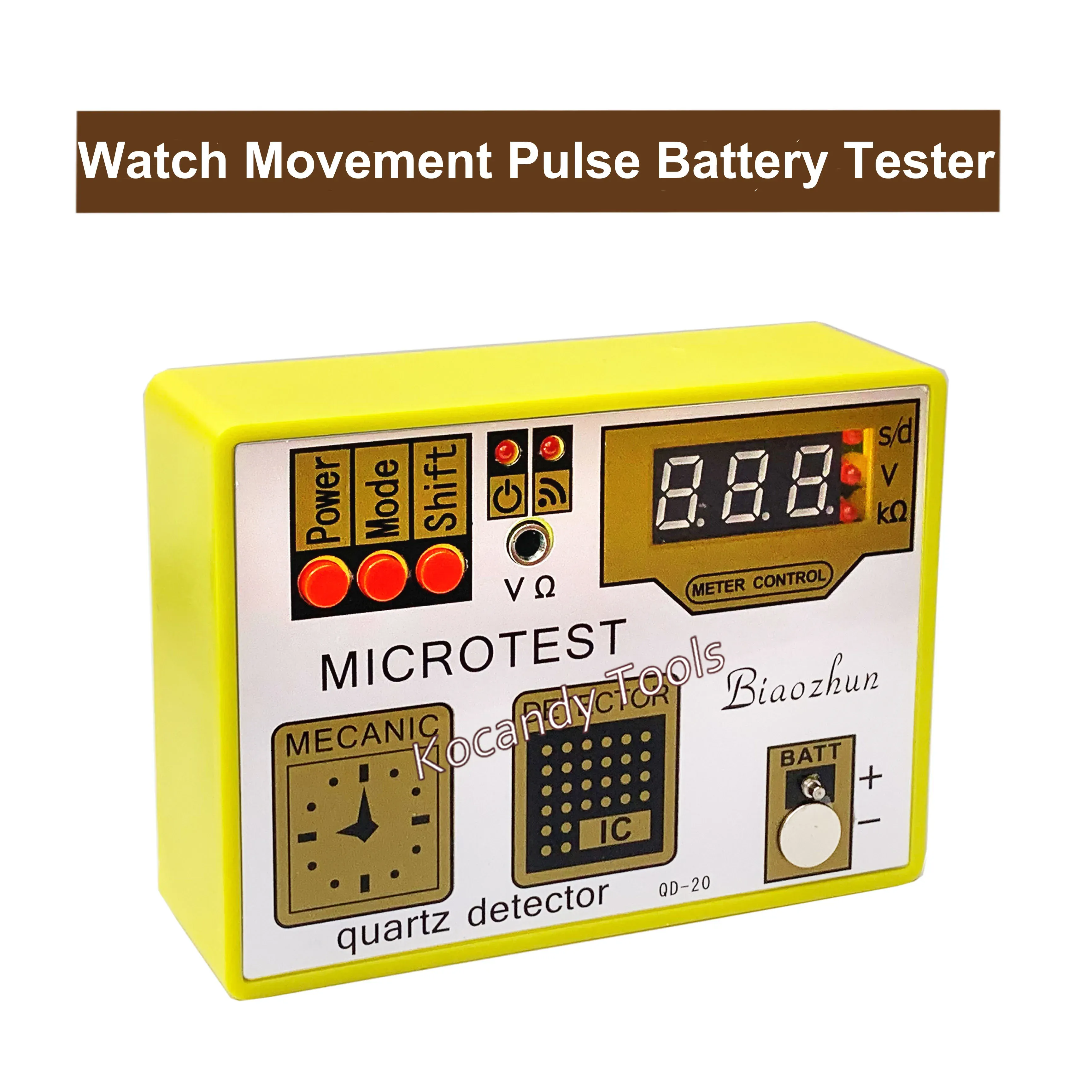
Compact QD-20 quartz movement tester measuring 10.8 x 8 x 3.1 cm with digital readout and test terminals.
The QD-20 movement tester and pulse checker integrates a digital readout, dual control dials, probe leads, and dedicated battery terminals. Stated features include battery measurement, pulse checking, error measurement, movement demagnetization, and an integrated second function stated for measuring daily accuracy.
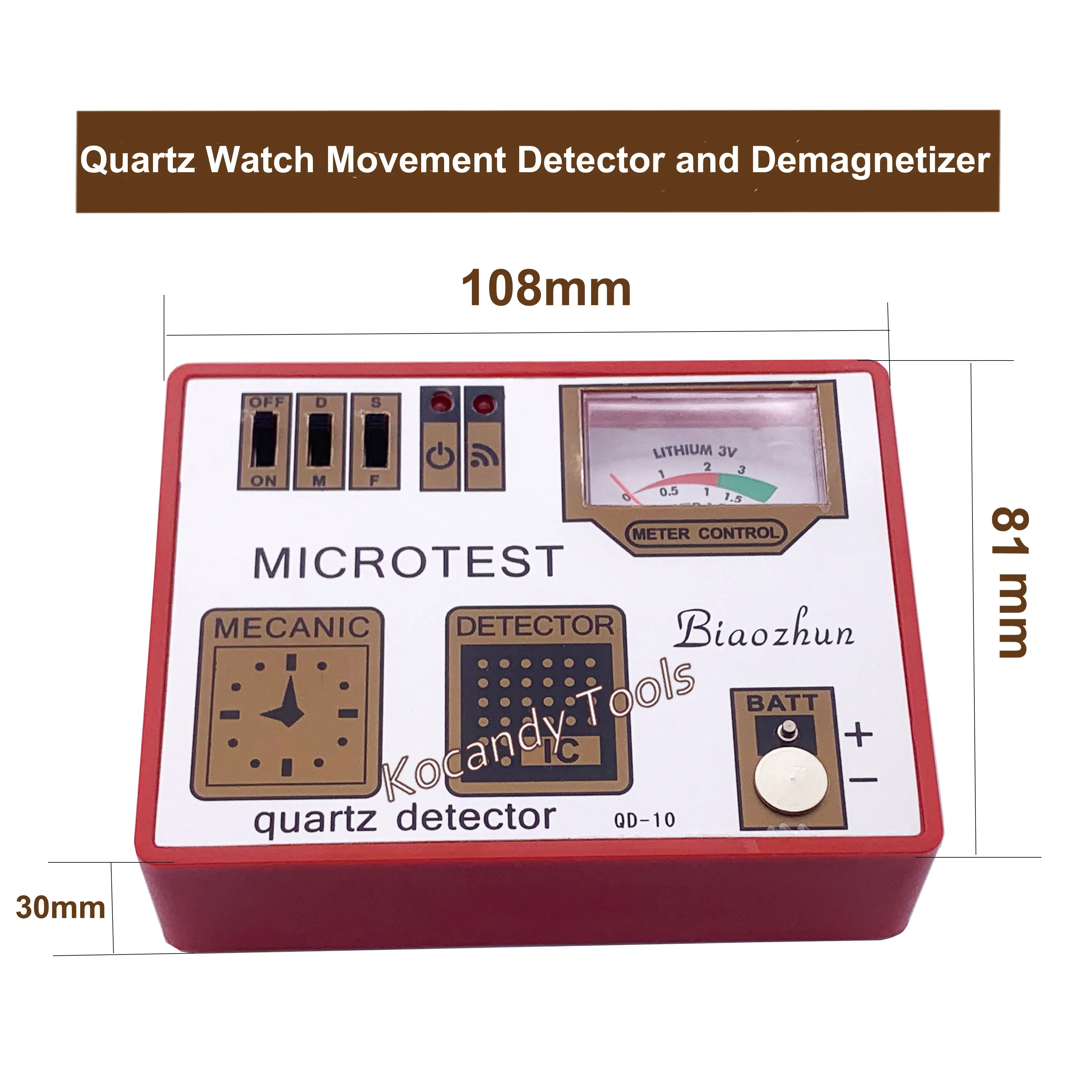
Portable QD-10 quartz movement analyzer with sensor pad and test leads for rapid pulse and cell checks.
The QD-10 analyzer provides a streamlined format designed for rapid verification. Its stated features focus on quartz movement correction, demagnetization, and battery testing. Stated specifications across both units are compared in the table below:
Feature / Specification | QD-10 Movement Analyzer | QD-20 Movement Tester |
|---|---|---|
Product Catalog Link | ||
Stated Functions | Movement correction, demagnetization, battery test | Pulse, battery test, demagnetization, error measurement, daily rate |
Stated Case Dimensions | Confirm by message | Approx. 10.8 x 8 x 3.1 cm (4.3 x 3.1 x 1.2 in) |
Stated Item Weight | 150 | 160 |
Housing Material | Plastic | Circuit board + plastic |
Power Source | Without battery included (Confirm by message) | 2 x 1.5V Common Battery (Not included) |
Supplied Accessories | Live wire | One cable |
Recommended Uses | Precision inspection and calibration | Precision inspection and calibration |
Diagnostic symptom triage: matching test results to corrective action
Interpreting the combination of cell voltage and pulse detection isolates the defective component before ordering replacement stock. A stopped watch presents varying electrical and mechanical behaviors depending on whether failure originated in the battery, the coil winding, or the mechanical wheel train.
Before disassembling plates or ordering parts, consult the diagnostic matrix below to map observed bench indicators to their hedged mechanical causes and appropriate workshop interventions:
Observed Bench Symptom | Diagnostic Takeaway (Hedged) | Recommended Workshop Action | Relevant Catalog Solution |
|---|---|---|---|
Cell voltage low; pulse absent | Depleted power cell | Replace disposable coin cell | Standard silver oxide cell |
Fresh cell installed; pulse regular; hands stationary | Electronic circuit intact; mechanical obstruction or gummed wheel train | Clean train wheels, clear magnetic rotor, check hand clearance | Movement servicing or replacement movement |
Fresh cell installed; pulse absent; zero current draw | Open circuit, damaged coil winding, or broken quartz crystal | Check coil resistance with probes; inspect circuit contact points | Circuit module or complete quartz movement |
Solar watch double-stepping; passes intermittently | Stored capacitor reserve depleted; low light retention | Recharge under direct illumination; inspect capacitor age | |
Unmarked movement; erratic stuttering pulse | Damaged trimmer, contaminated board, or movement carrying no readable caliber name | Measure movement diameter, hand post heights, and stem tap | Replacement caliber or Confirm by message |
When testing indicates that the movement circuit and coil function normally, watchmakers typically apply manual wheel train rotation or demagnetization before condemning the caliber. If clearing debris or demagnetizing fails to free the wheels, replacing the movement assembly remains the most reliable workshop solution.
Testing before ordering: handling standard cells versus solar accumulators
A vital distinction exists between standard disposable button cells and rechargeable quartz energy cells, commonly termed capacitors or accumulators. Treating these components identically during testing risks ruining expensive parts.
Standard quartz watches use silver oxide cells (such as 371, 377, 395, or SR920SW) rated at 1.55 volts, or lithium coin cells (such as CR2016 or CR2025) rated at 3.0 volts. These cells can be tested on standard bench battery check terminals.
In contrast, solar-powered movements use specialized rechargeable manganese titanium lithium units. The Citizen 295-55 Eco-Drive capacitor replacement (model CT295.55, battery size MT621) carries an explicit manufacturer warning: do not use a battery tester or voltmeter on these capacitors, as standard tester load circuits may degrade the component's ability to hold electrical charge.
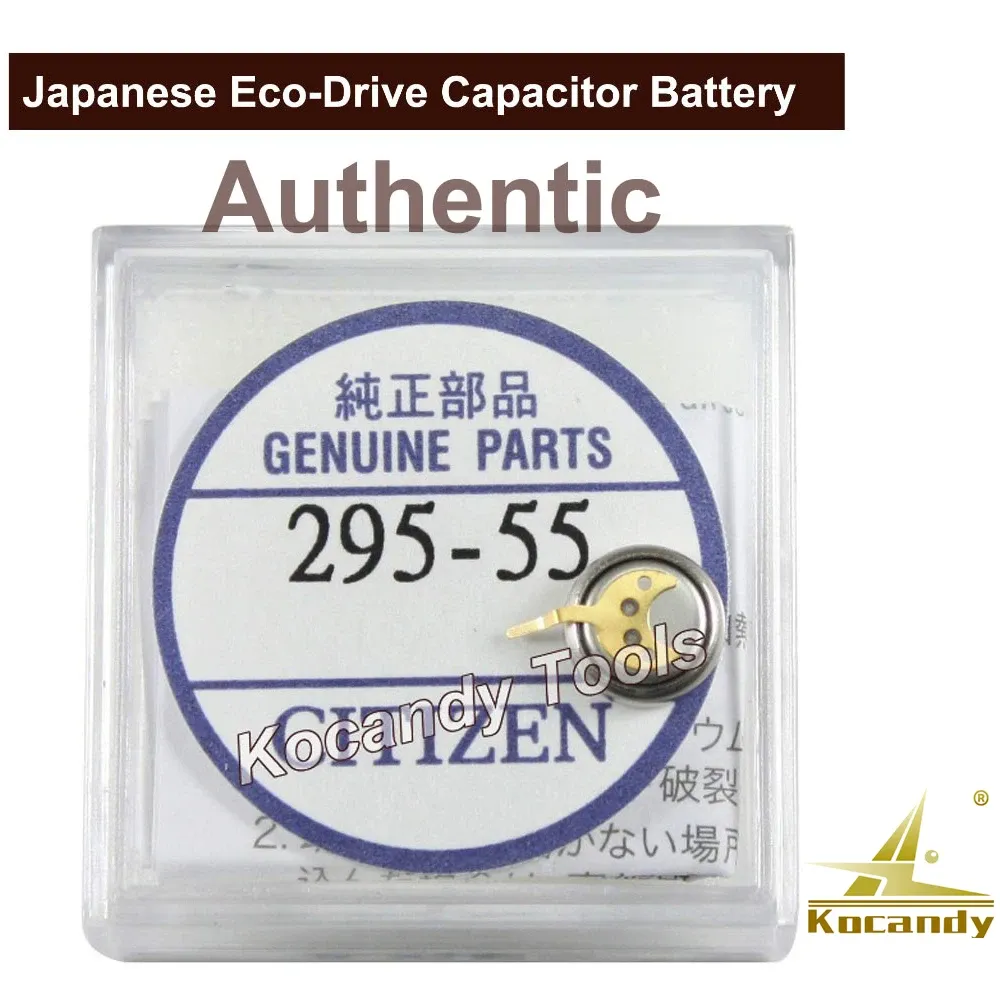
Factory-sealed model CT295.55 capacitor (MT621 cell) listed for Citizen solar quartz movements.
For comprehensive replacement procedures on solar models, consult after testing, our Eco-Drive capacitor replacement guide. Furthermore, whenever replacing an energy cell, always inspect the case tube and crown seals; see how to reseal the crown side after a battery swap to prevent moisture ingress from spoiling newly installed electronics.
Bench measurement worksheet: converting tester readings into parts identifiers
When bench testing reveals that a component must be replaced, compiling your diagnostic findings into a structured string ensures accurate parts verification. Catalog stock carries distinct calibers, coil configurations, and accumulator tabs.
To avoid ordering an incorrect battery size or mismatched movement version, record your tester measurements directly into the worksheet below before contacting our team:
Diagnostic Parameter | Recorded Bench Value | Purpose for Catalog Verification |
|---|---|---|
Movement Caliber Stamp | e.g. 8510A, 8625A, 2035, or movement carrying no readable caliber name | Identifies factory movement family and parts layout |
Cell Voltage Reading | Stated volts under load, or zero | Confirms whether primary power delivery failed |
Coil Pulse Status | Flashing regular, intermittent, or absent | Separates electronic circuit failure from train blockage |
Energy Cell Model Number | e.g. SR626SW, MT621, or CT295.55 | Pinpoints cell chemistry, thickness, and terminal brackets |
Physical Movement Dimensions | Plate diameter and total height in mm | Allows cross-referencing unbranded movements |
When submitting an inquiry, summarize your findings into a concise identifier format, such as: "QD-20 shows regular pulse, cell voltage 1.56V, hands stationary, caliber stamp 2035" or "pulse absent, cell voltage 0V, capacitor MT621 model CT295.55". Having this exact string ready allows our bench technicians to confirm whether an exact replacement component or suitable workshop alternative exists in catalog stock.
Brand disclaimer and workshop contact assistance
Kocandy is not affiliated with, authorised by, or a dealer for any watch brand, including Citizen, Seiko, Miyota, ETA, Ronda, Bergeon, or Horotec. All manufacturer names, caliber numbers, and model designations across our catalog are cited strictly for identification and comparative reference purposes.
If your tester readings indicate an electronic fault or your movement requires a replacement capacitor, movement assembly, or specialized testing tool, submit your details to our technical team:
We reply within one working day. If your size, model, or reading is not listed anywhere above, send it anyway — we check against the catalog to identify matching inventory or recommend suitable workshop alternatives.