Oct 11, 2026Repair Tutorials
How to Remove a Broken Watch Stem and Measure for Replacement
Where the stem snapped decides how it comes out: inside the movement, inside the crown, or past the tube. Routes, tweezers and stem extenders from our catalog, with measurements to send.
A broken winding stem halts watch setting and manual winding instantly. Stems typically snap from lateral bending during crown pulling, cross-threading, or metal fatigue near the square arbor. Before applying force, recognize that where the stem broke decides how you get it out. Rushing extraction risks gouging mainplates, stripping setting screws, or crushing case tubes. Breakages fall into three scenarios: trapped inside the movement, sheared inside the crown, or protruding past the tube.
Broken watch stem removal: identify where the stem broke first
When encountering a broken stem, first locate the fracture line under a 5x or 10x loupe. Stems feature distinct functional zones: male threads entering the crown, a smooth bearing neck inside the tube, a square hub driving the sliding clutch pinion, and a pilot pivot. Stress concentrates at the thread shoulder and setting lever notch. Knowing which section remains trapped indicates whether to release the setting detent, dissolve adhesive, or grip an exposed stub. Prying a trapped remnant without releasing the setting lever bends pins and ruins pinion teeth.
Inspecting the break point to choose the right extraction route
Inspecting the watch indicates your extraction procedure. If the crown detached with broken steel in its cavity, the movement still holds the stem arbor. If the crown pulled free with threads intact, the stem broke inside the plates. When sheared across the cylindrical neck, a stub may protrude past the case tube for direct external gripping.
The matrix below outlines five primary break points, their access routes, and required bench items.
Break point | Access route | What you need |
|---|---|---|
Sheared inside movement | Case back removed, movement keyless detent disengaged | Pegwood stick, fine bench tweezers, movement cushion |
Recessed loose in tube | Movement unlatched or uncased, tube passage cleared | Non-magnetic probe, mild magnetic needle, demagnetizer |
Sheared flush inside crown | Crown detached from case, thermal or chemical soaking | Pin vise, heat source, acetone solvent, brass needle |
Stub protruding past tube | Direct external access through case tube opening | Flat-jaw pliers or sturdy tweezers, protective case tape |
Trapped steel in luxury crown | Chemical bath without heat or mechanical force | Glass dish, potassium alum powder, warm water bath |
Work over a clean bench tray with raised edges. Hardened steel remnants release under spring pressure and bounce off benches easily.
Extracting a stem broken inside the movement
When a stem snaps inside the movement, the setting lever pin locks the remnant. Shaking will not dislodge it and risks balance pivots. Open the case back and rest the movement on a bench pad. Locate the setting release. If uncertain of the layout or if the movement carries no readable caliber name, verify the detent type before pressing.
Depress the push-detent gently with a sharpened pegwood point. Never press deeper than plate level; over-depressing dislodges the setting lever from the clutch yoke, forcing dial removal to reset. While holding the detent down, grip the stub with the Vetus ST-10 Fine Straight Tip Tweezers and draw the remnant straight outward.
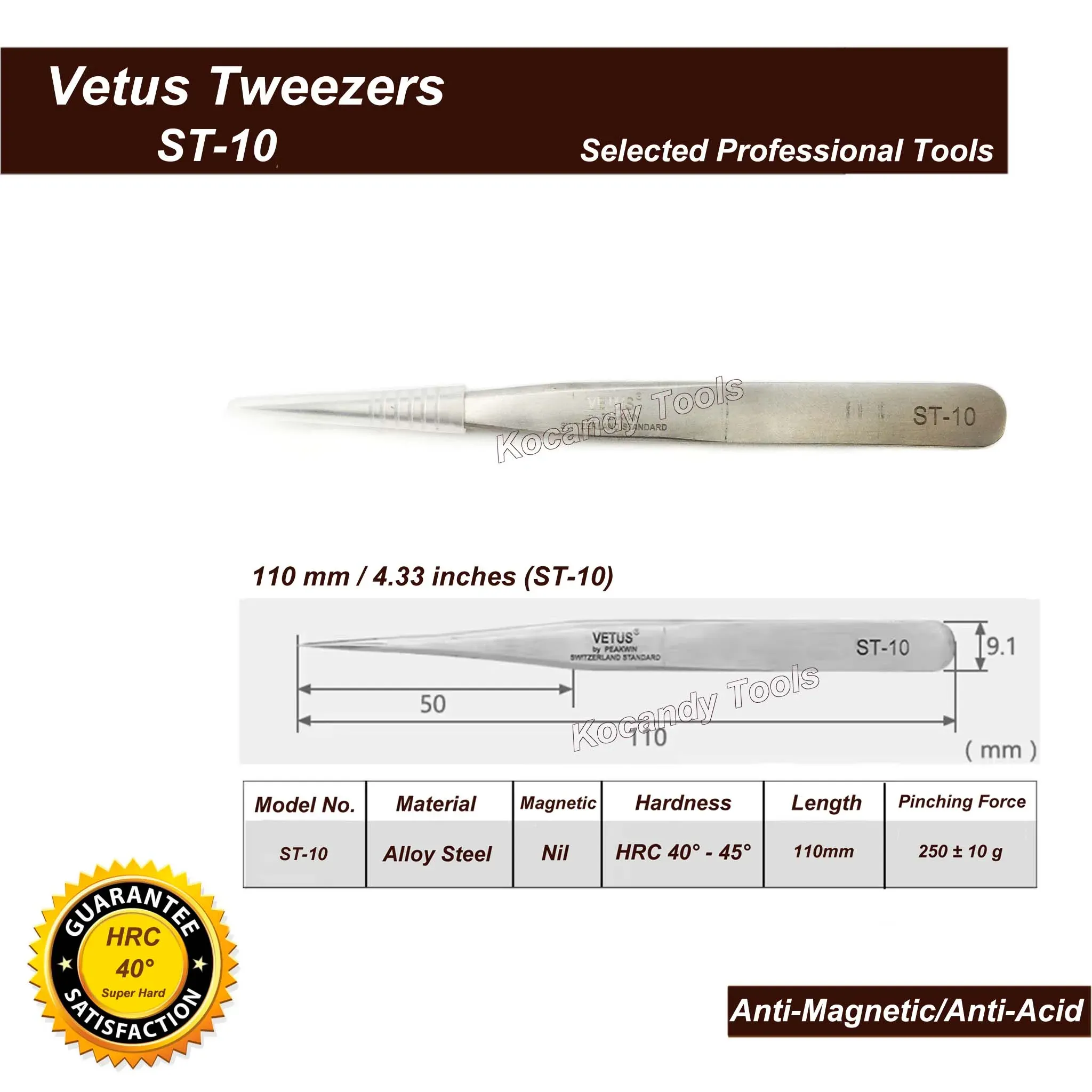
Vetus ST-10 fine straight tip tweezers with 110mm total length.
The magnet trick for recessed loose stem fragments
If the stem shears behind the setting lever notch, a loose stub may sit trapped in the pinion channel where tweezers cannot reach. Once the detent is depressed, the piece is mechanically free but recessed.
A technique discussed in repair communities uses mild magnetic attraction to draw out loose steel remnants. Technicians touch a magnetized needle to the fracture face through the case tube. Because the fragment is lightweight, attraction slides it forward until tweezers can grip it.
This community method requires clear cautions. Magnetic fields magnetize balance springs, causing timing drift. Anyone testing this technique must demagnetize the movement on a bench demagnetizer immediately afterward. Furthermore, magnets cannot overcome an engaged setting lever; the detent must remain depressed throughout.
Extracting a broken stem stub from the watch crown
When the stem breaks flush at the crown entrance, the threaded stub remains seized inside. Factory assembly often includes anaerobic threadlocker or shellac.
To salvage the crown, dissolve the adhesive bond first. Secure the crown in a brass-jawed pin vise and apply a drop of acetone to the thread recess with an oiler needle to soften cured resins. Keep solvents away from rubber gaskets and plastic spacers, which degrade in solvent.
If acetone alone fails, apply gentle heat with a warm air pencil away from internal gaskets. Heat breaks down threadlocker and expands crown metal. If an uneven ridge exists on the fracture face, engage it with a hardened scriber or fine tweezer point, rotating counter-clockwise to back the stub out.
Chemical dissolution with warm alum water as a last resort
When a stem snaps deep inside a crown without purchase, mechanical tools cannot grab the stub without destroying threads. Repairers frequently turn to chemical dissolution in warm potassium alum water.
Potassium alum dissolves carbon steel through galvanic oxidation without harming stainless steel, gold, gold plating, or brass. Dissolve alum powder in warm water inside a glass beaker. Suspend the crown with copper wire above settled sediment and keep the solution warm. Over 24 to 48 hours, the alum converts the steel stub into soft iron oxide slush rinsed clean ultrasonically.
This community method requires patience. Alum attacks carbon steel springs, so remove internal steel clips before immersion. Verify whether the crown is solid or plated metal, as damaged plating invites corrosion.
Precision tweezers for gripping broken stem fragments
Extracting sheared stem pieces requires tweezers with precise tip geometry, rigid stainless steel builds, and anti-magnetic properties. Standard tweezers have thick tips that cannot enter narrow gaps between plates and case walls. Precision tweezers allow controlled clamping force directly on a sheared shoulder without slipping.
The table below lists tip profiles and stated specifications of precision tweezers in our catalog.
Tweezer | Stated tip | Stated length | Product link |
|---|---|---|---|
Vetus ST-10 | Fine straight tip | 110mm total, 50mm tip section | |
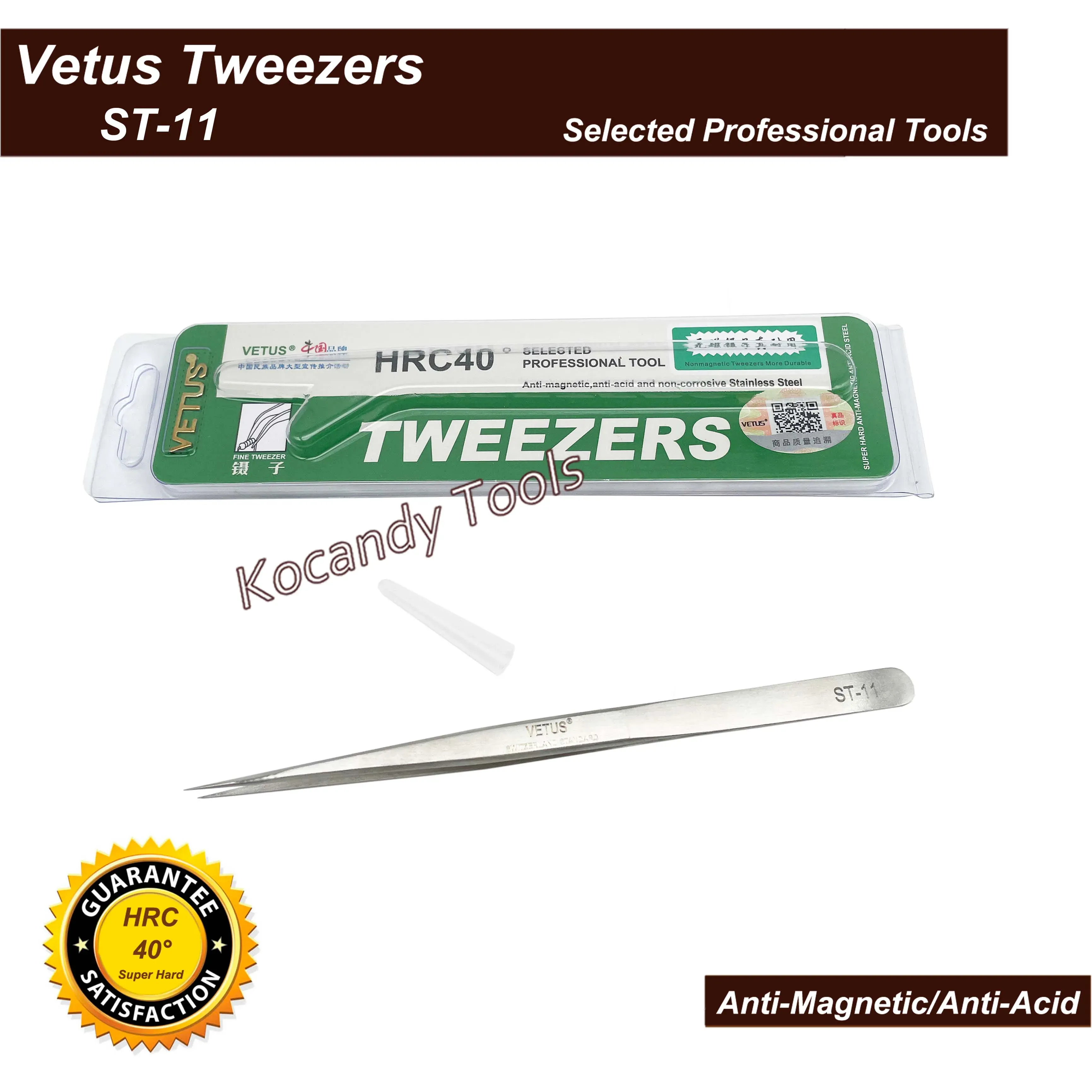
Vetus ST-11 | Sharp and straight super fine tip | Confirm by message | |
Vetus ST-12 | Fine straight tip | 110mm total, 50mm tip section | |
Vetus ST-15 | Fine curved tip | 115mm total, 33mm curved tip | |
Vetus ST-16 | Sharp, fine straight super fine tip | 180mm total, 65mm tip section |
For deep rehauts, the long body of the Vetus ST-16 Super Fine Tip Tweezers provides reach across tall chapter rings. For angled approaches around casing clamps, the curved jaws of the Vetus ST-15 fine curved tip tweezers reach behind movement spacers where straight tweezers cannot enter.
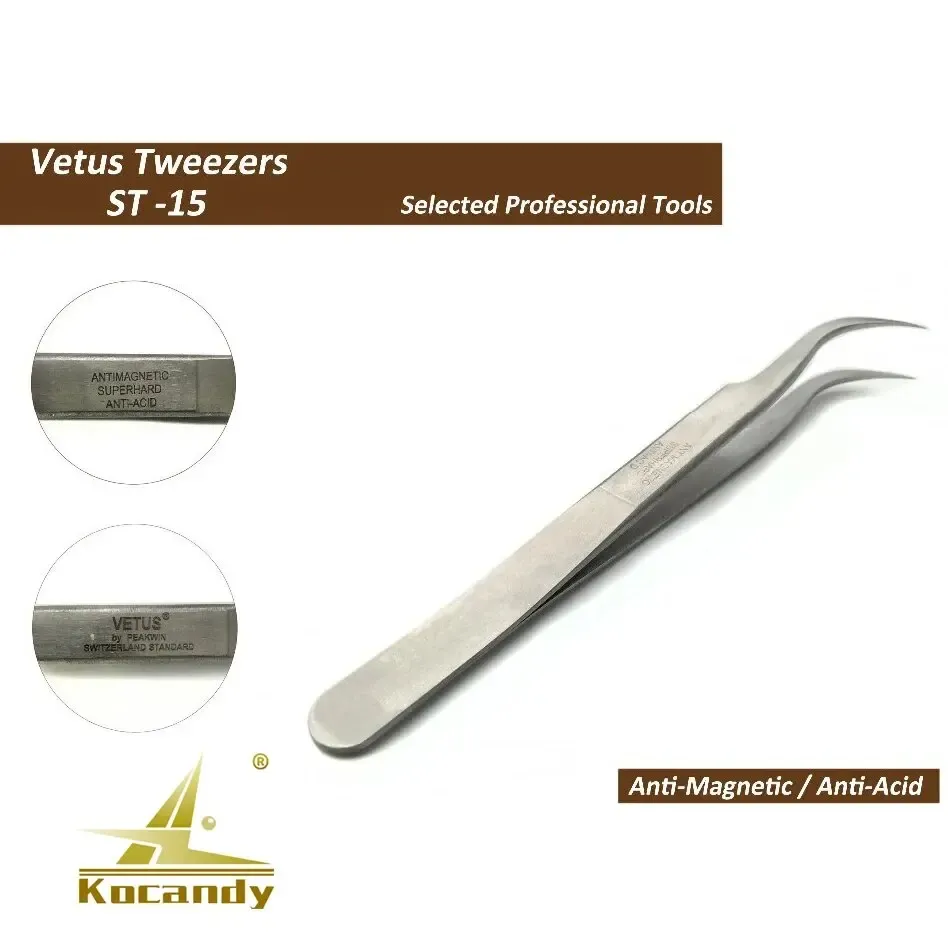
Vetus ST-15 curved tip tweezers with 115mm total length and 33mm curved tip.

Vetus ST-16 super fine straight tip tweezers with 180mm total length.
Measuring the extracted stem stub and thread diameter
Once extracted, place fragments side by side to reconstruct the stem. Reconstructing the piece yields two essential measurements: external thread diameter and total functional length.
Using digital calipers, measure the outside diameter of the threaded section. Winding stem threads follow metric standards, commonly Tap 10 (0.90 mm) down to Tap 6 (0.50 mm). To identify your specification, measure the stem thread against this ladder before ordering parts. If calipers read between standard sizes, take multiple readings on clean crests to avoid burr distortion.
Next, record the length from the crown shoulder to the arbor tip. When fitting a new assembly, you must also match the replacement crown, stem and tube so the crown seats flush without binding.
Choosing between a replacement stem and stem extender rods
With measurements in hand, repairers choose between two solutions: fitting a new factory stem or installing a threaded stem extender rod.
A replacement stem is standard practice when the caliber is known, restoring factory hub tolerances. For discontinued or vintage calibers where stems are unavailable, an extender rod offers a practical fix. It features an internal female thread that screws onto the broken stub, extending into a new male thread.
The table below lists stem extender sets in our catalog with stated movement families.
Product | Stated movement families | Count | Product link |
|---|---|---|---|
Winding Stem Extender Rods for 2824 | 2824, 2836, 2892, 7750, 9015, 8200, 2671, 6601, 2035, pc movement | 10 types plus 2 tube joints | |
Winding Stem Extender Rods for 2035 | 2824, 2671, 2892, 7750, 9015, 8200, 6601, 2035, AL121, PC21 movement | 10 types plus 2 tube joints | |
Stem Extenders 100 pcs Set | Stated as general wristwatch repair for 0.9mm threads | 100 pieces |
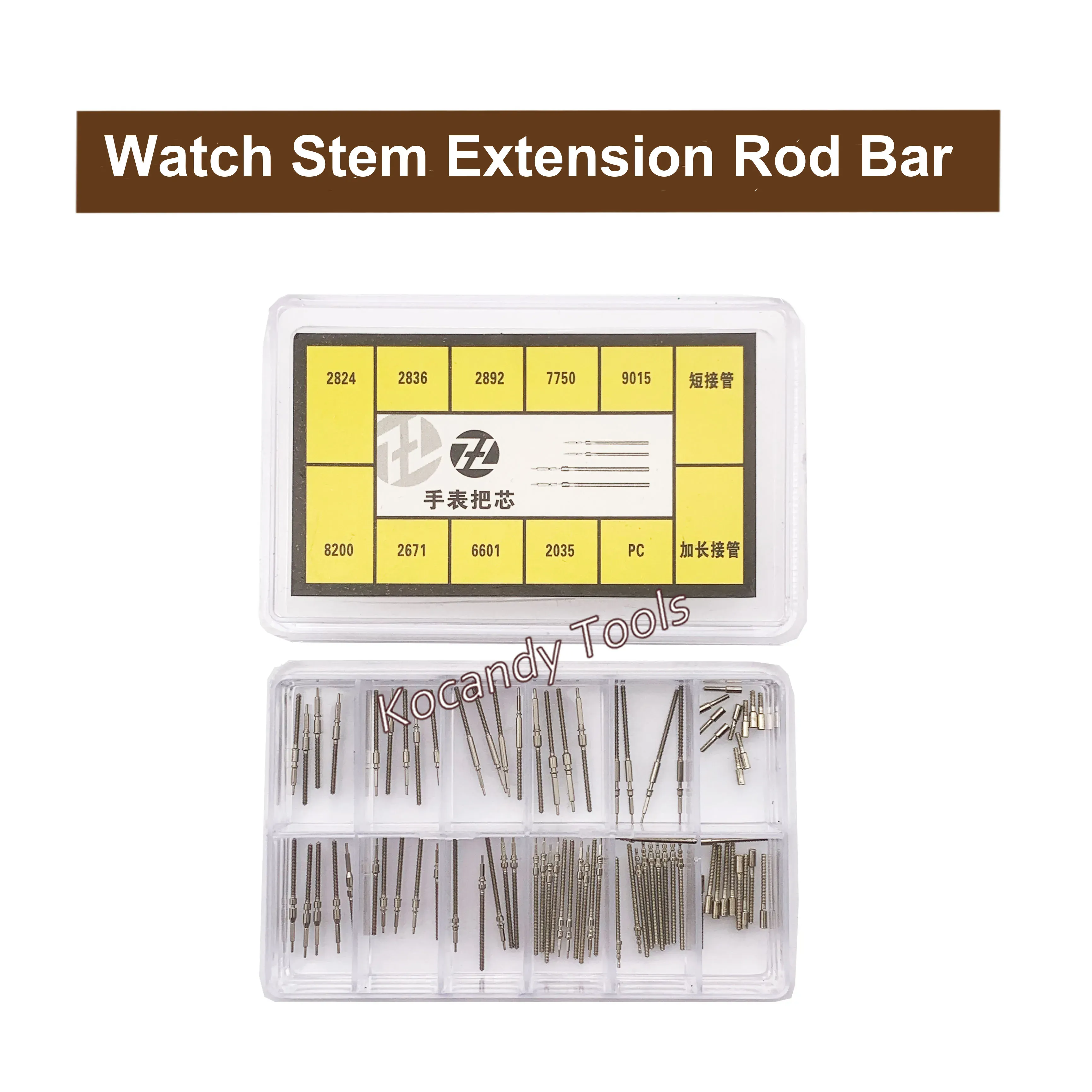
Assorted watch stem extenders packaged with 12 compartmentalized storage sections.
Extender listings cite 0.9mm threads with lengths stated variously as 5.5mm, 10.5mm, 6.5mm, and 10mm across packaging charts and labels, while quartz adapter listings cite 0.7mm and 0.9mm sizes. If your repair demands an exact extension length, send your caliper readings before ordering so we can confirm physical dimensions.
Preparing your stem identifiers before contacting Kocandy
Before contacting our team, gather your repair identifiers. Kocandy displays no prices on site because tools and stem components depend strictly on physical fit. Having clear numbers ready lets us check inventory quickly.
Record these four details:
- Thread outside diameter in millimeters (such as 0.90 mm or 0.70 mm).
- Movement caliber stamped on bridges (such as 2824 or 2035), or state that the movement carries no readable caliber name.
- Total stem length or remaining stub length.
- Crown tap size and cavity depth if reusing the crown.
Kocandy is not affiliated with, authorised by, or an official dealer for any watch brand, including ETA, Sellita, Seiko, Citizen, Miyota, Rolex, Omega, or Vetus. All brand designations and calibers are referenced solely for compatibility.
If your thread size, caliber model, or extension length is not listed above, send your measurements anyway. Contact our team via our contact form. We review every inquiry against our inventory and reply within one working day with matching stock recommendations.