Oct 27, 2026Buying Guides
Watchmaker Loupe and Magnifier Guide: Choosing Magnification for Bench Work
Compare watchmaker loupes by magnification and mounting style. Match 1.5X to 3.5X eyewear, headband frames, and 10X eye loupes to bench tasks, focal distances, and assembly clearance.
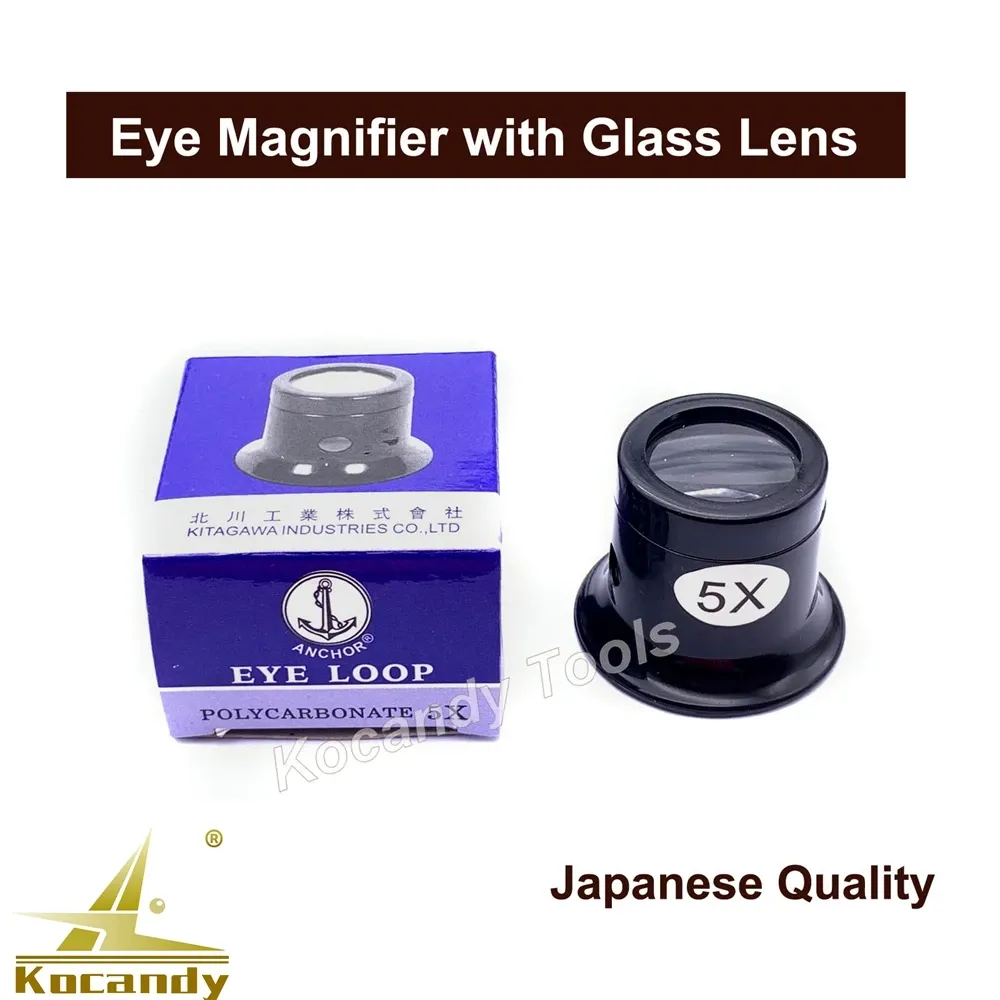
A watchmaker's loupe is chosen by focal distance, depth of field, and physical tool clearance rather than magnification strength alone. Selecting an overly powerful loupe restricts working distance to millimeters, blocking clearance for tweezers and screwdrivers. Conversely, too weak a magnifier leaves you straining to inspect balance pivots, jewel settings, and gear teeth. At Kocandy, our catalog covers foldable clip-on eyewear magnifiers, hands-free headband loupes, and traditional orbital eye loupes.
Watchmaker Loupe Magnification: Matching Power to Bench Tasks
Selecting a magnifier begins with the relationship between optical power and focal distance. Higher magnification shortens the working distance between lens and movement. A low-power 1.5X or 2.5X lens provides 15 to 25 cm (6 to 10 inches) of clearance, leaving ample room for hands, screwdrivers, and tweezers. A 5X lens contracts working distance to 5 to 7 cm (2 to 3 inches), providing ideal resolution for gear train inspection while permitting delicate manipulation. At 10X magnification, working distance shrinks to approximately 2.5 cm (1 inch), and depth of field collapses to fractions of a millimeter.
Because no single focal length accommodates every procedure, watchmakers keep multiple magnification tools at hand: a low-power optic for casing, hand setting, and plate disassembly where tool clearance is essential, and a high-power loupe reserved for static inspection, pivot checks, and escapement analysis.
Low Magnification (1.5X to 2.5X): Casing, Assembly, and Tweezer Clearance
Low magnification between 1.5X and 2.5X represents the primary working zone for movement assembly, casing, and uncasing. At this power, the field of view encompasses an entire 30 mm movement, allowing the technician to monitor multi-lever interactions across the mainplate without panning the head.
Low magnification preserves stereoscopic depth perception and hand-eye coordination. A 15 to 25 cm focal distance provides generous vertical headroom above the movement holder. When guiding bridge screws or steadying a balance cock with watch tweezer tip sizes suited to micro-clearances, low magnification ensures tool shanks do not collide with the lens or frame.
Medium Magnification (3.5X to 5X): Train Wheel Inspection and Dial Work
Medium magnification from 3.5X to 5X functions as the standard working inspection tier for mechanical calibers. This power resolves fine features indistinct under 2X lenses, including pinion leaf engagement, hairspring flatness, keyless clutch teeth, and dial printing uniformity.
At 3.5X to 5X, the 5 to 7 cm working distance accommodates steady manual control. Watchmakers use this distance to position oiler needles into shock settings or guide wheel pivots into bridge jewels. This range is equally suited for quartz servicing, where technicians inspect printed circuit tracks, insulator films, and motor coil windings. When working alongside watch quartz movement tester procedures, a 5X magnifier lets you position probes securely without scratching coil insulation.
High Magnification (10X): Escapement, Pivots, and Caliber Identification
A 10X loupe is an analytical diagnostic tool rather than an assembly optic. With a focal distance of roughly 2.5 cm (1 inch), there is minimal vertical space to manipulate tweezers or screwdrivers beneath the lens. Attempting assembly under 10X magnification causes tool collisions, scratched plates, and obstructed lighting.
Instead, 10X magnification is deployed for static inspection. Watchmakers use a 10X optic to examine balance staff pivots for microscopic scoring, verify pallet jewel security within shellac, and inspect guard pin clearance. It is essential for detecting microscopic lint or dried oil residue requiring pegwood cleaning, as detailed in our guide on watch cleaning and polishing supplies. In addition, a 10X loupe is the primary instrument for deciphering caliber marks hidden beneath the balance wheel when identifying watch movement calibers.
Foldable Eyewear Magnifiers: Model ZJJH00002 with 1.5X, 2.5X, and 3.5X Lenses
For technicians who wear prescription spectacles or prefer binocular viewing, our catalog includes the foldable eyewear magnifier under model ZJJH00002. This tool features a lightweight clip mechanism designed to mount directly onto the frame or bridge of standard eyeglasses, eliminating facial muscle tension.
Catalog specifications record an overall length of 10 cm, an item height of 4 cm, a 0.1 cm width placeholder, and a weight of 40 grams. Fabricated from acrylic, the unit includes three interchangeable lens options supplying 1.5X, 2.5X, and 3.5X magnification settings. The folding hinge permits the watchmaker to flip the optical unit upward out of the line of sight when consulting parts trays, and lower it instantly when returning to the bench block.
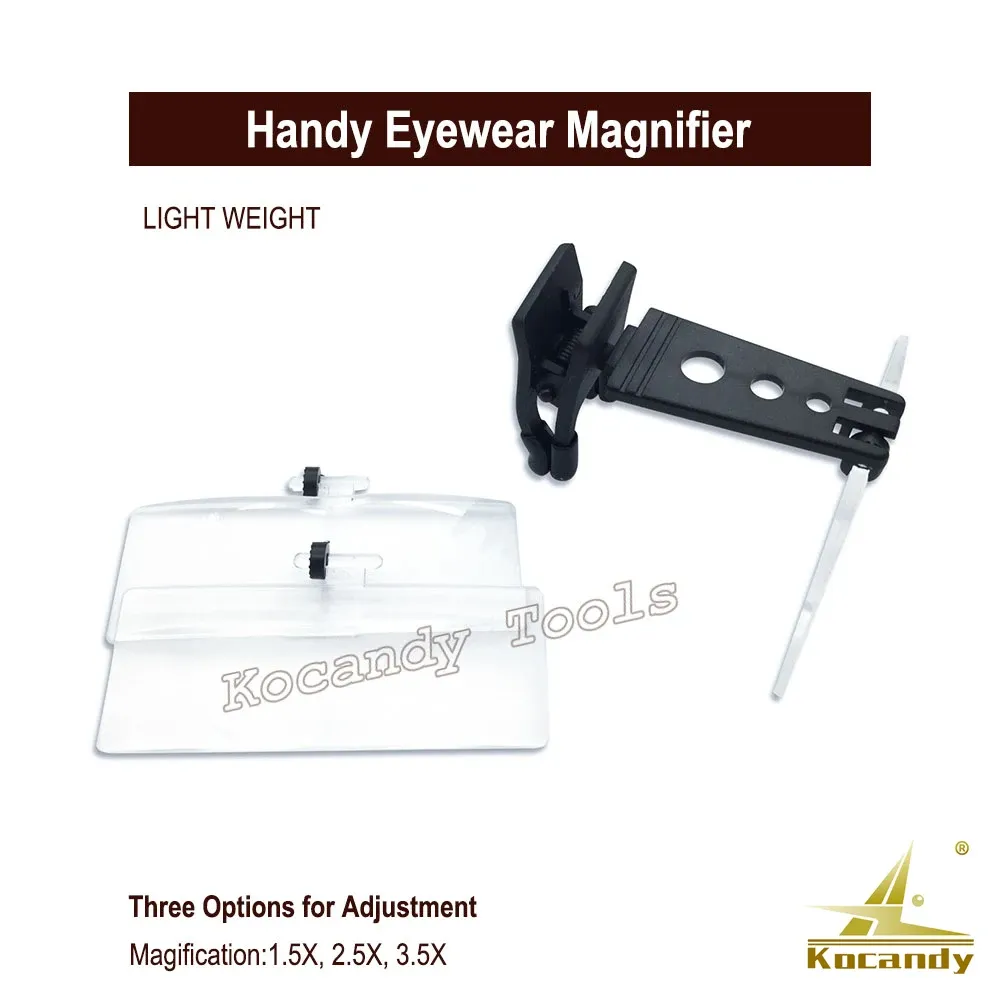
Model ZJJH00002 foldable eyewear loupe standing with interchangeable lens fitted.
Headband Loupes: Model ZJJH00003 for Hands-Free Bench Work
Continuous bench work with a handheld loupe can cause ocular fatigue and temple strain from squinting the orbital socket. To eliminate this strain, catalog model ZJJH00003 provides a headband magnifier loupe in an ergonomic wearing style. An adjustable headband and metal ring support the optical cone firmly on the brow without facial clamping or wire loops.
Model ZJJH00003 is built from acrylic, with catalog records listing a 10 cm length, 4 cm height, 0.1 cm width placeholder, and 40-gram weight. Specifications list Feature 6 as 10X magnification and Feature 7 as 5X magnification, covering movement inspection and assembly. The tool includes a durable storage case.
Catalog text for model ZJJH00003 mentions an attached light and three lens options. These clauses represent boilerplate shared across catalog entries; catalog photography confirms an unpowered headband loupe assembly offering 5X and 10X magnification.
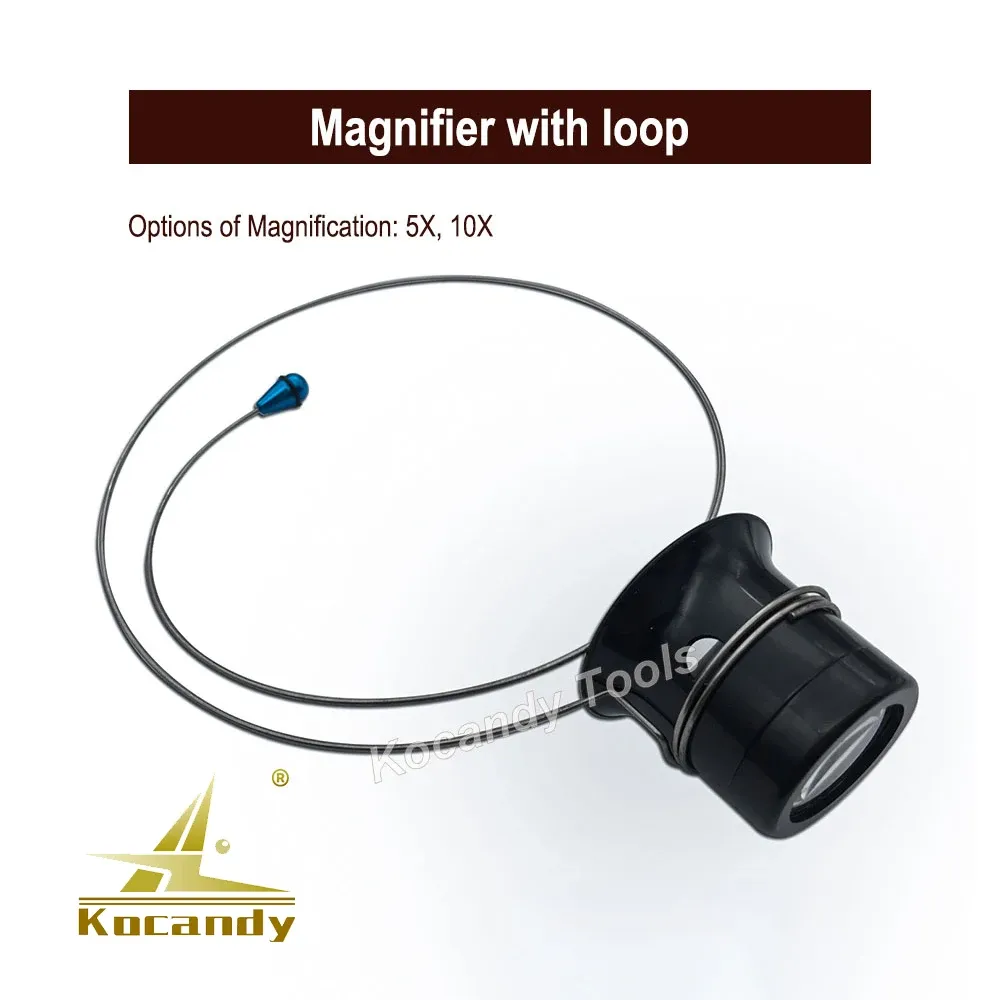
Model ZJJH00003 headband magnifier loupe configured with head strap for hands-free bench inspection.
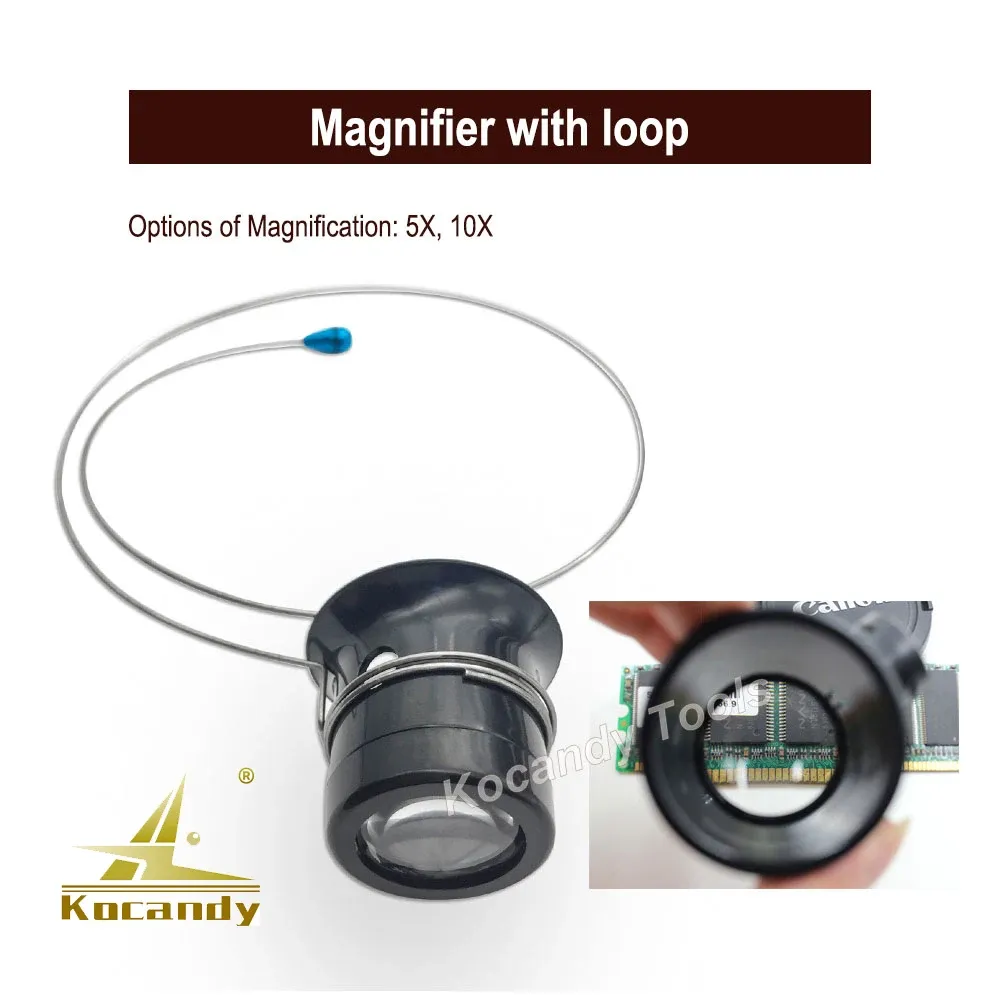
Close-up of the loupe cone and optic assembly on the ZJJH00003 headband magnifier.
Eyepiece Loupes: Model BCFJ-GF-B-0005 for Detail Inspection
The monocular eye loupe remains the classic visual instrument of horology. In our catalog, this form factor is represented by model BCFJ-GF-B-0005, a compact eyepiece. Weighing only 10 grams, it is exceptionally lightweight, allowing watchmakers accustomed to orbital gripping to hold the loupe with minimal muscular effort.
Model BCFJ-GF-B-0005 features a black thermoplastic body and polished glass lens, measuring 2.5 cm (25 mm) in diameter and 3.5 cm (35 mm) in height. The eyepiece includes a flared rubber eyecup that blocks ambient glare and cushions the orbital bone. While the title cites portable 10X and 5X magnification, catalog photography displays the barrel marked 10X. Like model ZJJH00003, catalog text carries boilerplate citing built-in lighting and three lenses; the actual tool is an unpowered, single-optic inspection barrel.
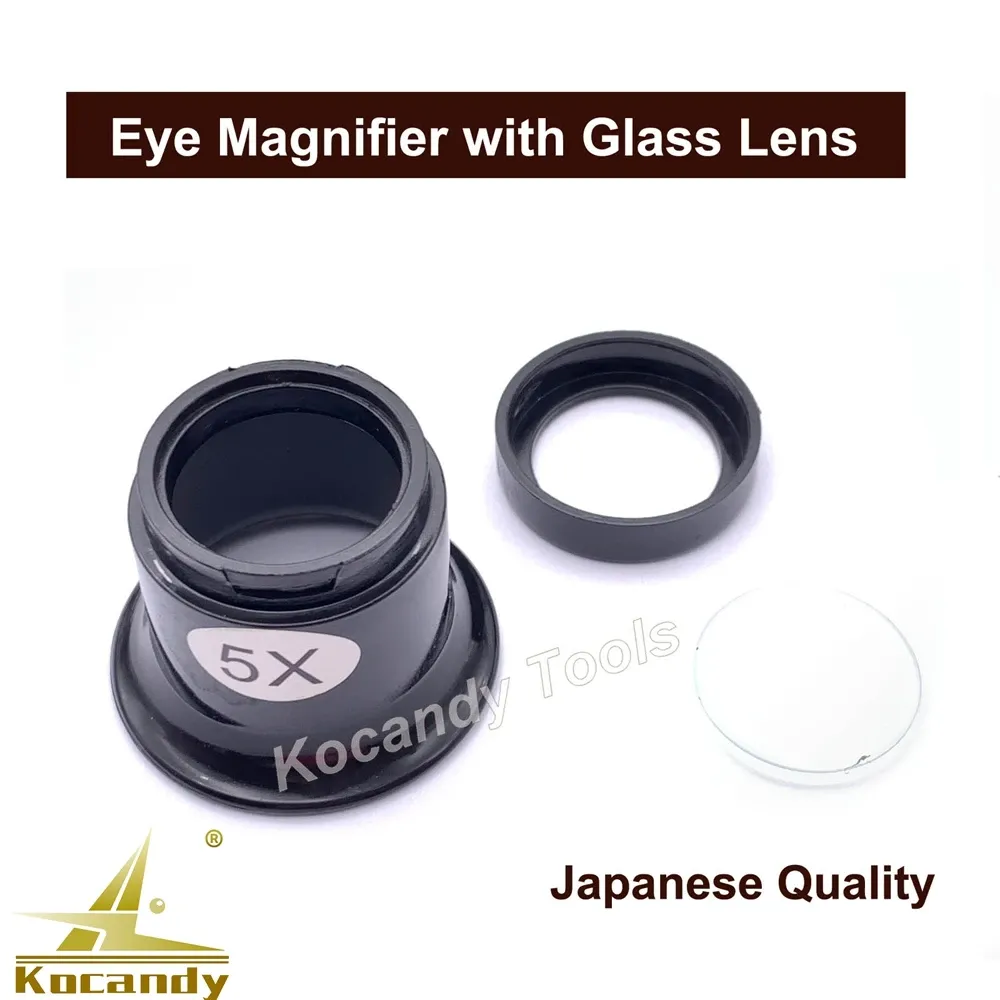
Model BCFJ-GF-B-0005 compact jeweller loupe featuring rubber eyecup and 10X barrel marking.
Magnifier Specifications and Bench Comparison Reference
To assist in matching magnifier form factors, mounting styles, and optical powers to bench requirements, the tables below outline catalog specifications across all three products in scope.
Table A: Magnifier Model Specifications and Mounting Styles
Model number | Mounting style | Stated magnification | Body & lens material | Stated dimensions & weight | Product link |
|---|---|---|---|---|---|
ZJJH00002 | Eyeglass clip-on, foldable | 1.5X, 2.5X, 3.5X | Acrylic | Length 10 cm, height 4 cm, weight 40 g | |
ZJJH00003 | Headband / head loop | 5X, 10X | Acrylic body, metal ring | Length 10 cm, height 4 cm, weight 40 g | |
BCFJ-GF-B-0005 | Orbital eyepiece with rubber eyecup | 10X (title also lists 5X) | Plastic and glass (thermoplastic body) | Diameter 2.5 cm, height 3.5 cm, weight 10 g |
Table B pairs standard bench operations with recommended powers and tool types.
Table B: Bench Tasks and Magnification Selection Guide
Bench operation | Recommended magnification | Approximate working distance | Operational craft requirements | Suited catalog model |
|---|---|---|---|---|
Casing, uncasing, hand setting, and strap replacement | 1.5X to 2.5X | 15 to 25 cm (6 to 10 in) | Maximum vertical tool clearance; broad field of view across the entire dial and case circumference | Model ZJJH00002 |
Gear train bridge assembly and endshake verification | 3.5X to 5X | 5 to 7 cm (2 to 3 in) | Sufficient focal clearance for tweezer tips; clear resolution of jewel holes and wheel pivots | Model ZJJH00002 / Model ZJJH00003 |
Keyless work adjustment, calendar mechanisms, and quartz testing | 3.5X to 5X | 5 to 7 cm (2 to 3 in) | Clear visibility of sliding pinion teeth, jumper springs, and printed circuit tracks | Model ZJJH00003 |
Balance staff pivot inspection and hairspring truing | 10X | Approx. 2.5 cm (1 in) | High optical resolution to detect pivot scoring, bends, and touching hairspring coils | Model BCFJ-GF-B-0005 / Model ZJJH00003 |
Pallet jewel impulse face check and caliber mark reading | 10X | Approx. 2.5 cm (1 in) | Extreme close-up inspection; checks shellac stability and miniature caliber engravings | Model BCFJ-GF-B-0005 |
Table C summarizes the specification anomalies and the verification points to confirm before ordering.
Table C: Catalog Specifications and Inquiry Verification Checklist
Model number | Verified catalog specifications | Catalog anomalies to verify | Workshop verification action |
|---|---|---|---|
ZJJH00002 | 1.5X, 2.5X, 3.5X interchangeable lenses; Acrylic; 40 g weight | Item width listed as 0.1 cm placeholder | Confirm clip mounting width and suitability for your eyeglass frame thickness |
ZJJH00003 | 5X and 10X magnification features; Headband style; 40 g weight | Text mentions attached light and three lenses (boilerplate) | Confirm headband strap adjustment range and single-lens optical cone configuration |
BCFJ-GF-B-0005 | 10 g weight; 2.5 cm diameter, 3.5 cm height; Rubber eyecup | Title states 10X/5X; photo marked 10X; boilerplate cites built-in light | Confirm whether 5X or 10X barrel optic is required for your bench order |
Assembling Your Loupe Identifier Before Requesting a Match
Orders and stock checks are initiated by quoting exact specifications. Compiling your bench requirements into a structured identifier string ensures our workshop desk can verify optical power and physical fit immediately:
- Target Bench Task: State your primary operation, such as casing and dial fitting (1.5X–2.5X), gear train assembly and oiling (3.5X–5X), or balance pivot inspection (10X).
- Mounting Configuration: Specify your preferred wearing style—eyeglass clip-on (model ZJJH00002), headband mount (model ZJJH00003), or traditional orbital eyepiece (model BCFJ-GF-B-0005).
- Working Distance Requirement: Indicate if you need extended vertical clearance (15 to 25 cm for screwdrivers and tweezers) or close-up diagnostic focus (2.5 cm for pivot checks).
- Catalog Model Number: Quote reference ZJJH00002, ZJJH00003, or BCFJ-GF-B-0005.
Workshop Inquiries and Brand Disclaimer
Kocandy is an independent supplier of horological tools, workshop fixtures, and movement replacement components. Kocandy is not affiliated with, authorised by, or a dealer for any watch brand or optical manufacturer mentioned, including Seiko, Rolex, Omega, Citizen, Breitling, Panerai, Hublot, ETA, Bergeon, Horotec, or Vetus. All references to magnifier designs, model numbers, or magnification ratings represent stated catalog designations. Catalog snapshots record stated magnification ratios and physical form factors, not proprietary optical glass grades, lens coatings, or aberration-corrected doublet specifications.
If your required magnification power, focal distance, mounting frame, or model reference is not listed anywhere above, send your workbench specifications through our contact page. Describe your intended repair procedure, frame preferences, and component dimensions. We check customer inquiries directly against our workshop catalog and reply within one working day.