Oct 12, 2026Reference & Sizing
Watch Rotor and Balance Wheel Tool Guide: Caliber Matching for Movement Bench Tools
Rotor axle punches, shock spring extractors and balance wheel removers: caliber-stated tools for movement bench work. Read the stamp, match the tool, send us the number.
Automatic winding rotors, balance wheel assemblies, and shock spring systems operate under tight mechanical clearances. Servicing an oscillating weight axle or balance assembly with a mismatched punch or makeshift lever risks shearing pivots, distorting hairsprings, or scoring plates. Because movements feature proprietary clearances and retainers, bench tools must match the caliber designation stamped onto the movement.
Selecting the correct tool begins with reading the caliber reference rather than the brand on the dial. A driver made for a Novodiac spring or an ETA balance bridge will not clear a different caliber family. Once you identify your caliber, our catalog provides dedicated punches, extractors, positioning removers, and calibration stands.
Watch Rotor and Balance Wheel Tools: Caliber-Specific Matching at the Bench
Movement tools divide into caliber-dedicated fixtures and adjustable bench supports. Caliber-dedicated fixtures engage specific components—such as a hollow punch sized to stake an oscillating weight axle or a slotted extractor engineered to turn a multi-lobed shock spring without slipping. These require an exact caliber match to prevent damage. Adjustable supports and stands provide stable positioning across multiple calibers, supporting the balance staff or hairspring collet on polished surfaces for inspection, truing, and endshake adjustment.
Identifying Your Movement Operation Before Selecting a Tool
Before ordering movement tools, determine the mechanical operation your caliber requires:
- Rotor Axle Staking: Dismantling worn rotor bearings requires hollow-tipped punches supporting the axle perimeter while driving the pin.
- Shock Spring Extraction: Servicing balance jewels requires rotating bayonet shock springs without bending delicate retaining tabs.
- Balance Wheel Assembly Disassembly: Lifting the balance wheel requires guided vertical separation to protect hairspring coils from distortion.
- Hairspring Truing and Inspection: Uncased balances require elevated static stands to check concentricity and poise under magnification.
- Modular Chronograph Assembly: Servicing modular chronographs requires dedicated mounting plates to pre-tension start/stop springs in registration.
Each procedure demands dedicated geometry that interfaces cleanly with movement plates.
Rotor Weight Axle Punch Sets for Automatic Calibers
Oscillating weights experience constant rotational stress, causing axle wear or rotor wobble. Replacing a friction-fit axle requires driving it out with a punch bore matching axle diameter and shoulder height to avoid crushing pivots.
Our catalog supplies an oscillating rotor weight axle punch set in 316 stainless steel (70 g). The catalog title and description list this four-piece set for calibres 1570, 2135, 2235, 3035, and 3135. However, catalog body text also cites suitability for ETA calibres 2892, 7750, and 2000, describing a single handle with three replacement heads. Catalog media show individual punches marked for 1570, 2135, 2235, and 3035/3135. Specify your required caliber and punch profile when inquiring.
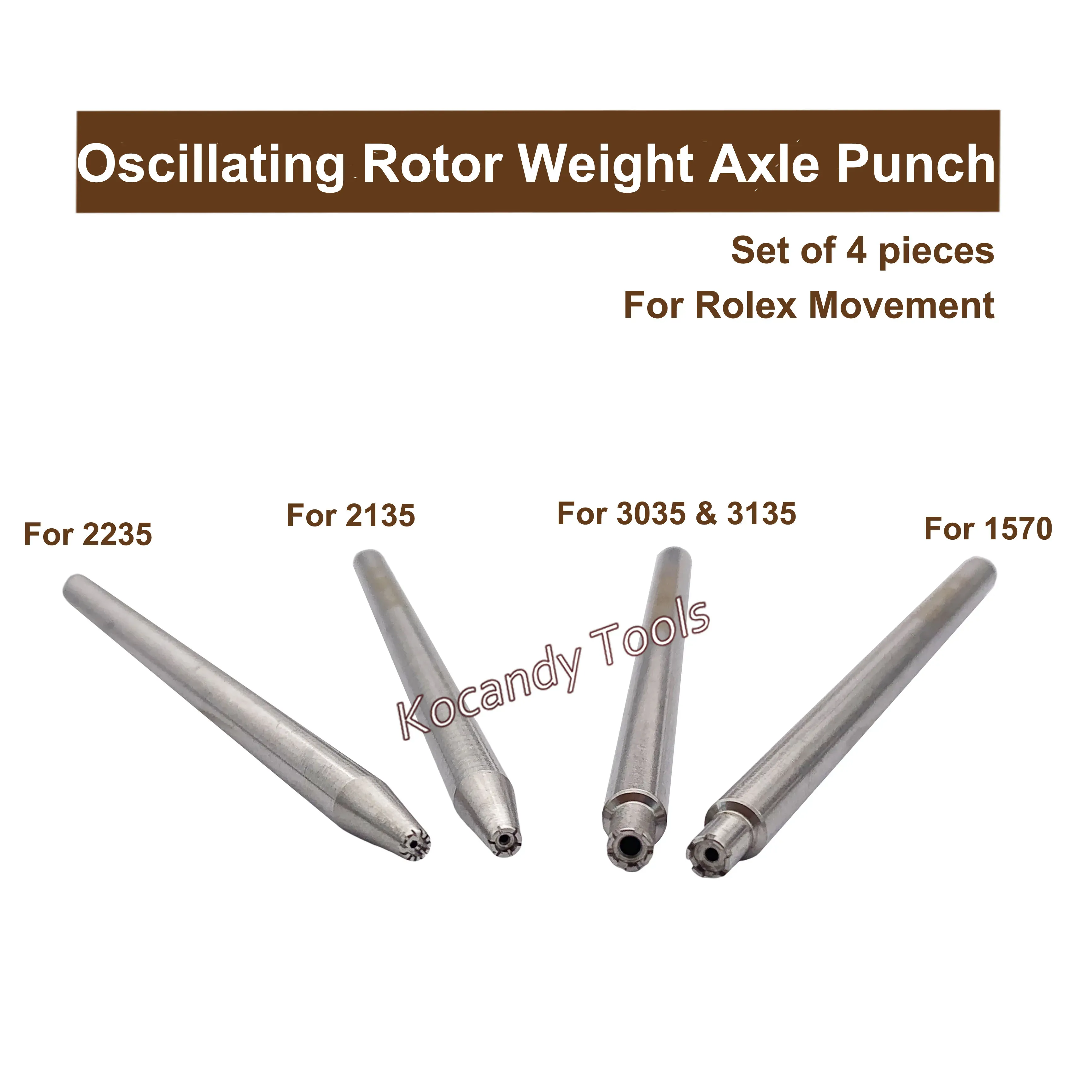
Four rotor weight axle punches arranged with caliber markings for 2235, 2135, 3035, and 1570.
Table A outlines stated specifications for the rotor axle punch set.
Table A: Rotor Axle Punch Reference
Product | Stated calibres | Contents | Material | Product link |
|---|---|---|---|---|
Rotor weight axle punch set | 1570, 2135, 2235, 3035, 3135 (also notes 2892, 7750, 2000) | 4 pcs (body notes 1 handle + 3 replacement heads) | High Graded 316 Stainless Steel |
Novodiac Shock Spring Extractors for Calibers 2834, 2836, and 2671
Balance staff pivots rest inside jeweled shock settings. Unlike hinged Incabloc springs, bayonet Novodiac shock springs are three-lobed spring steel rings seated in annular grooves. Removing or reinstalling them requires rotating the spring until its retaining lobes align with release slots. Prying with tweezers risks launching springs or scratching chatons.
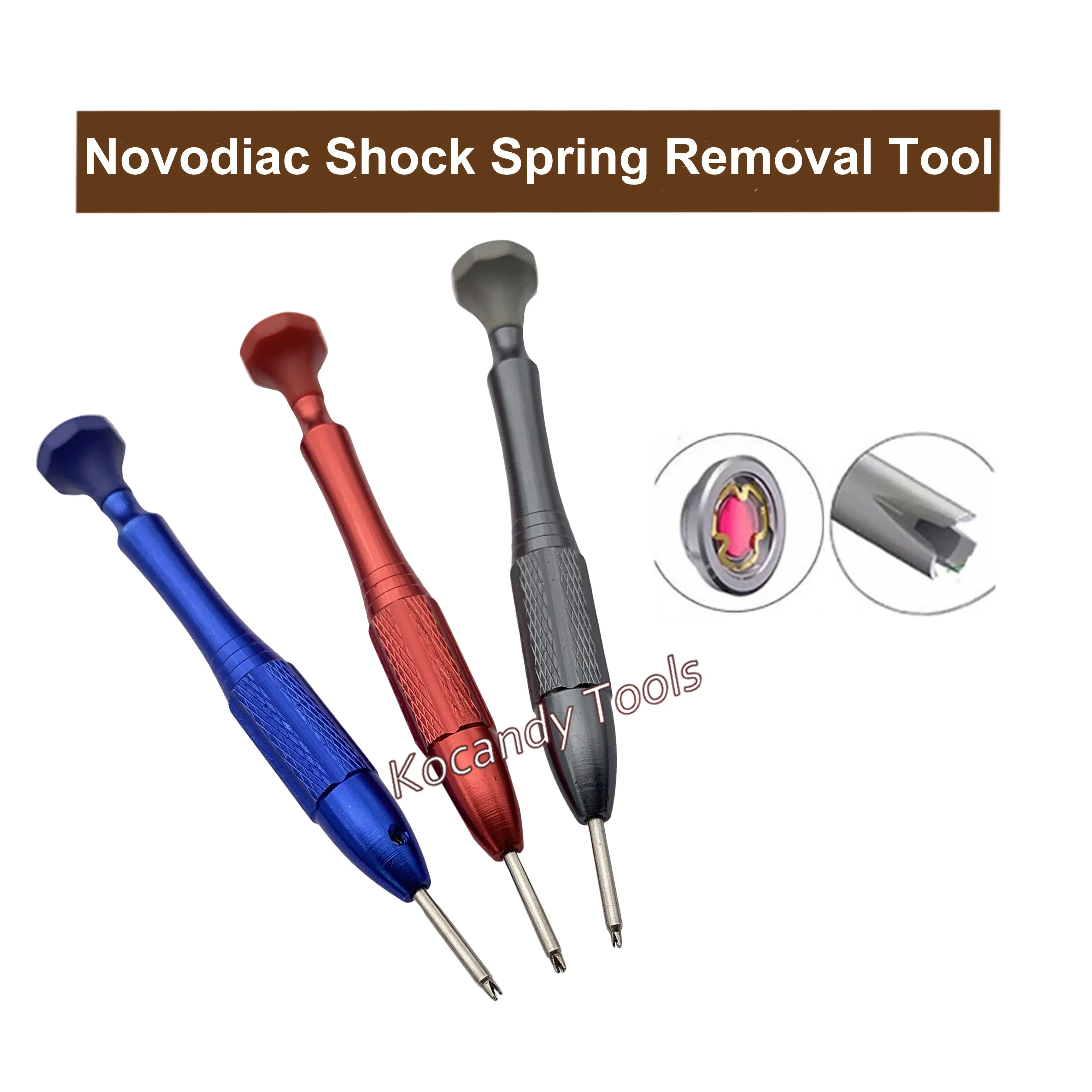
The practical Novodiac shock spring extractor set is engineered for shock struts and dampers on movements 2834, 2836, and 2671. Machined from stainless steel (130 g, approx. 10 cm / 3.94 in length), the set provides three stated tip sizes: 1.2 mm (0.047 in), 1.4 mm (0.055 in), and 1.6 mm (0.063 in). The package includes three color-coded tools and a storage bag.
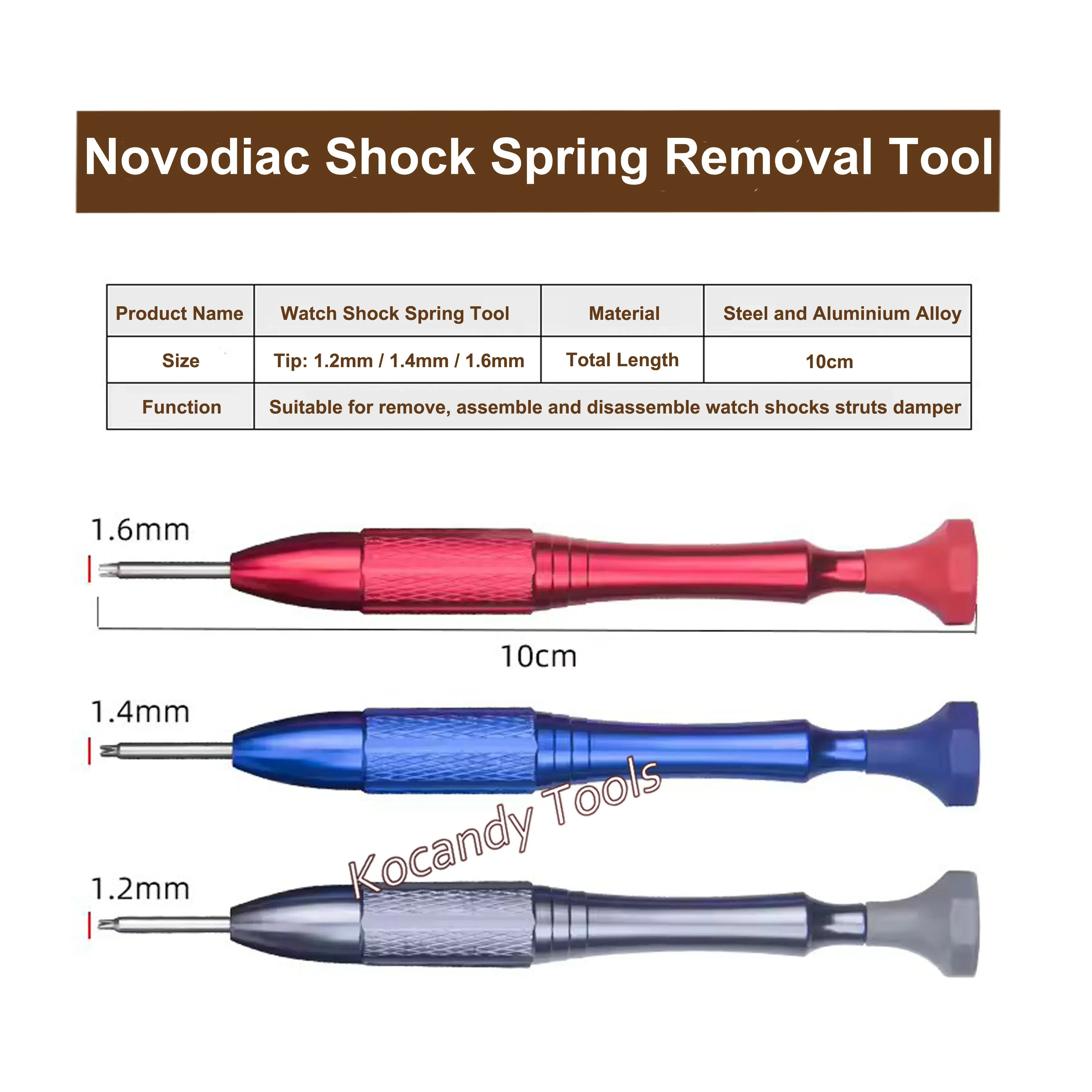
Novodiac shock spring removal tools in 1.2 mm, 1.4 mm, and 1.6 mm stated tip sizes.
Table B details stated parameters for the Novodiac extractor and precision balance remover.
Table B: Shock Spring & Balance Tool Reference
Product | Stated calibres | Stated sizes | Product link |
|---|---|---|---|
Novodiac shock spring extractor set | 2834, 2836, 2671 | Tips: 1.2 mm, 1.4 mm, 1.6 mm (overall length approx. 10 cm) | |
Precision balance wheel remover | ETA L888, ETA C07 | Length approx. 20 mm, width approx. 54 mm, height approx. 53–54 mm |
Precision Balance Wheel Removers with Caliber Positioning
Removing balance wheels from modern movements requires delicate handling. Free-sprung balances and laser-welded hairsprings are vulnerable to uneven leverage, where prying bridges with standard levers risks bending pivots or distorting hairspring collets.
The precision balance wheel remover is a dedicated disassembly fixture engineered for ETA L888 and C07 movements. Machined from stainless steel and aluminium alloy (200 g), it uses positioning guide pins and a brass screw to guide a controlled vertical lift without lateral tilt. The kit includes one remover for ETA L888, one remover for ETA C07 (C-07), and a plastic storage box. Stated dimensions are approx. 20 mm length, 54 mm width, and 53–54 mm height.
Balance Wheel Hairspring Stands for Inspection and Calibration
Once the balance assembly is detached, inspecting the hairspring requires an elevated stand supporting the balance cock while suspending the wheel freely to verify coil flatness, concentric expansion, and regulator spacing.
Our catalog provides two distinct hairspring calibration stands:
- Aluminum Alloy Balance Wheel Hairspring Stand: A compact support measuring approx. 6.0 cm x 3.3 cm (130 g) with a 38 mm upright needle. Balance spring base diameter is listed as approx. 10 mm in body text and approx. 7 mm in specifications.
- Brass Balance Wheel Hairspring Stand F31415: Machined from solid brass (160 g) with a 40 mm base diameter and 43 mm height. It includes two stands with accessories and features adjustable bracket hole spacing from 5 mm to 8.3 mm.
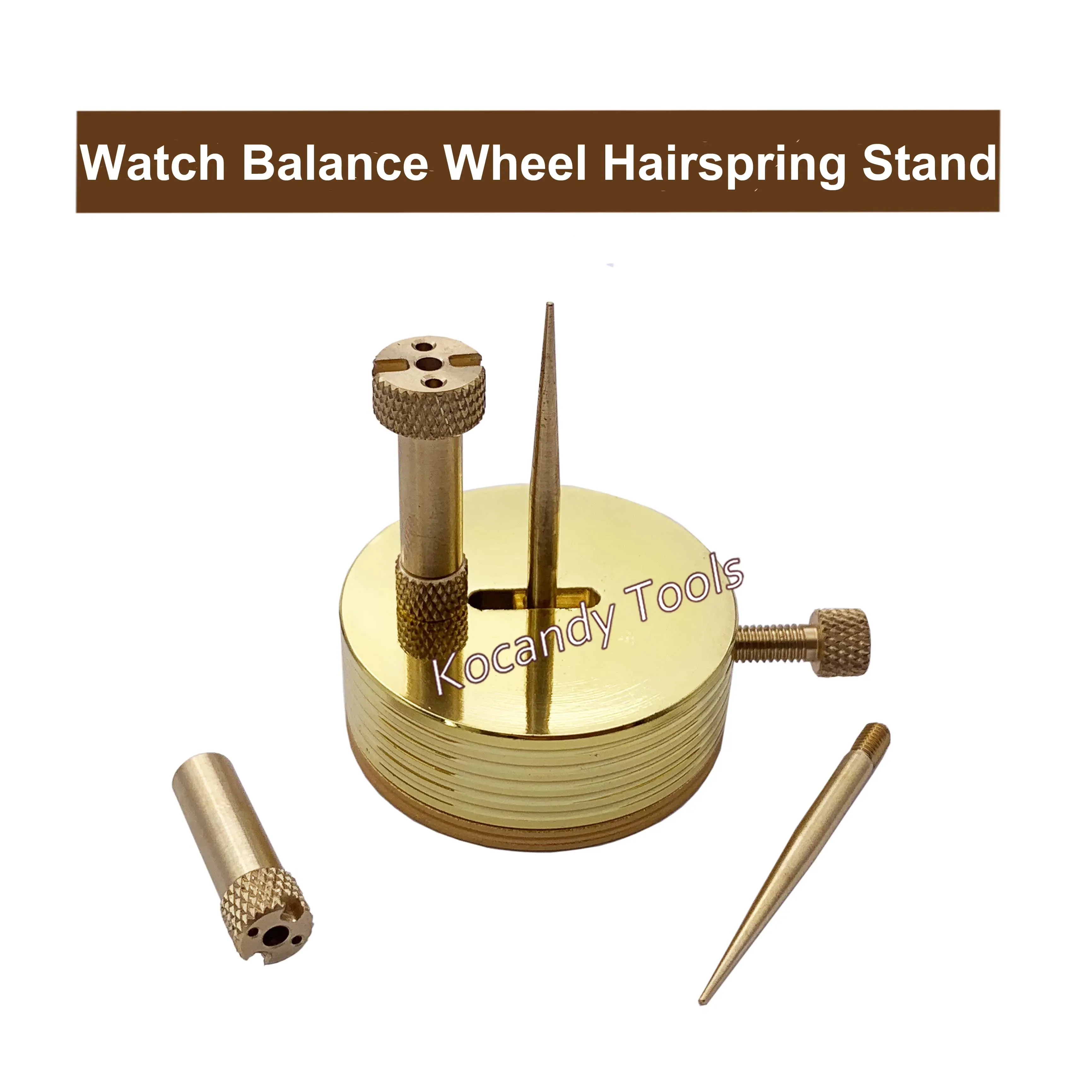
Model F31415 brass balance hairspring stand with 40 mm base and adjustable bracket spacing.
Chronograph Timing Module Mounting Plate for Caliber 2894-2
Modular chronographs carry their timing mechanism on an independent plate mounted to the dial side of the base movement. Caliber 2894-2 features delicate levers and springs requiring precise registration during service.
The watch movement repair set for 2894-2 is a dedicated timing module mounting plate engineered for the ETA 2894-2 chronograph module (catalog text notes Carlier ETA 2894-2). Machined from aluminium alloy (100 g), the fixture serves specifically for pre-tensioning the module start/stop spring during assembly and calibration. The package includes one mounting holder and a storage box. Visual records display factory locator markings including WMT and FAT504-2 for screw hole alignment.
Master Caliber to Tool Reference Matrix
To cross-reference your movement caliber against our catalog tools, locate your caliber in Table C. If your caliber is unlisted, measure your component dimensions against the stated sizes.
Table C: Full Caliber to Tool Matrix
Calibre (stated) | Tool type | Product link |
|---|---|---|
1570, 2135, 2235, 3035, 3135 (catalog also cites 2892, 7750, 2000) | Oscillating rotor weight axle punch | |
2834, 2836, 2671 | Novodiac shock spring extractor | |
ETA L888, ETA C07 | Precision balance wheel remover | |
2894-2 (chronograph module) | Chronograph module mounting plate | |
Unspecified calibres (60 x 33 mm base) | Balance hairspring calibration stand | |
Unspecified calibres (adjustable 5–8.3 mm) | Adjustable balance hairspring stand |
How to Read Movement Caliber Stamps and Verify Clearances
Never guess your movement caliber from case back engravings or brand logos; inspect the movement plates under a 10x bench loupe.
On European calibers, the caliber reference is stamped beneath the balance wheel rim alongside the maker hallmark, or engraved on bridges. If the caliber number is obscured or unengraved under the balance rim, consult our guide on how to identify an unmarked caliber before selecting a tool.
When extracting shock springs or staking rotor axles, never hold uncased movements by hand. Secure the caliber in a dedicated movement holder to prevent dial damage and pivot fractures, as outlined in our guide on holding the movement while you work. If your movement requires an unlisted punch, measure axle shoulder and chaton diameters with calipers before inquiring.
Compiling Your Tool Identifier and Catalog Inquiries
Before messaging Kocandy, compile your bench specifications into a single identifier string:
- Caliber Reference: Caliber number and execution stamp read from the movement plate (e.g., 2836-2, L888.2, 3135, or 2894-2).
- Service Task: Rotor axle staking, Novodiac spring extraction, balance wheel removal, or hairspring truing.
- Component Dimensions: Shock spring diameter (1.2, 1.4, or 1.6 mm), rotor axle diameter, or balance bridge screw spacing in millimeters.
- Target Catalog Item: Stated product name or model code from the tables above.
Kocandy is an independent supplier of watchmaker tools and parts. Kocandy is not affiliated with, authorised by, or an official dealer for Rolex, ETA, Cartier, Bergeon, Horotec, Seiko, Citizen, Breitling, Panerai, Hublot, or Vetus. All caliber numbers cited represent stated-for compatibility references only.
If your caliber stamp, axle dimension, or shock spring diameter is unlisted, send your measurements through our contact page. We check customer specifications against catalog stock and reply within one working day.