Oct 12, 2026Reference & Sizing
Watch Case Opener Die Reference Guide: Sizing, Geometry, and Catalog Codes
Dedicated case-back dies are chosen by geometry, not brand guesswork. BRL and PAN codes with stated dimensions, grooved-rim sets, and the caliper readings to send us for a match.
A dedicated watch case opener die is chosen by physical geometry, not by brand guesswork. Many screw-down watch backs feature proprietary perimeter milling, polygonal facets, or pin arrangements designed to resist universal openers. When high factory torque or aged gaskets lock a case back, adjustable wrench pins can slip and gouge the finish. Dedicated socket dies engage the full circumference simultaneously, distributing torque evenly across all contact points. Matching a back to the catalog die requires reading the steel profile and taking caliper measurements. For generic backs, choosing between Jaxa, friction ball and knife tools suffices; proprietary backs require a dedicated die.
Watch Case Opener Dies: Identifying Your Case-Back Geometry First
Before ordering a die or quoting a catalog number, inspect the case back under a 10x bench loupe. Engagement interfaces fall into three structural categories across our catalog:
- Faceted Polygonal Backs: A raised perimeter ring with flat outer facets (twelve or fifteen flats). The die cup must match both the facet count and internal diameter.
- Fine-Grooved Serrated Rims: A circular perimeter milled with continuous vertical splines. The matching die is an internally toothed metal ring seating with zero lateral play.
- Multi-Pin Perimeter Sockets: Circular holes drilled symmetrically around the periphery, engaging hardened steel pins arranged in five-pin or six-pin circular arrays.
Never assume a die code from dial text alone. Tooling changes across production runs; physical geometry determines the die.
Measuring Case Backs: Dimensions That Narrow Down the Die Choice
Digital calipers are required to identify die size. Never measure the bezel; measure the case-back ring directly.
For polygonal backs, measure two dimensions: flat-to-flat diameter (between opposing parallel flats) and point-to-point diameter (between opposing outer vertices). Because corner vertices extend further outward, point-to-point spans are always larger than flat-to-flat spans. Quoting only one dimension risks ordering a die that binds across flats or slips over vertices. For grooved rims, measure outside crest diameter across teeth. For pin backs, count the holes and measure center-to-center span.
What you measure | How | What it narrows |
|---|---|---|
Profile geometry & edge pattern | Inspect perimeter under a 10x bench loupe | Determines whether you require faceted polygonal (BRL/PAN), perimeter-grooved (5537/5539), or multi-pin (Seamaster/5700) dies |
Polygon facet count | Count consecutive flats around the entire perimeter | Distinguishes 12-flat patterns (BRL34, PAN series) from 15-flat patterns (BRL35, BRL36, BRL38) |
Flat-to-flat diameter | Measure distance between parallel opposing flats with caliper jaws | Directly matches catalog flat-to-flat specifications on polygonal BRL and PAN dies |
Point-to-point diameter | Measure distance between opposite outermost apex points | Confirms apex clearance and seats the die fully over corner vertices |
Grooved rim outer diameter | Measure outside crest diameter of the fine-toothed ring | Matches stepped sizes in No. 5537 (18.5–29.5 mm) or No. 5539 (30.5–36.5 mm) sets |
Pin circle count and span | Count perimeter holes (5 vs 6) and measure center-to-center span | Matches 5-pin or 6-pin dies in the 9-piece Seamaster kit across 20 mm, 30 mm, 33 mm, or 43 mm spans |
Faceted Polygonal Dies: The BRL34, BRL35, BRL36, and BRL38 Series
The BRL series comprises dedicated metal alloy and aluminium alloy dies listed for Breitling-style polygonal case backs. The catalog divides this series into two distinct polygon geometries.
The BRL34 die features 12 flat sides round the hex, with stated catalog dimensions of flat to flat 34.80 mm and point to point 35.86 mm.
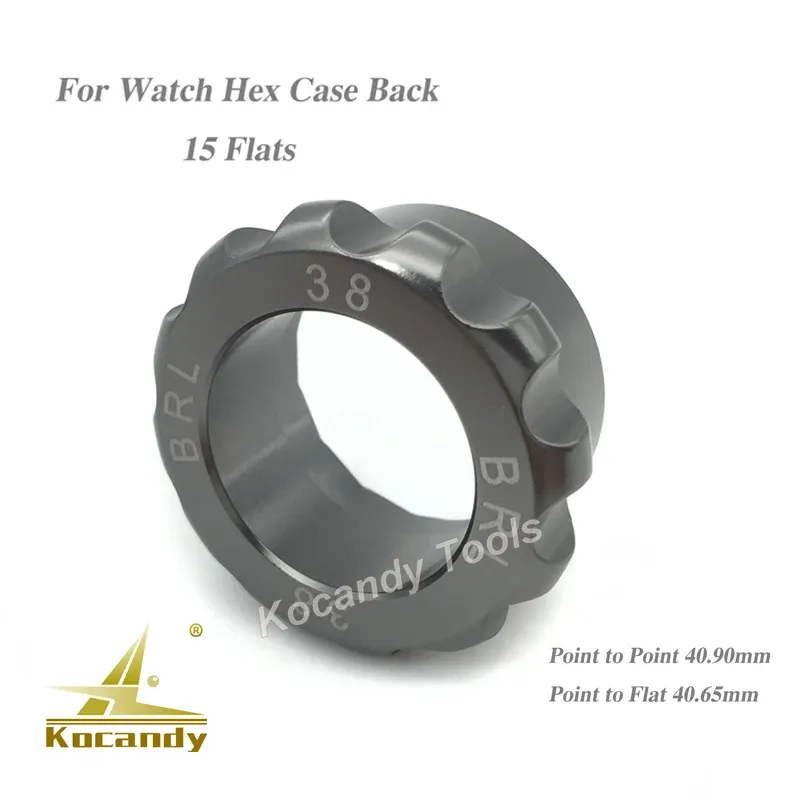
In contrast, the BRL35, BRL36, and BRL38 dies feature 15 flat sides round the hex. Stated catalog dimensions are: BRL35 at point to flat 35.30 mm and point to point 35.68 mm; BRL36 at point to flat 38.11 mm and point to point 38.34 mm; and BRL38 at point to flat 40.65 mm and point to point 40.90 mm.
Always count facets under magnification before selecting a code. Fitting a 15-flat die onto a 12-flat back concentrates torque onto isolated corners and strips metal edges.
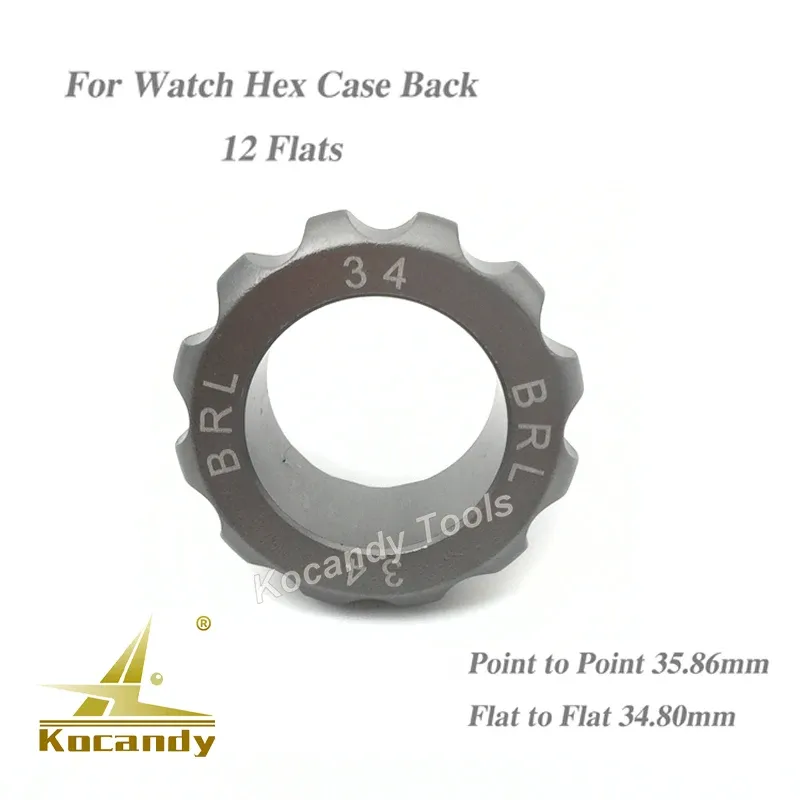
BRL34 die profile with twelve flats and 35.86 mm point-to-point dimension.
Fluted Polygonal Dies: PAN40, PAN44, 45 mm, and PAN47 Profiles
The PAN series comprises large polygonal socket dies machined from high grade aluminium alloy, listed for Panerai-style case backs. All four profiles in this family share a uniform geometry: 12 flat sides round the hex.
Designations reflect nominal watch sizing, but bench selection requires checking measured caliper readings against catalog dimensions:
- PAN40: stated for 40 mm case backs; flat to flat 35.72 mm, point to point 37.22 mm.
- PAN44: stated for 44 mm case backs; flat to flat 39.40 mm, point to point 41.10 mm.
- 45 mm Die: stated for 45 mm case backs; flat to flat 41.73 mm, point to point 43.44 mm.
- PAN47: stated for 47 mm case backs; flat to flat 43.60 mm, point to point 45.45 mm.
Compare your measured flat-to-flat span against these catalog dimensions rather than relying solely on nominal case width.
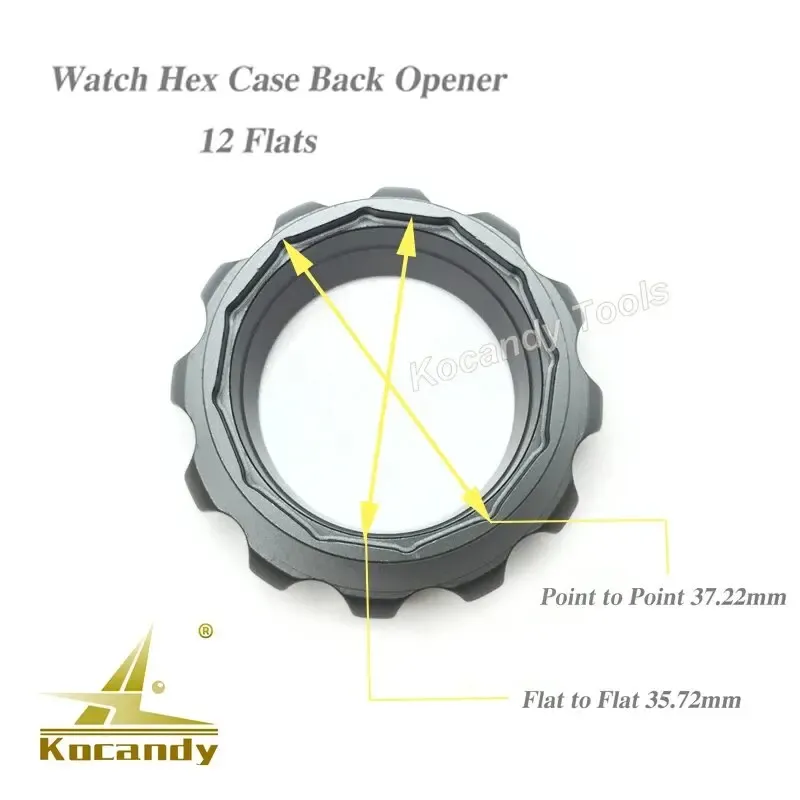
PAN40 die profile with twelve flats and 35.72 mm flat-to-flat dimension.
Grooved Rim Opener Sets: No. 5537 and No. 5539 Reference Ranges
Finely serrated case backs require full-circumference grooved check rings. The Kocandy catalog provides two complementary boxed sets supplied with dedicated manual wrench handles.
The No. 5537 set (catalog model SP000059, steel and aluminium) is listed for grooved case backs from 18.5 mm to 29.5 mm, typical of midsize and vintage cases. The kit includes a storage box, one manual wrench handle, and six grooved die rings: NO.0 (18.5 mm), NO.1 (20.2 mm), NO.2 (22.5 mm), NO.3 (26.5 mm), NO.4 (28.3 mm), and NO.5 (29.5 mm).
The No. 5539 set (catalog model RLBK-SP-S-5539, #316 stainless steel) is listed for modern sports cases. Although titled as a six-die opener, the kit contains seven grooved check rings: NO.0 (30.5 mm), NO.1 (31.5 mm), NO.2 (32.5 mm), NO.3 (33.5 mm), NO.4 (34.5 mm), NO.5 (35.5 mm), and NO.6 (36.5 mm).
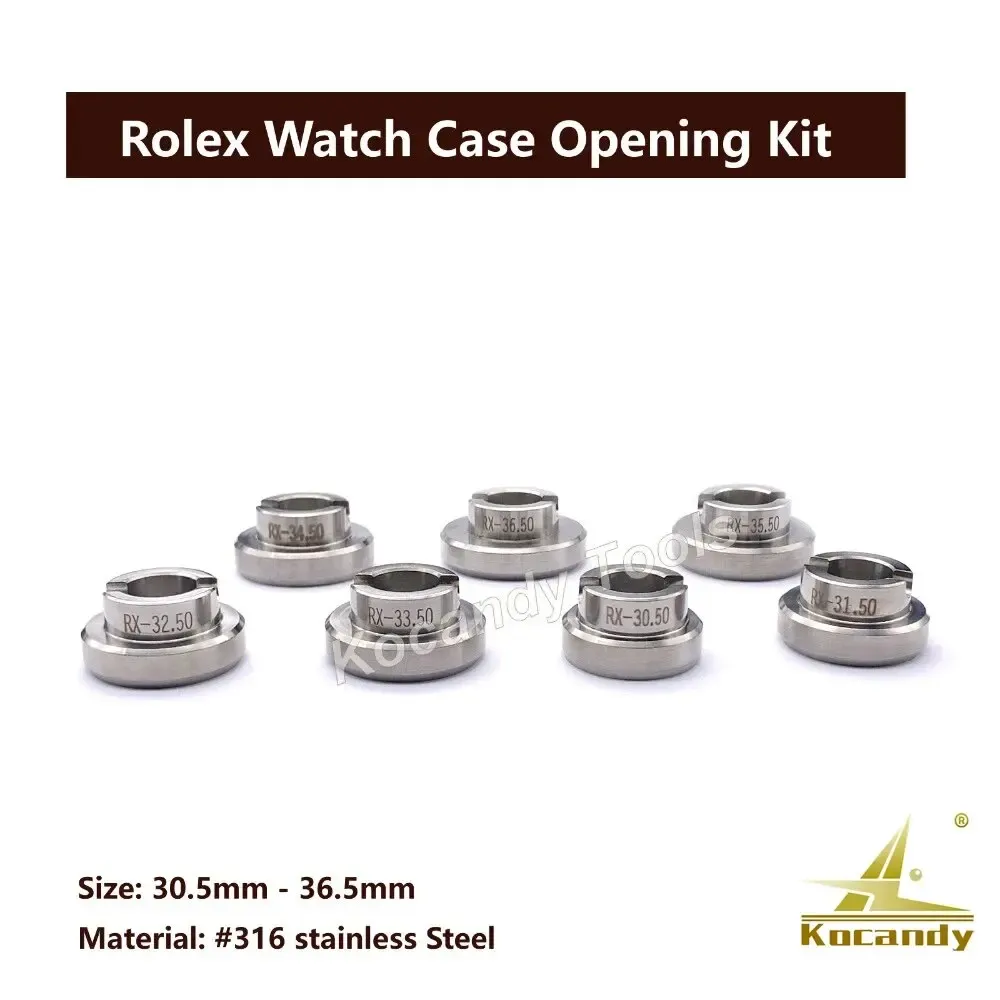
No. 5539 grooved die series covering 30.5 mm through 36.5 mm diameters.
Multi-Pin and Bench Machine Sets: Omega Seamaster and 5700 Dies
Case backs featuring circular holes require dedicated pin dies that seat into sockets without lateral play.
The 9-piece Seamaster wrench dies kit (aircraft grade aluminum alloy) is listed for Omega Seamaster case backs. The kit provides one manual wrench handle and eight grooved pin dies: four dies with five pins and four dies with six pins, covering case diameters of 20 mm, 30 mm, 33 mm, and 43 mm. Count the case pin holes before selecting a five-pin or six-pin die.
For bench machine setups, the professional 5700 series dies and hand tools set operates with 5700 bench machines and manual wrenches. It is listed for screw cases on Omega 508, 510, and Cal. 8800 watches. Individual millimeter die diameters are unlisted in catalog records; confirm by message.
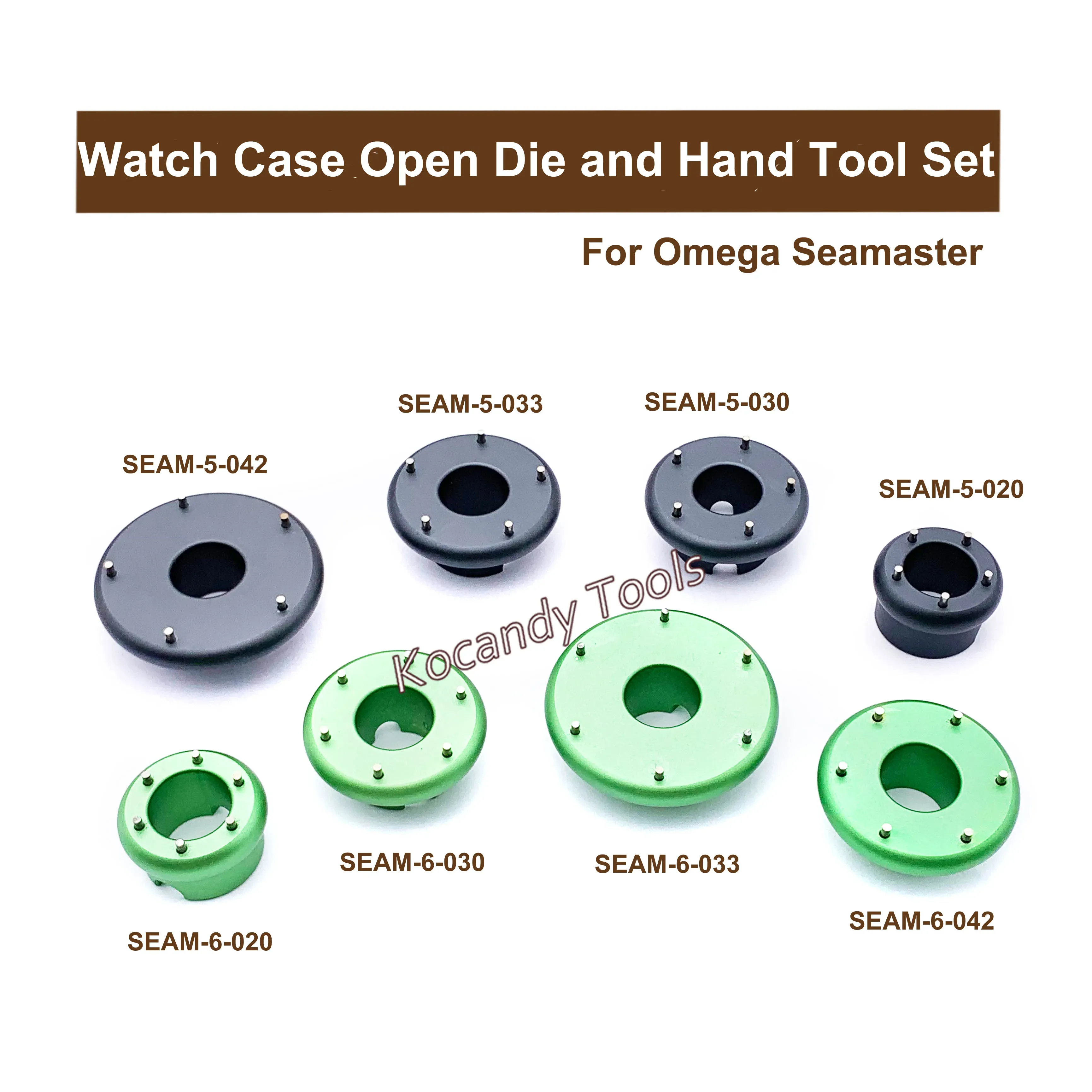
Seamaster wrench dies arranged by pin count across stated case diameters.
Master Reference: Stated Die Codes, Dimensions, and Product Numbers
Cross-reference your measured case dimensions against catalog die codes, stated model designations, and complete opener kits below. Table A details individual polygonal socket dies; Table C details multi-die boxed sets and bench systems.
Table A: Single-Die Polygonal Reference (BRL and PAN Series)
Die / set | Stated designation | Stated size detail | Product link |
|---|---|---|---|
BRL34 | Stated for Breitling hex case backs | Flat to flat 34.80 mm, point to point 35.86 mm (12 flats) | |
BRL35 | Stated for Breitling hex case backs | Point to flat 35.30 mm, point to point 35.68 mm (15 flats) | |
BRL36 | Stated for Breitling hex case backs | Point to flat 38.11 mm, point to point 38.34 mm (15 flats) | |
BRL38 | Stated for Breitling hex case backs | Point to flat 40.65 mm, point to point 40.90 mm (15 flats) | |
PAN40 | Stated for Panerai hex case backs | Flat to flat 35.72 mm, point to point 37.22 mm (12 flats) | |
PAN44 | Stated for Panerai hex case backs | Flat to flat 39.40 mm, point to point 41.10 mm (12 flats) | |
45 mm PAN | Stated for Panerai hex case backs | Flat to flat 41.73 mm, point to point 43.44 mm (12 flats) | |
PAN47 | Stated for Panerai hex case backs | Flat to flat 43.60 mm, point to point 45.45 mm (12 flats) |
Table C: Multi-Die Sets and Bench Systems Reference
Product | Stated for | Size / span | Contents | Product link |
|---|---|---|---|---|
No. 5537 Opener Set | Stated for Rolex, Tudor, and other grooved case backs | 18.5 mm, 20.2 mm, 22.5 mm, 26.5 mm, 28.3 mm, 29.5 mm | Storage box, wrench handle, 6 grooved die rings | |
No. 5539 Opener Set | Stated for Rolex, Tudor, and other grooved case backs | 30.5 mm, 31.5 mm, 32.5 mm, 33.5 mm, 34.5 mm, 35.5 mm, 36.5 mm | Storage box, wrench handle, 7 grooved check rings | |
9pcs Seamaster Kit | Stated for Omega Seamaster case backs | 20 mm, 30 mm, 33 mm, 43 mm | Wrench handle, 4 five-pin dies, 4 six-pin dies (9 pieces total) | |
Omega 5700 Dies Set | Stated for Omega 508, 510, Cal. 8800 and 5700 machine | Confirm by message | Wrench handle, set of screw-case dies |
Bench Practice: Seating Dedicated Dies Without Slipping or Scoring
Precise die engagement requires bench preparation. An exact die slips if debris prevents complete seating.
First, clean the perimeter with pegwood and a brush. Dried grime in corners or teeth prevents dies from bottoming out, pushing torque onto upper edges and scoring metal.
Second, always secure the watch in a case holder with nylon pins. Never hold a case by hand under factory torque; tilting concentrates force onto a single facet and shears it.
Third, apply firm axial downward pressure before turning the wrench. If the back resists normal torque, stop immediately. Consult bench methods for when the back still will not move rather than forcing the die.
Assembling Your Die Identifier Before Requesting a Match
To verify catalog compatibility or request an unlisted die code, compile your case measurements into a standard bench identifier string:
- Pattern Type: Faceted polygon, grooved rim, or multi-pin socket.
- Element Count: Number of flats (12 vs 15) or pin holes (5 vs 6).
- Caliper Readings: Flat-to-flat and point-to-point spans in millimeters to two decimal places (e.g., Flat 39.40 mm, Point 41.10 mm), or grooved rim crest diameter.
- Target Catalog Code: Nearest reference code (such as BRL36, PAN44, No. 5537 NO.3, or 9pcs Seamaster 33mm).
Providing both flat-to-flat and point-to-point readings enables our workshop to test stock dies directly against your measurements.
Catalog Inquiries and Brand Disclaimer
Kocandy is an independent supplier of watchmaker tools and parts. Kocandy is not affiliated with, authorised by, or a licensed dealer for Breitling, Panerai, Rolex, Tudor, Omega, Bergeon, Horotec, or any other trademarked watch brand. All brand and die codes cited describe physical case-back geometry and catalog stated-for specifications.
If your case size or caliper reading is unlisted, send your measurements through our contact page. Provide your measured dimensions and a case-back photo. We check customer readings directly against catalog inventory and reply within one working day.